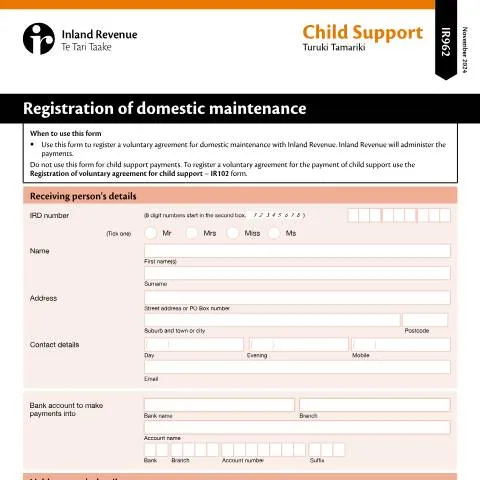
Navigating the IR962: Your Guide to Domestic Maintenance Registration
The IR962 form, officially known as the Registration of Domestic Maintenance, serves as a crucial tool for individuals seeking to formalize agreements regarding domestic maintenance in New Zealand. Understanding the implications and processes surrounding this document can significantly impact the financial welfare of involved parties, particularly in terms of child support and maintenance obligations.
Understanding the Context: Why Register Domestic Maintenance?
In situations where individuals are caring for children, ensuring financial support from another party is essential. By registering a voluntary agreement through the IR962 form, the receiving person can establish a clear and enforceable method for receiving domestic maintenance payments. This agreement is particularly beneficial for parents who may not have formal child support arrangements in place.
The form facilitates the management of these payments through the Inland Revenue Department (IRD), which provides a structured approach to ensure that obligations are met. Importantly, this form is not intended for child support payments but is specifically designed to address domestic maintenance.
How to Approach Completing the IR962
Filling out the IR962 form requires careful attention to detail. Both parties involved—the receiving person and the liable person—must provide accurate information to avoid delays and complications.
Step-by-Step Breakdown of the Form:
- Receiving Person’s Details:
- Provide your IRD number, ensuring it is the correct 8-digit format.
- Indicate your preferred title (Mr, Mrs, Miss, Ms) and provide your full name.
- Fill in your address, including street number, suburb, and postcode.
- Provide contact details including daytime and evening phone numbers, mobile, and email address.
- Specify the bank details for payments, including bank name, branch, account name, account number, and suffix.
- Liable Person’s Details:
- Similar to the receiving person, the liable person must complete their IRD number, title, name, address, and contact information.
- Domestic Maintenance Details:
- Clearly state the amount to be paid weekly, monthly, or yearly, ensuring the minimum is $10 per week.
- Indicate the start date for payments, which cannot be a date in the past.
- If there is a lump sum payment, specify the amount.
- Declaration:
- Both parties must sign the form, confirming that the information provided is accurate.
Key Timelines: When to Submit the IR962
Understanding the timeline associated with the IR962 is vital:
- The form should be submitted as soon as a voluntary agreement is reached between the receiving person and the liable person.
- Payments commence on the specified start date; however, if this date is in the past, payments will begin from the date the form is received by IRD.
- It is critical to allow sufficient processing time, especially if payments are required urgently.
Once submitted, the IRD will assess the information and set up the payment structure accordingly.
Consequences of Non-Compliance: What Happens If You Forget?
Failing to submit the IR962 can have significant repercussions. Without this registration, maintenance payments may not be enforced, leaving the receiving person vulnerable to non-payment. Additionally, it could complicate any future legal proceedings regarding child support or maintenance agreements. Therefore, ensuring timely submission of the form is crucial to safeguard rights and entitlements.
Distinct Differences: IR962 vs. Other Forms
While navigating administrative processes, it’s essential to distinguish the IR962 from other similar forms. The primary distinction lies in its specific focus on voluntary domestic maintenance agreements rather than child support:
| Form Code | Title | Purpose |
|---|---|---|
| IR962 | Registration of Domestic Maintenance | To register voluntary agreements for domestic maintenance |
| IR102 | Registration of Voluntary Agreement for Child Support | To register agreements specifically for child support payments |
Handling Unique Circumstances: Addressing Complex Cases
Not every situation is straightforward when it comes to domestic maintenance. Several unique circumstances may necessitate special consideration:
- International Situations: If the liable person resides outside New Zealand, additional complexities may arise, including the enforcement of payments across borders.
- Involvement of Minors: If a child is a minor, it is crucial that both parents understand their rights and obligations under New Zealand law.
- Urgent Needs: In cases of immediate financial need, prompt submission of the IR962 and clear communication with IRD can help expedite arrangements.
Preparatory Steps: Gathering Necessary Documentation
Before submitting the IR962, it is advisable to prepare relevant documentation to ensure a smooth process. Consider gathering:
- Proof of identity for both parties, which may include birth certificates or passports.
- Any previous agreements related to maintenance or child support that may influence the current arrangement.
- Bank statements or letters from financial institutions to validate the bank details provided.
The Regulatory Framework: Understanding the Legislation
The IR962 operates under the auspices of the Child Support Act 1991, which lays the foundation for maintenance and support obligations in New Zealand. This legislation ensures that children’s financial needs are prioritized in domestic arrangements. Adhering to these legal frameworks not only protects the involved parties but also reinforces the broader commitment to child welfare in New Zealand.
Maximizing Your Experience: Practical Tips for Using the IR962
To ensure a successful registration process with the IR962, consider the following practical tips:
- Double-check all information for accuracy before submission to avoid delays.
- Keep copies of all submitted documents for your records.
- Communicate openly with the other party to confirm all details and ensure mutual understanding.
Submitting the IR962 can be a significant step towards establishing a clear and enforceable domestic maintenance agreement. By being informed and prepared, you can navigate this process with greater confidence.
Understanding the Domestic Maintenance Registration Process
When dealing with domestic maintenance in New Zealand, understanding the registration process is crucial. The process begins with filing a claim for domestic maintenance through the Ministry of Social Development (MSD). If you’re a parent seeking child support or maintenance, you will need to provide detailed information about your financial situation and the needs of your child. This documentation is essential for determining the amount of maintenance that can be awarded.
The application form, known as the MSD Child Support Application Form, requires you to specify income details, living arrangements, and any other relevant financial disclosures. Be prepared to provide evidence such as payslips, bank statements, or tax returns. Once your application is submitted, the MSD will assess it and usually conclude within six weeks. However, timelines may vary, and you should stay in touch with the agency to receive updates on your application status.
Post-application, if you are approved for domestic maintenance, your case will be managed through a dedicated case officer at MSD. This officer will help guide you through ongoing responsibilities, including adjustments for changes in living circumstances, income fluctuations, or other life changes that might affect maintenance payments. It’s essential to maintain open communication with your case officer and report any changes promptly, as this can impact the amount of support you receive.
Impact of Domestic Maintenance on Tax Obligations
A critical aspect that often gets overlooked in the domestic maintenance process is its implications on your tax obligations. In New Zealand, child support payments are not considered taxable income for the recipient or a deductible expense for the payer. This distinction is vital for both parties involved, as it can influence overall financial planning.
For example, if you are receiving maintenance, you might want to factor this into your budgeting, knowing that it does not affect your tax bracket. However, if you are the one providing maintenance, understanding that these payments won't provide you with any tax relief is equally important. It’s advisable to consult with a tax professional to determine how your maintenance obligations interact with your overall tax situation, especially if you have other income sources or deductions.
In addition to the implications on direct income taxes, it's also worth considering how domestic maintenance might affect any government support you receive. Should your income level fluctuate due to changes in maintenance payments, it may influence your eligibility for certain benefits. Therefore, keeping detailed records of any maintenance payments made or received is beneficial, as this documentation can be useful if you need to discuss adjustments with the Inland Revenue Department (IRD) or MSD.
Dispute Resolution in Domestic Maintenance Cases
In New Zealand, disputes concerning domestic maintenance can arise for various reasons, such as disagreements on the amount, frequency of payments, or changes in circumstances affecting either party. Understanding the mechanisms available for resolving these disputes is essential for maintaining a constructive relationship between the parties involved.
Initially, it’s advisable to attempt direct communication with the other party to resolve the issue amicably. Clear communication can often clarify misunderstandings or miscalculations regarding payments. However, if direct negotiation fails, you can escalate the matter to the Family Court or the Family Dispute Resolution (FDR) service.
The FDR service offers a mediation process that helps both parties reach a mutually acceptable agreement without the need for a formal court hearing. This approach can save time, reduce stress, and lead to more amicable outcomes. Mediation is typically a more cost-effective method compared to court proceedings and allows for greater control over the final agreement.
If mediation does not yield satisfactory results, you may proceed to file an application with the Family Court. Here, a judge will review the case details and make a ruling, which may include adjustments to the maintenance amounts, which could be in favour of either party based on the evidence presented. It’s crucial to be prepared with all relevant documentation and to clearly articulate your position regarding the dispute. Keeping thorough records of all communications and payments will facilitate your case in court.