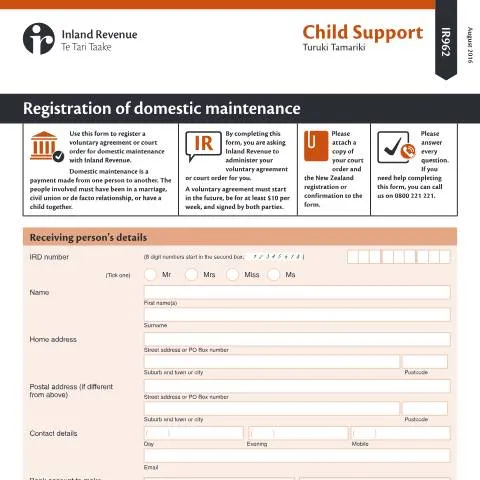
Understanding the Importance of IR962: A Practical Guide for Families
When it comes to ensuring that children receive the necessary financial support after a relationship has ended, the Registration of Domestic Maintenance (IR962) form plays a vital role. This official document from the Inland Revenue Department (IRD) is essential for registering voluntary agreements or court orders for child support. It serves not merely as a bureaucratic formality; it is a lifeline that safeguards the well-being of children in New Zealand.
Who Should File the IR962 Form?
The IR962 form must be filled out by individuals who have a financial obligation towards a child, typically arising from a previous marriage, civil union, or de facto relationship. The parties involved are usually categorized into two groups:
- Receiving Party: This is the individual who will receive the child support payments.
- Liable Party: This is the individual who is obligated to make the child support payments.
It’s important to note that both parties can also agree to a voluntary maintenance arrangement, which must meet specific criteria such as being for a minimum of $10 per week. This adds flexibility for families seeking to manage their child support arrangements amicably.
Step-by-Step: Completing the IR962 Form
Completing the IR962 involves several key steps that can lead to a smoother registration process. Below, we outline how to fill out the form properly.
Gathering Necessary Information
Before you start filling out the form, it's essential to have the following details ready:
- IRD Numbers: Both the receiving and liable parties need their 8-digit IRD numbers.
- Personal Details: Names, addresses, and contact information of both parties.
- Bank Account Information: The receiving party must provide their bank details for payments.
- Details of the Maintenance Agreement: The amount and frequency of payments, as well as the effective date.
Filling Out the Form
Ensure every field is completed accurately. Incomplete forms can lead to delays or even rejection of the application. Here’s a breakdown of important sections:
- Receiving Person's Details: Include full names, addresses, contact numbers, and email addresses. Ensure your bank information is accurate for receiving payments.
- Liable Person's Details: Similar to the receiving party's section, provide all necessary information about the liable party.
- Domestic Maintenance Details: Specify the payment amount, frequency (weekly, monthly, or annually), and start date.
Declaration and Signature
Both parties must sign the form if it is a voluntary agreement. If you are registering a court order, only the initiating party needs to sign. Ensure that all information is true and accurate to the best of your knowledge, as providing false information can have serious consequences.
Submitting the IR962 Form: Your Next Steps
Once the IR962 form is completed, the next step is to submit it to the IRD. Here is how to do it:
- Mailing Address: Send the completed form to the IRD at PO Box 39010, Wellington Mail Centre, Lower Hutt 5045.
- Processing Time: While specific timelines can vary, expect a processing time of several weeks, so submit the form promptly to avoid delays in payments.
What Happens After Submission?
Upon submission, the IRD will process your application. During this phase, it's crucial to understand how to follow up:
Tracking Your Application
You can track the status of your application by:
- Contacting the IRD: Call them at 0800 221 221 for inquiries regarding your application status.
- RealMe Account: If you have a RealMe digital ID, you can log in to check your details and any updates related to your child support application.
Possible Outcomes
Once processed, you will receive a letter from the IRD confirming either the registration of the voluntary agreement or court order. It's essential to keep this documentation for your records, as it may be required for future reference or modifications to the arrangement.
Handling Issues: What If There Are Problems?
Sometimes, issues may arise during the process. Here’s how to handle them effectively:
In Case of Rejection
If your application is rejected, review the letter from the IRD carefully. Common reasons for rejection can include:
- Incomplete information or missing signatures.
- Failure to provide necessary documentation, such as a court order.
- Payments not meeting minimum requirements.
If rejected, you can reapply after rectifying the issues. Contact the IRD for specific guidance on what corrections are necessary.
Addressing Errors or Missing Information
If you realize there's an error after submission or if you forgot to include documentation, promptly contact the IRD. They may allow you to submit the missing information by phone or through their online portal.
Special Cases: Unique Situations That May Arise
Every family situation is different, and sometimes unique circumstances can complicate the registration process. Here are some specific scenarios:
International Situations
If the liable party is living overseas or if the receiving party resides in a different country, specific regulations may apply. The IRD can provide guidance on how international agreements may affect child support obligations, especially if you are dealing with complexities regarding jurisdiction.
Children with Special Needs
For children requiring additional care or support due to disabilities, financial obligations might be adjusted. It's critical to communicate any special needs clearly in your application, and you may need to provide additional documentation to substantiate these claims.
In Cases of Domestic Violence
If domestic violence has affected the relationship, unique protections may apply. Make sure to discuss your situation with the IRD and explore the possibility of obtaining a court order that protects your safety while ensuring child support obligations are met.
Consequences of Non-Compliance: Understanding Your Obligations
Fulfilling child support obligations is not just a legal requirement; it's a moral responsibility to ensure the welfare of children involved. Failure to adhere to the registered agreement can lead to serious ramifications:
- Legal Consequences: Non-compliance can result in court actions to enforce payment, including wage garnishment.
- Impact on Credit Rating: Child support arrears can affect your credit history, influencing future financial opportunities.
- Potential Criminal Charges: In severe cases, repeated failure to pay child support can result in criminal charges.
It’s crucial to stay proactive and discuss any difficulties you encounter in making payments with the IRD before they escalate into bigger problems.
The Legal Framework Surrounding Child Support in New Zealand
The necessity for the IR962 form and the wider child support system is grounded in the Child Support Act 1991. This legislation aims to ensure that children receive financial support from both parents, regardless of the parental relationship. Understanding the historical context can help clarify why the regulations are structured as they are.
Key Features of the Child Support Act
| Features | Description |
|---|---|
| Maintenance Payments | Obligations defined based on the income of the liable person, ensuring fair contributions. |
| Voluntary Agreements | Allows parents to mutually agree on maintenance terms outside of court, which can be less intimidating and more collaborative. |
| Enforcement Measures | Outlines legal actions that can be taken against individuals who fail to meet their obligations. |
Moving Forward: What Lies Ahead for Your Child Support Journey
Engaging with the child support system can feel overwhelming, but it’s a crucial step in ensuring that children receive the support they need. By understanding the nuances of the IR962 form and the processes surrounding it, you can navigate this landscape with greater confidence.
For those who may face challenges or uncertainties, reaching out to the IRD or qualified professionals can be invaluable. Keeping open lines of communication with the other party involved and maintaining transparency can also aid in creating a sustainable child support agreement.
Understanding Domestic Maintenance Registration Process
Registering for domestic maintenance in New Zealand is essential for individuals needing to establish legal financial support arrangements. The process largely revolves around the Child Support scheme, administered by the Inland Revenue Department (IRD). When you initiate your application, it's important to gather relevant documentation to streamline your registration experience. You’ll need to provide evidence of your relationship with the child, details of your financial situation, and any existing agreements regarding child support. If you are the receiving parent, you can apply for registration through the IRD's website, which is highly recommended for its user-friendly interface and comprehensive guidance.
As part of your registration, the IRD will assess your income, allowing them to calculate the amount of child support you are eligible to receive. It’s crucial to note that New Zealand operates on a fiscal year running from 1 July to 30 June, meaning your financial details must reflect earnings within this timeframe for accurate calculations. If your financial situation changes, such as a job change or relocation, promptly notify the IRD to ensure that your child support arrangement is recalibrated accordingly.
Eligibility Criteria and Exceptions in the Child Support Scheme
Determining eligibility for domestic maintenance involves various factors that can impact your application. Generally, parents or guardians must be responsible for the day-to-day care of the child. Eligible children usually include those under the age of 18, or those who are financially dependent due to disability. However, some nuances may affect your eligibility. For example, if a child is residing overseas and living with a different guardian, eligibility for child support can become complex. In such cases, establishing the child's residence and dependency status is critical.
Moreover, there are exceptions based on shared care arrangements. If both parents share equal care responsibilities, the amount of support required may be adjusted. The IRD has specific criteria for what constitutes shared care, typically involving at least 28% of the care being provided by both parents. Understanding these exceptions and clearly documenting your situation can significantly influence the determination of your domestic maintenance obligations.
Impact of Changes in Circumstances on Maintenance Payments
Changes in personal circumstances can have a substantial effect on domestic maintenance obligations. If you experience a significant life event such as a change in employment status, marital status, or relocation, it’s essential to communicate these changes to the IRD promptly. This is crucial because child support payments are calculated based on your current financial situation. Failure to report changes can result in overpayments or underpayments, which may lead to complications down the line.
Furthermore, if you anticipate a temporary decline in income due to health issues or other personal matters, the IRD provides mechanisms to apply for temporary adjustments to your child support payments. Familiarizing yourself with these options can help you manage your financial obligations during challenging times. Documentation such as medical certificates or termination letters from an employer will typically be required to support your application for temporary modifications.
Lastly, understanding the implications of non-compliance with child support payments is vital. Should payments not be made, the IRD has the authority to take enforcement actions, which can include garnishing wages or freezing bank accounts. Staying proactive in communicating with the IRD and managing your financial commitments will help maintain a positive relationship with the agency and ensure the well-being of the child.