Understanding the Social Contribution Return & Annual Income Tax Return
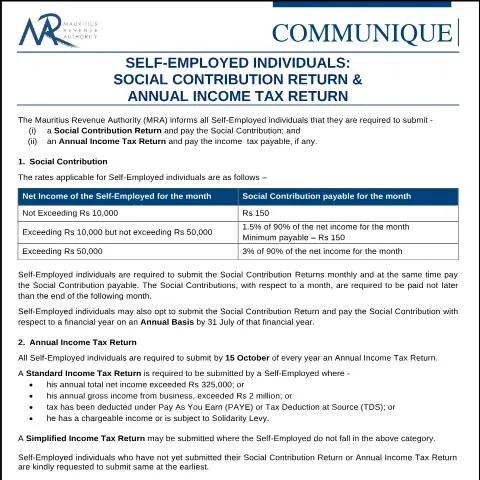
The Social Contribution Return & Annual Income Tax Return, as stipulated in the CommuniqueCSG250222, holds significant importance for self-employed individuals in Mauritius. This document serves dual purposes: it facilitates the declaration of both social contributions and annual income tax. By comprehending the nuances of this form, individuals can ensure compliance with local regulations and avoid penalties.
Distinctive Features of the Social Contribution Return
Many self-employed individuals often confuse this document with other financial returns. However, the Social Contribution Return is specifically tailored for self-employed individuals to declare their social contributions on a monthly or annual basis, whereas standard tax returns usually pertain solely to income tax.
- Monthly vs Annual Submission: The Social Contribution can be submitted monthly with payments or opted for annually, which is a unique feature among tax-related documents.
- Separate Regulations: The calculation of social contributions is distinctly separate from income tax, further underlining the necessity for self-employed individuals to treat this return with due diligence.
Submission Timeline and Post-Submission Procedures
Timeliness in submitting the Social Contribution Return & Annual Income Tax Return is crucial. The deadlines imposed by the Mauritius Revenue Authority (MRA) are stringent, and adherence to them can prevent unnecessary complications.
Key Dates
- Social Contribution Return: To be submitted monthly, with payment due by the end of the following month.
- Annual Income Tax Return: Must be filed by 15 October each year.
Failure to meet these deadlines may result in financial penalties or disqualification from receiving financial assistance meant for self-employed individuals.
Preparing Necessary Justifications for the Return
Compiling the required justifications when filling out the Social Contribution Return & Annual Income Tax Return is paramount for ensuring accuracy and compliance. Each situation may demand different supporting documents.
Common Justifications Needed
- Net Income Statements: Monthly income statements providing a breakdown of earnings.
- Business Expenses: Documentation of business expenses that can be deducted from gross income.
- Tax Deductions Receipts: If any tax has been deducted under the Pay As You Earn (PAYE) or Tax Deduction at Source (TDS), these documents will be essential.
Who Must File This Form?
This return primarily targets self-employed individuals who fall within specific income brackets set by the MRA. Understanding the profile of individuals who are required to submit this form ensures compliance and clarity.
Income Thresholds and Categories
The following categories indicate who must submit the Annual Income Tax Return:
| Category | Annual Income Threshold |
|---|---|
| Must submit Standard Income Tax Return | Exceeding Rs 325,000 or gross income from business exceeding Rs 2 million |
| Must submit Simplified Income Tax Return | Individuals not falling in the above category |
| Tax deductions applied | Individuals who have had tax deducted under PAYE or TDS |
| Subject to Solidarity Levy | Individuals with chargeable income |
Decoding the Sections of the Form
Each section of the Social Contribution Return & Annual Income Tax Return requires careful attention due to potential pitfalls that could lead to errors in submission.
Key Sections Overview
- Personal Information: Ensure your National ID details are accurately recorded.
- Income Details: Clearly itemize different sources of income, specifying any deductions or exemptions.
- Social Contribution Calculation: Pay close attention to the sliding scale for contributions; miscalculating due amounts can result in additional fines.
Delivery Channels: Navigating Submission Options
Understanding the different channels for submitting the Social Contribution Return & Annual Income Tax Return can save time and ensure compliance. Whether opting for online submission or in-person filing at designated offices, each method presents unique advantages.
Comparison of Submission Methods
| Method | Advantages | Considerations |
|---|---|---|
| Online Submission | Quick, convenient, and allows for immediate confirmation of receipt. | Requires a stable internet connection and access to the MRA portal. |
| Paper Submission | Good for those without internet access; can be double-checked before submission. | Longer processing time and risk of lost documents. |
| In-Person at MRA Office | Access to assistance from MRA officials for clarity on form filling. | Time-consuming due to queues; need to allocate specific business hours for visits. |
Concluding Thoughts: The Importance of Timely and Accurate Filing
The Social Contribution Return & Annual Income Tax Return is more than just a bureaucratic necessity; it is an essential part of financial management for self-employed individuals in Mauritius. Understanding the intricacies of this document, the timelines for submission, and the specifics of the filing process can help avoid penalties and ensure compliance with the law.
Should you have any uncertainties or require additional information regarding the submission, consider reaching out to the Mauritius Revenue Authority. Their representatives are available to assist during working hours, ensuring every self-employed individual can navigate their filing obligations with confidence.
Understanding the Social Contribution System in Mauritius
The Social Contribution system in Mauritius is designed to ensure social security coverage for all workers within the formal and informal sectors. The contributions are primarily aimed at providing benefits such as old-age pensions, disability pensions, and other social welfare benefits. It is essential to understand that these contributions are mandatory and governed by the National Pensions Act, with the Mauritius Revenue Authority (MRA) overseeing compliance and collection.
Employers and employees must contribute to the National Pension Fund (NPF) at a predetermined rate of the employee's gross salary. Additionally, self-employed individuals are also required to contribute based on their declared income. The Social Contribution Return, typically filed annually, is critical as it summarizes the total contributions payable for the fiscal year.
When filing your Social Contribution Return, you must include the following:
- Total number of employees covered under the NPF.
- Gross earnings of each employee.
- Contributions due for each employee, calculated at the prescribed rate.
- Any outstanding contributions from prior periods.
It is crucial to file your return accurately and on time to avoid penalties. The deadline for submission aligns with the annual income tax return deadline, typically due on or before 30 September following the end of the financial year on 30 June. The MRA provides a user-friendly online portal for simplifying the submission process through the MauPass single-sign-on system, linked to your National Identity Card.
Filing Your Annual Income Tax Return: Key Considerations
The Annual Income Tax Return is a critical component of the financial obligations for both individuals and corporations in Mauritius. Understanding the nuances of the tax return process can significantly impact your financial standing and compliance with local tax laws. The income tax system in Mauritius operates on a flat rate, which reflects the government's commitment to simplicity in tax administration.
Fill in your form directly online
No printing: type your details into the boxes of the official form, tick, then download the PDF ready to send.
- 1Type into the form boxes
- 2Tick in one click
- 3Save and download the PDF
For individuals, the income tax return typically encompasses all sources of income, including salaries, rental income, and any other earnings accrued throughout the fiscal year. It is vital to accurately report your total income to avoid discrepancies that could trigger audits. The tax return must be completed using the appropriate forms, primarily the IT Form, and submitted electronically via the MRA's e-filing system.
Here are essential deductions and allowances available for taxpayers:
- Personal exemptions based on your dependent status.
- Special allowances for medical expenses, education, and contributions to approved pension schemes.
- Investment tax credits for qualifying investments in designated sectors.
Filing your Annual Income Tax Return not only contributes to your compliance with Mauritian tax laws but also ensures you benefit from potential tax refunds. The process is streamlined through the MauPass system, enabling easy access to tax documents, previous submissions, and real-time updates regarding your tax status.
Consequences of Non-Compliance and How to Rectify Errors
Non-compliance with the Social Contribution Return and Annual Income Tax Return in Mauritius can lead to severe penalties, including fines and interest on unpaid amounts. The MRA actively conducts audits to ensure adherence to tax obligations, and they have the authority to impose sanctions for late or inaccurate filings. Awareness of these consequences underscores the importance of timely and accurate submissions.
If you discover an error in your previously submitted returns, whether it pertains to underreporting income or miscalculation of contributions, it is paramount to take corrective measures promptly. You can submit an amended return to the MRA by indicating the changes made, which will help mitigate any penalties that could arise from the oversight.
Additionally, if you are facing financial constraints that hinder your ability to pay due taxes or contributions, it is advisable to contact the MRA directly. They offer mechanisms such as installment payments or even waivers in certain circumstances, reflecting a commitment to support taxpayers while ensuring compliance.
In summary, understanding the Social Contribution Return and the Annual Income Tax Return processes in Mauritius is essential for all taxpayers and employers. Compliance ensures that you are not only fulfilling your legal duties but are also contributing to the broader social welfare system, which ultimately benefits all citizens. Take advantage of the resources available through the MRA, including their online platforms, to facilitate a smoother filing experience.