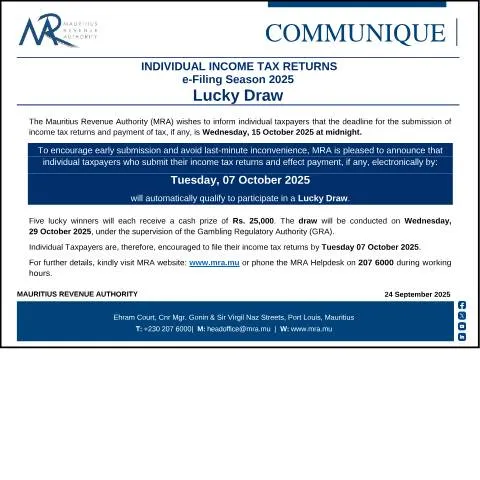
Understanding the Individual Income Tax Returns e-Filing Season 2025 Lucky Draw
The Individual Income Tax Returns documentation for the e-Filing Season 2025, codified under Communique240925, represents an essential component of taxpayer engagement in Mauritius. It is not merely a procedural formality; this document opens avenues for taxpayers to ensure compliance with the tax regime while offering them a chance at financial rewards through a well-structured incentive.
The Core Objective of the Document
This document is primarily intended for individual taxpayers within Mauritius to facilitate the online filing of their income tax returns. By adhering to the specified guidelines and deadlines, taxpayers can not only fulfill their legal obligations but also enter a Lucky Draw that awards cash prizes for early submissions. The MRA, through this initiative, aims to promote timely compliance and reduce the last-minute rush associated with tax filing.
Key Dates and Deadlines: A Timeline for Taxpayers
Understanding the timeline associated with the Individual Income Tax Return submissions is crucial to successfully navigating the tax landscape in Mauritius. The following key dates must be kept in mind:
- Deadline for Submission: Wednesday, 15 October 2025, at midnight.
- Lucky Draw Submission Deadline: Tuesday, 07 October 2025.
- Lucky Draw Announcement: Wednesday, 29 October 2025.
Consequences of Late Submission
Should a taxpayer fail to submit their income tax return by the stipulated deadline, they may face penalties. It is vital to remain proactive in addressing tax obligations to avoid additional charges, such as late fees or interest on unpaid taxes.
Exploring the Submission Channels: Online vs. Physical Filing
The Mauritius Revenue Authority (MRA) provides various channels for tax return submission, each with its unique characteristics.
Online Filing via the MRA Portal
With a strong push towards digitalization, the MRA encourages taxpayers to utilize the e-filing portal available on the government website. Key advantages include:
- Speed: Instant submission and confirmation.
- Convenience: Accessible from anywhere at any time.
- Participation in Lucky Draw: To qualify for the prize, submissions must be completed online by the designated early submission date.
Physical Filing at MRA Offices
For those who prefer traditional methods, submissions can also be made in person at designated MRA offices. However, this method lacks the convenience and speed of online filing.
Taxpayers leveraging this route should consider the following:
- Longer Processing Time: The verification process may take additional time.
- Risk of Errors: Handwritten forms can lead to possible misinterpretations by MRA staff.
Addressing Submission Challenges: Errors and Missing Documentation
In the event of submission errors or missing documents, taxpayers have specific recourse options.
Handling Errors in Submission
If a taxpayer realizes an error after submission, it is crucial to act quickly. The following steps should be taken:
- Contact the MRA Helpdesk at +230 207 6000 immediately for guidance.
- Prepare to submit a revised income tax return where applicable.
Missing Documentation
Taxpayers are encouraged to ensure that all necessary documents are submitted. In the case of absent documentation, it may result in delays or penalties. The MRA recommends the following preparatory steps:
- Ensure all income statements, deductions, and personal information are accurately documented.
- Utilize a checklist based on previous tax returns to ensure completeness.
Rewards and Responsibilities: Navigating Tax Obligations
Submissions via the Individual Income Tax Returns form not only fulfill legal obligations but also unlock opportunities for financial benefits.
Understanding Your Moral and Civic Duty
Filing income tax returns is not solely a legal requirement but a civic duty that contributes to national development. Compliance ensures that the government can fund essential public services and infrastructure through tax revenues.
Incentives for Timely Filing
Taxpayers who file before the early submission deadline of 07 October 2025 can enter the Lucky Draw, standing a chance to win one of five cash prizes of Rs 25,000 each. This not only adds a financial incentive but also alleviates the stress of last-minute filings.
Regulatory Framework: The Laws Behind Tax Returns
The Individual Income Tax Returns framework is governed by various legal stipulations originating from the Constitution of Mauritius (1968) and the PSC Act of 1955. These legal frameworks ensure that the taxation process remains transparent, fair, and in accordance with democratic principles.
The Role of the Mauritius Revenue Authority
The MRA is tasked with enforcing tax laws, ensuring compliance, and facilitating taxpayer education. Their initiatives aim to simplify the tax filing process and encourage public participation.
Unique Aspects of the Individual Income Tax Returns Form
This specific form stands apart from other tax-related documentation due to its focus on individual income earners and the unique incentive structure tied to electronic submissions.
Distinguishing Features
Distinct from corporate tax returns or value-added tax forms, this document is tailored specifically for non-corporate entities, emphasizing individual financial accountability.
Additionally, the inclusion of the Lucky Draw element sets it apart from standard filing processes, creating a unique motivator for timely compliance.
Conclusion: Making Your Income Tax Return Submission Count
Completing the Individual Income Tax Returns for the e-Filing Season 2025 is more than a mere obligation; it’s an opportunity to contribute to the nation while possibly earning a financial reward. Understanding the process, timelines, and available support ensures taxpayers can navigate their responsibilities effectively. By taking advantage of the early submission and ensuring accurate documentation, taxpayers position themselves not only for compliance but also for participation in a rewarding initiative.
Understanding Tax Obligations in Mauritius
Before diving into the specifics of the e-Filing season and the exciting Lucky Draw for the year 2025, it is essential to grasp the fundamental tax obligations that residents and citizens of Mauritius are expected to fulfill. The Mauritius Revenue Authority (MRA) oversees the administration of taxes in the country, ensuring compliance with the tax laws set forth in the Income Tax Act.
Individuals earning an income in Mauritius must file an Individual Income Tax Return (IITR) annually, detailing their earnings and any deductions applicable. The tax year runs from 1 July to 30 June of the following year, and residents must submit their returns by 30 September of the assessment year. Those who fail to comply with these deadlines may face penalties, including fines and interest on unpaid taxes.
It's also important to note that various sources of income are subject to different tax rates, and understanding these intricacies can significantly affect your overall tax liability. For instance, income from employment is taxed at a flat rate, while capital gains and dividends may be treated differently. The MRA provides a clear breakdown of rates and exemptions, allowing taxpayers to navigate their responsibilities effectively.
The E-Filing Process: A Step-by-Step Guide
As Mauritius continues to modernize its tax administration, the e-Filing system has become a crucial tool for taxpayers. The MRA encourages individuals to utilize the e-Filing platform on their official website, where users can access personalized tax information and submit returns electronically. This system not only streamlines the filing process but also enhances the accuracy of submissions.
To begin with, taxpayers must have a registered account with the MRA's online portal, which requires their National ID number linked to the Central Population Database. Once logged in, individuals will find clear options to start their Individual Income Tax Return. Users should gather the necessary documents, including proof of income, tax identification numbers, and any relevant deductions.
The e-Filing system is designed to be user-friendly, guiding taxpayers through each section of the form. Upon completion, individuals can review their entries before submission. An immediate acknowledgment will be generated, confirming that the return has been successfully filed. This not only provides peace of mind but also establishes a record of compliance with the tax obligations.
Maximizing Your Chances in the e-Filing Lucky Draw
This year, the MRA has announced an exciting Lucky Draw to incentivize timely and accurate submissions of Individual Income Tax Returns for the 2025 assessment year. Participation in this draw requires filing your return using the e-Filing system by the stipulated deadline of 30 September 2025. Let’s explore strategies to not only ensure compliance but also maximize your chances of winning.
To qualify for the Lucky Draw, individuals must file their tax returns accurately. It is essential to double-check all entries and ensure that any claimed deductions are substantiated with the necessary documentation. The MRA may conduct audits on returned forms, so maintaining proper records is vital.
Additionally, taxpayers should be aware that the earlier they file their returns, the better their chances of winning in the draw. Early submissions will be entered into the Lucky Draw, increasing the likelihood of being selected among the winners. The MRA will announce the winners shortly after the deadline, and prizes may include cash incentives, vouchers, or other rewards that promote financial literacy.
Furthermore, engaging with the MRA’s informational resources can enhance your understanding of the e-Filing process and tax obligations. Attending informational webinars or workshops, often hosted by the MRA, can provide insights into the most common errors made during the e-Filing process. Learning from others’ experiences can help you avoid similar pitfalls.