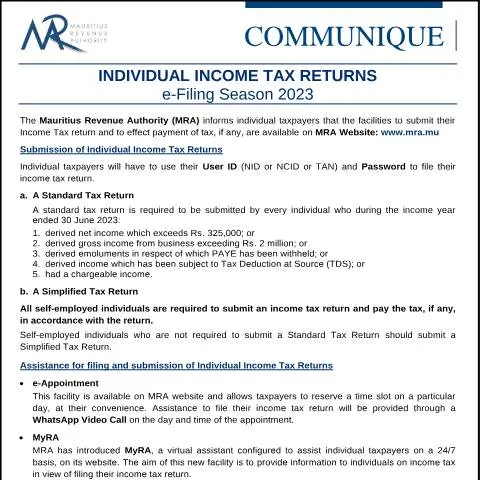
Navigating the e-Filing Season: A Comprehensive Guide for Individual Income Tax Returns 2023
The deadline for filing individual income tax returns is approaching, and many taxpayers are preparing to complete the e-Filing Season 2023. Understanding the process is essential for anyone who falls under the obligations set forth by the Mauritius Revenue Authority (MRA). This guide will detail the specific steps required, the nuances of the filing process, and what individuals can expect after they submit their returns.
The Framework of the Filing Process: Who Needs to File?
Before delving into the specifics of the Individual Income Tax Returns, it's crucial to establish who is required to file. According to the MRA guidelines, any individual who meets one of the following criteria must submit a return:
- Individuals whose net income exceeds Rs. 325,000 during the income year that ended on June 30, 2023.
- Those who derive gross income from business activities exceeding Rs. 2 million.
- Individuals from whom Pay As You Earn (PAYE) has been withheld.
- Individuals whose income has been subject to Tax Deduction at Source (TDS).
- Individuals with a chargeable income.
Additionally, self-employed individuals must also file an income tax return, even if they do not meet the threshold for a Standard Tax Return. They can opt for a Simplified Tax Return, which is specifically designed for those who may have less complex financial situations.
Understanding Standard vs. Simplified Tax Returns
The distinction between a Standard Tax Return and a Simplified Tax Return is essential for compliance. A Standard Tax Return involves a more detailed documentation process and is typically required for individuals with more substantial income. In contrast, the Simplified Tax Return offers a streamlined filing process for self-employed individuals, thereby reducing their administrative burden.
Filing Mechanisms: Digital Platforms and Traditional Methods
Taxpayers have various options for submitting their Individual Income Tax Returns. Here are the primary channels available:
1. Online Filing through MRA Website
Using the MRA’s online portal is the most efficient and encouraged method for filing. Taxpayers must use their User ID, which could be their National Identification Card (NID), National Company Identification (NCID), or Tax Account Number (TAN), along with a password to access the e-filing system. Once logged in, taxpayers can complete their returns and make any necessary payments directly. The benefits of filing online include:
- Immediate feedback on submission status.
- Access to real-time assistance via the MyRA virtual assistant.
- Convenience of filing from anywhere, at any time.
2. Paper Submissions
While the MRA advocates for e-filing, paper submissions remain an option, albeit less efficient. Taxpayers opting for this route must download the required forms from the MRA website, meticulously complete them, and then deliver them to the designated MRA office. It is crucial to ensure that all information is accurate and complete to avoid delays.
3. In-person Assistance
For individuals who might find the online process daunting, MRA provides in-person assistance through e-Appointment services. This system allows taxpayers to book a time slot for assistance via WhatsApp Video Call. This option is particularly valuable for those who require step-by-step guidance in completing their returns.
Dissecting the Form: A Closer Look at the Required Sections
The Individual Income Tax Returns form comprises various sections that must be accurately completed. Here's a breakdown of the critical sections of the form along with common pitfalls to avoid:
1. Personal Information
Taxpayers must enter their personal details—name, address, and National ID number—correctly. A common mistake occurs when individuals misplace their NID, leading to mismatched records and delays in processing. Ensure that all documentation matches what is officially on record with government authorities.
2. Income Details
This section requires a comprehensive declaration of all sources of income during the fiscal year. This includes:
- Salaries and wages
- Business income
- Investment income
Accurate reporting is crucial, as discrepancies can trigger audits. It's advisable to maintain comprehensive records and documents for verification purposes.
3. Deductions
Taxpayers may be eligible for certain deductions, such as contributions to approved retirement schemes or charitable donations. However, it’s important to strictly adhere to the regulations governing these deductions to avoid overestimating and facing penalties.
4. Tax Credits
Individuals may claim credits for tax withheld at source. Ensure that the amounts match the supporting documentation provided by employers or financial institutions. Errors in claiming these credits are a frequent source of complications.
Timeline: Key Dates and Their Significance
Understanding the timeline for filing is essential to ensure compliance with tax regulations. The MRA has established the following key dates for the 2023 e-Filing season:
- Start Date: The e-filing season officially opened on September 1, 2023.
- Deadline for Submission: Individual taxpayers must file their returns by October 16, 2023.
- Post-Submission Processing: Following submission, taxpayers can expect an acknowledgment from MRA. This typically occurs within a few business days of submission.
Late submissions can result in penalties, so it is advisable to file as early as possible to avoid last-minute complications.
After Submission: What Happens Next?
Once the return is submitted, several processes are triggered, including:
1. Acknowledgment of Submission
The MRA will send an acknowledgment receipt confirming the submission. Keep this receipt for your records, as it's essential for future reference.
2. Review and Assessment
The MRA will review the submitted returns. In cases where discrepancies are found or additional information is needed, the MRA will reach out to the taxpayer directly. It is crucial for taxpayers to respond promptly to any inquiries to expedite the review process.
3. Payment of Taxes
If tax liability is determined, you will receive a notification regarding the amount due. Payments can be made online through the MRA portal, enhancing convenience and ensuring timely processing.
Engagement and Feedback: The Taxpayer Satisfaction Survey
As part of their ongoing improvement efforts, the MRA encourages taxpayers to participate in the Taxpayer Satisfaction Survey (TSS) following the submission of their returns. This feedback mechanism enables the MRA to gauge public perception and enhance the taxpayer experience. Moreover, participants will automatically enter a draw to win attractive prizes, including cash awards of Rs. 25,000, Rs. 15,000, and Rs. 10,000.
Engagement with the MRA through surveys not only aids in improving services but also fosters a sense of community between taxpayers and the authorities, emphasizing a collaborative approach to taxation.
Final Tips for a Smooth Filing Experience
As the deadline approaches, taxpayers should remember a few best practices:
- Organize Documentation: Ensure that all supporting documents are readily available before starting the e-filing process.
- Double-Check Entries: Verify that all information entered in the tax return is accurate to avoid complications.
- Seek Assistance if Needed: Utilize the MRA’s e-Appointment service or MyRA for guidance when necessary.
By following these guidelines and being proactive in the filing process, individuals can navigate the e-Filing Season 2023 with confidence and ease.
Fill in your form directly online
No printing: type your details into the boxes of the official form, tick, then download the PDF ready to send.
- 1Type into the form boxes
- 2Tick in one click
- 3Save and download the PDF
Understanding the Individual Income Tax Returns Framework in Mauritius
The Individual Income Tax Returns (IITR) framework in Mauritius operates under the guidelines established by the Mauritius Revenue Authority (MRA). The tax system is governed by various laws, including the Income Tax Act 1995, which outlines the obligations of individuals earning income within the country. Tax residents are required to file their returns annually, regardless of their employment status or the source of their income.
It is important to understand the different categories of income that must be declared. This includes salary, business income, interest, dividends, and any other income derived from various sources. Additionally, taxpayers must keep in mind that Mauritius has a progressive tax rate system; thus, the amount of tax payable is determined by the income bracket into which the taxpayer falls. The rates for personal income tax range from 0% to 15%, depending on the income level. Understanding how these brackets function is essential to ensure accurate reporting and tax compliance.
Key Considerations for e-Filing: Eligibility Criteria and Required Documentation
Before beginning the e-filing process for the 2023 Individual Income Tax Returns, it’s critical to ascertain whether you meet the eligibility criteria set forth by the MRA. Primarily, all individuals who are tax residents and have earned a taxable income during the fiscal year (1 July 2022 – 30 June 2023) must file their returns. Additionally, even those taxpayers who have earned below the taxable threshold are encouraged to file their returns to ensure compliance and maintain their tax records accurately.
To facilitate a smooth e-filing experience, gather the necessary documentation in advance. This includes:
- National Identity Card: A valid ID is required to log into the MauPass system. Your National ID is linked to your Central Population Database record, enabling secure access to e-services.
- Payslips and Tax Certificates: It’s essential to collect your monthly payslips and the annual tax certificate from your employer, which details your total earnings and tax deductions for the fiscal year.
- Bank Statements: If you have investment income, ensure you have the relevant bank statements to report any interest earned accurately.
- Supporting Documents for Deductions: If you intend to claim deductions for expenses such as medical bills or donations to charity, gather all relevant receipts and documents to substantiate your claims.
Having these documents at hand will streamline the e-filing process, minimizing the potential for errors and ensuring you complete your tax return accurately and efficiently.
Common Pitfalls During e-Filing and How to Avoid Them
While e-filing facilitates the tax return process, several common pitfalls can lead to complications if not addressed properly. Awareness of these issues can save time and minimize stress during the tax season.
One typical mistake is failing to report all sources of income. Many individuals may overlook certain income streams, especially if they derive income from part-time work or freelance projects. It is crucial to ensure all income is accounted for in the IITR.
Another frequent error occurs when taxpayers rush through the return process without reviewing their entries. This can lead to incorrect data being submitted, which may result in penalties or delayed processing. It is advisable to take sufficient time to review your completed return before submission.
Additionally, some taxpayers fail to utilize the available online resources and FAQs provided by the MRA. These resources can clarify specific requirements and often answer common queries. If uncertainty arises, reaching out to MRA customer service can provide the necessary guidance to navigate your filing properly.
Finally, make sure to file your return before the deadline. For the 2023 tax season, the deadline for e-filing is set for 15 November 2023. Late submissions may incur penalties, which can accumulate based on how long the filing is overdue.