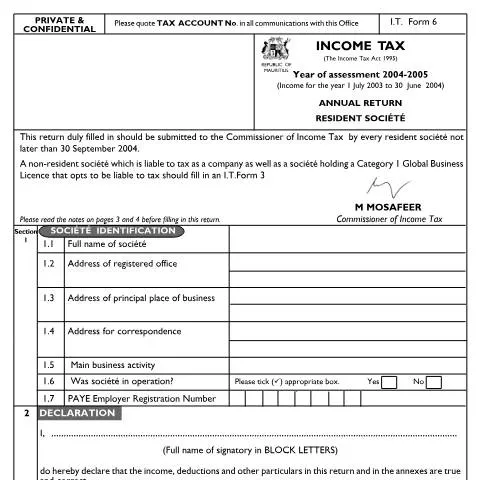
Navigating the intricacies of the I.T. Form 6 for Resident Sociétés
The I.T. Form 6, a critical document within Mauritius' tax framework, serves as an annual return for resident sociétes. Understanding its significance is essential for businesses aiming to comply with local tax regulations. To contextualize this, consider the scenario of a local société receiving income from various sources, including trade and property. Accurately filling out this form is not just a bureaucratic exercise; it directly impacts the société's financial health and legal standing.
Who is responsible for submission and when?
The submission of the I.T. Form 6 is mandated for every resident société in Mauritius. It must be submitted to the Commissioner of Income Tax by the deadline of 30 September 2004 for the income year spanning from 1 July 2003 to 30 June 2004. While many might overlook the importance of this deadline, it's crucial to recognize that failure to comply could result in penalties or, worse, legal repercussions for the société.
Understanding Resident Sociétés
- A resident société is defined as one that has its seat in Mauritius or has at least one associate residing in the country.
- This status is significant because it determines the tax liabilities and obligations of the société in relation to its associates.
Completing the Form: Sections Explained
The I.T. Form 6 is divided into several key sections, each requiring precise information. The sections include details on identification, declaration, and a breakdown of income. Here’s a closer look:
Section 1: Société Identification
In this section, the société must provide essential information such as:
- Full Name: This should be the registered name of the société as per the Registrar of Companies.
- Addresses: Include the registered office, principal place of business, and correspondence address to ensure all communications reach the right destination.
- Main Business Activity: Clearly specify the primary business operations to facilitate accurate tax assessments.
- PAYE Employer Registration Number: If applicable, include this number to streamline payroll tax processes.
Section 2: Declaration
Here, the signatory must declare that all information provided is accurate and truthful. This is a legal affirmation and carries weight in case of audits or disputes.
The Importance of Accurate Financial Reporting
Section 3 of the I.T. Form 6 requires sociétes to report their income sources. Understanding how to present this information can be pivotal. Key sub-sections include:
Business Income Reporting
Reporting on business income can be complex. Companies must detail:
- Turnover/Sales: Total revenue from sales.
- Cost of Sales: Deductions must be clearly indicated to determine gross profit.
- Net Profit Calculation: After deducting business expenses, the net profit per accounts should be determined accurately.
Moreover, any allowable and non-allowable expenses must be distinguished to align with tax regulations.
Income from Property
If the société derives income from property within or outside Mauritius, it must report gross and net figures for each property source. This section is vital for sociétes heavily vested in real estate, as it directly affects their overall tax liabilities. A thorough breakdown, supported by appropriate documentation such as rental agreements, is recommended.
Consequences of Non-Compliance: What’s at Stake?
Understanding the consequences of failing to submit the I.T. Form 6 or inaccuracies in reporting is imperative. The repercussions can range from monetary penalties to potential audits by the MRA, which can disrupt business operations. Sociétes may also find themselves facing interest charges on late submissions, compounding their financial challenges.
What to Do in Case of Refusal or Errors
In instances where a submission is refused due to errors or missing information, the société should take immediate corrective measures:
- Review the reasons for rejection as communicated by the tax office.
- Gather any additional documentation or clarification required to address the discrepancies.
- Resubmit the corrected I.T. Form 6 along with a letter of explanation if necessary.
Remaining proactive in addressing any issues enhances the société’s compliance standing and mitigates risks associated with tax non-compliance.
Understanding the Process After Submission
Following submission, it is crucial for sociétes to understand the subsequent processes. Once the I.T. Form 6 is submitted, the tax office will:
- Review the submitted documents for accuracy and completeness.
- Communicate any findings or requests for further information.
- Assess the tax owed or refund due, issuing statements accordingly.
Monitoring communications from the tax office after submission is essential to ensure that any queries are promptly addressed, ultimately leading to a smoother tax resolution process.
Fill in your form directly online
No printing: type your details into the boxes of the official form, tick, then download the PDF ready to send.
- 1Type into the form boxes
- 2Tick in one click
- 3Save and download the PDF
Timeline of Tax Assessment and Payment
The fiscal year runs from 1 July to 30 June, which establishes the timeline for assessments. Understanding this timeline helps sociétes plan their financial strategies effectively. A typical process may unfold as follows:
| Event | Date |
|---|---|
| End of Fiscal Year | 30 June |
| Submission Deadline for I.T. Form 6 | 30 September |
| Issuance of Tax Assessment | Within 3 months post-submission |
| Due Date for Tax Payment | As specified in the assessment |
Unique Cases: Foreign Sociétés and Complex Situations
In the realm of taxation, unique scenarios such as foreign sociétes, minors, or complex business structures can introduce additional considerations:
Foreign Sociétés
Non-resident sociétes that are liable to tax must complete an I.T. Form 3 instead of the I.T. Form 6. This distinction is crucial for compliance, as the tax obligations differ significantly based on residency status.
Minors or Special Circumstances
In cases where a société is partially managed by minors or involves intricate partnerships, it may require special consideration or additional documentation. Consulting with tax professionals can provide clarity and ensure adherence to regulatory standards.
Conclusion: Proactive Engagement with Tax Obligations
Accurate and timely submission of the I.T. Form 6 is not merely a bureaucratic task; it is a fundamental duty that can significantly influence a société's operational landscape. By understanding the nuances of the form, the implications of compliance, and the steps to take in various circumstances, sociétes can better navigate the complexities of Mauritian tax law. Engaging proactively with these obligations will ultimately protect their interests and foster sustained growth.