Understanding the 2005/2006 Annual Return for Resident Société
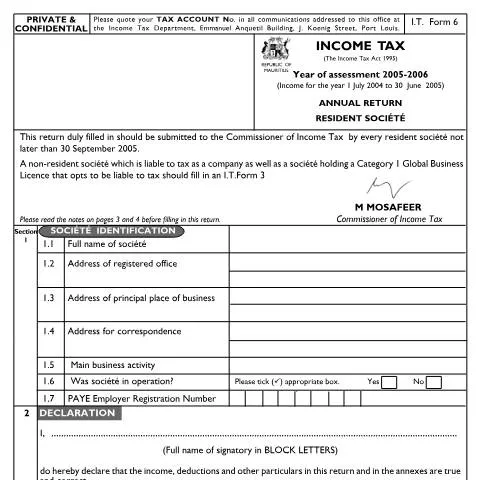
Filing an annual return is an essential requirement for any resident société in Mauritius. The I.T. Form 6, also known as the 2005/2006 Annual Return, serves as a formal declaration of the income earned during the assessment year, which in this case spans from 1 July 2004 to 30 June 2005.
This document is pivotal in the broader context of tax compliance, allowing the Mauritius Revenue Authority (MRA) to assess the tax liabilities accurately. Understanding its nuances, particularly how it differentiates from other forms, can significantly impact the compliance process for companies operating within the legal framework of Mauritius.
Key Distinctions: How I.T. Form 6 Differs from Other Tax Returns
It is essential to clarify how the I.T. Form 6 fits into the spectrum of tax documents. While various forms are utilized for tax reporting, the I.T. Form 6 is uniquely designated for resident sociétés, which are defined under Mauritian law as entities with their seat in Mauritius or those with at least one resident associate. This specificity is critical:
- Resident vs. Non-Resident Taxation: The form focuses solely on resident sociétés, distinguishing it from I.T. Form 3, which is applicable to non-resident sociétés and those with a Category 1 Global Business Licence opting for tax liability.
- Income Assessment Period: The income reported pertains specifically to the financial year ending 30 June 2005, aligning with the fiscal calendar in Mauritius.
- Business Activities Declaration: Unlike some generic forms, the I.T. Form 6 requires detailed disclosure of various business activities undertaken by the société, allowing for a nuanced tax assessment based on operational specifics.
Crucial Submission Calendar: Deadlines and Subsequent Actions
Timeliness is paramount in tax matters. For the 2005/2006 Annual Return, the submission deadline was set for 30 September 2005. Missing this deadline can incur penalties, potentially compromising the société’s standing with the MRA.
The chronological flow of events surrounding this submission includes:
- Preparation: As the fiscal year closes on 30 June, sociétés must begin gathering necessary financial documents well in advance of the deadline.
- Filing: The completed I.T. Form 6 must be submitted to the Commissioner of Income Tax. For compliance, ensure that any annexes and supporting documentation, such as financial statements, are included.
- Confirmation: Upon successful submission, a notification of receipt should be sought from the MRA to ensure that the return has been acknowledged and is being processed.
- Follow-Up: If any discrepancies arise or additional information is required, the société will need to respond promptly to avoid further complications.
Contextual Importance: The Role of I.T. Form 6 in the Tax Compliance Landscape
Positioned within a larger framework, the I.T. Form 6 plays a significant role in ensuring that resident sociétés comply with tax regulations. Filing this return is not merely a formality; it is a key component in determining the overall tax obligations of the société and its associates.
- Tax Liability Calculation: The information provided helps the MRA calculate the tax liabilities of associates based on their share of the société’s income.
- Facilitating Transparency: By enforcing the declaration of income and expenses, the form promotes transparency and accountability within the business sector.
- Data for Economic Planning: The aggregated data collected from these returns also assists in national economic planning and policy-making by providing insight into business operations and trends.
Step-by-Step Guide: From Initiation to Submission
Navigating the entire process of completing and submitting the I.T. Form 6 requires careful attention to detail. Here’s a step-by-step guide to streamline your experience:
1. Gather Necessary Documentation
Before filling out the form, collect all relevant financial records, including:
- Income statements
- Balance sheets
- Annexes detailing operational activities
2. Complete the Form
The form consists of several sections. Each must be filled out accurately. Key sections include:
- Section 1: Identification details of the société, including registered office, principal place of business, and nature of business activities.
- Section 2: A declaration by the signatory affirming the accuracy of the information provided.
- Section 3: Detailed breakdown of income sources, including trade, property, and other income.
3. Review and Validate
Double-check all entries for accuracy. Ensure all calculations are correct and that all required signatures are in place.
4. Submission Channels
Filing can be conducted through various channels, each with its nuances:
| Method | Description |
|---|---|
| Online Submission | Utilizing the MauPass single-sign-on system tied to the National ID Card, sociétés can file electronically via govmu.org. |
| Paper Submission | Physical forms may be submitted at designated MRA offices. Make sure to retain copies for your records. |
| Submission at Guichet | Direct submissions can be made at specific government service centers, offering face-to-face assistance if needed. |
5. Await Confirmation
Post-submission, monitor for confirmation of receipt. This is critical to ensure compliance and to avoid penalties.
Post-Submission: Understanding the Feedback Loop
After submission, the journey does not end. The MRA will review the returned form. Possible outcomes include:
- No Queries: If all information is in order, the return will be processed, and tax assessments will be sent accordingly.
- Request for Clarification: In case of discrepancies or missing information, the MRA may contact the société for further details.
- Audit Considerations: Random audits may occur. Keeping thorough records and documentation supports compliance if the form is selected for review.
Conclusion: Ensuring a Smooth Compliance Experience
Filing the I.T. Form 6 represents a crucial responsibility for resident sociétés in Mauritius. Understanding its specific requirements, the importance of deadlines, and the procedural steps involved can greatly enhance the compliance experience. Proper preparation and attention to detail not only ensure successful submission but also pave the way for smoother interactions with the MRA in the future.
As the Mauritian tax landscape evolves, staying informed about changes to regulations and submission processes will be paramount for all sociétés.
Significant Government Reforms in Mauritius (2005-2006)
During the years 2005 and 2006, Mauritius saw a number of significant governmental reforms that aimed to enhance efficiency and transparency in public service delivery. The initiatives taken during this period were closely tied to the evolving socio-economic context of the nation, requiring a responsive approach from the government.
One of the notable reforms was the introduction of the e-Government initiative, which aimed to digitise public services for enhanced accessibility. The government sought to streamline processes and cut down waiting times for citizens seeking various services. Key milestones included the launch of the government portal, which allowed for online submission of applications and forms; this was particularly vital during the initial phase of the programme.
Moreover, legislative amendments were made to various acts, such as the Public Service Commission (PSC) Act, which allowed for improved oversight and recruitment practices within public services. The aim was to ensure that appointments were based on merit and transparency, thus fostering a more accountable public sector.
The establishment of the Local Government Service Commission (LGSC) in this period also stood out, as it provided a framework for the recruitment and management of local government personnel. This body responded to the need for more localized management structures in governance, enhancing service delivery at the community level.
Fill in your form directly online
No printing: type your details into the boxes of the official form, tick, then download the PDF ready to send.
- 1Type into the form boxes
- 2Tick in one click
- 3Save and download the PDF
Economic Impact and Fiscal Developments (2005-2006)
The years 2005 and 2006 were challenging yet crucial for the Mauritian economy. The government faced various economic pressures, including the need to sustain growth while managing public finances effectively. This period was marked by key fiscal developments that sought to bolster the national economy.
The introduction of the Mauritius Revenue Authority (MRA) played a pivotal role in transforming tax administration through enhanced compliance measures and the pursuit of a more effective taxation system. The MRA focused on increasing the tax base while ensuring that tax collection processes were fair and efficient. This spurred a greater emphasis on e-filing for taxes, promoting a digital-first approach that reduced manual errors and increased accessibility for taxpayers.
Additionally, the fiscal year running from 1 July to 30 June witnessed the introduction of new taxation policies aimed at attracting foreign investment, including tax incentives for specific sectors such as tourism and information technology. These policies were vital in positioning Mauritius as an emerging market destination.
Through these measures, the government aimed to stimulate job creation and support sustainable economic growth, ultimately striving to maintain the nation’s status as a stable investment climate in the Indian Ocean region.
Impact on Social Welfare and Educational Initiatives (2005-2006)
The social fabric of Mauritius was significantly impacted by various welfare initiatives that were introduced during the 2005-2006 period. The government placed a strong emphasis on education and social support systems as a means to uplift the standard of living for all Mauritians.
One of the key initiatives was the launch of educational reforms aimed at improving the quality of primary and secondary education. The government allocated increased budgets to the Ministry of Education, which facilitated the training of teachers and the upgrading of school facilities across the nation. These reforms were critical in addressing disparities in educational outcomes among different regions.
In addition to educational advancements, the government also focused on social welfare programmes. These included the expansion of social grants and assistance programmes designed to support vulnerable populations, such as the elderly, disabled, and low-income families. The emphasis was not only on providing financial assistance but also on empowering citizens through skill development and vocational training.
These multifaceted approaches during 2005 and 2006 illustrated the government's commitment to fostering an inclusive society where citizens had equal opportunities to thrive, thereby laying the groundwork for sustainable social development in the years to come.