Overview of the Recent Synthetic Drug Seizure at Mauritius International Airport
On 20 March 2019, the Mauritius Revenue Authority (MRA) issued an official notice concerning a significant drug interdiction operation conducted at the SSR International Airport. This operation exemplifies the ongoing efforts of Mauritian authorities to combat drug trafficking and safeguard public health and security. The seizure involved synthetic drugs valued at approximately Rs 15 million, highlighting the seriousness of drug-related crimes and the importance of border control measures.
Context and Scope of the Operation
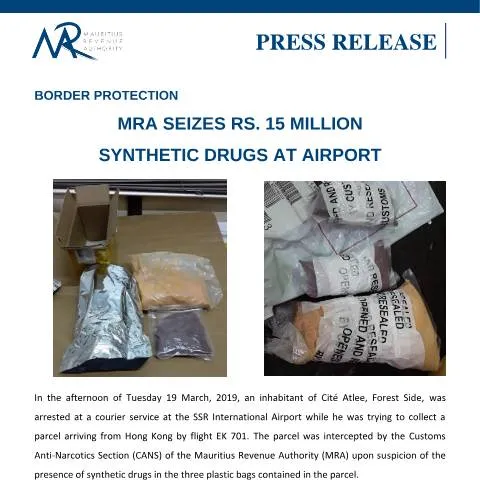
The incident took place on the afternoon of 19 March 2019, when a parcel arriving from Hong Kong was intercepted by the Customs Anti-Narcotics Section (CANS) within the framework of routine border control activities. The parcel was destined for a recipient residing in Cité Atlee, Forest Side. The interception was prompted by suspicion arising from the parcel’s contents and the context of international drug trafficking patterns, which Mauritius actively monitors and combats through stringent customs procedures and cross-agency collaboration.
The parcel was handled under the authority of the Mauritius Revenue Authority, which operates within the legal framework provided by the Customs Act and related regulations. The detection was facilitated by field tests conducted on the suspected contents, which confirmed the presence of synthetic drugs in three plastic bags containing powders of different colors: purple, brown, and orange.
Who is Affected and the Legal Implications
This operation directly involves the individual attempting to collect the parcel, who was identified as a resident of Cité Atlee. The suspect was arrested by the Anti-Drug and Smuggling Unit (ADSU) of the MRA’s Customs Anti-Narcotics Section. Under Mauritian law, such individuals face serious legal consequences, including potential charges under the Dangerous Drugs Act and related legislation. The arrest underscores the active enforcement measures in place to prevent illegal drug circulation within the country.
The seizure of drugs valued at Rs 15 million demonstrates the scale of illicit activities targeted by the authorities. The illegal substances, identified as synthetic drugs, pose significant health risks and are associated with organized crime. Mauritian law provides for stringent penalties, including imprisonment and fines, for those involved in trafficking or possession of such substances.
Points of Emphasis and Public Involvement
The authorities emphasize the importance of vigilance and community cooperation in the fight against drug trafficking. Members of the public are encouraged to report any suspicious activities related to drugs or illicit activities through the official channels provided by the Mauritius Revenue Authority. The Stop Drug platform and the dedicated hotline at 8958 serve as accessible avenues for anonymous reporting, helping to strengthen border security and community resilience.
References and Organisms Responsible
This operation was carried out by the Mauritius Revenue Authority, specifically through its Customs Anti-Narcotics Section, in collaboration with the Anti-Drug and Smuggling Unit. The MRA’s role encompasses customs enforcement, tax collection, and combating illicit activities at points of entry and within the country. The legal basis for these activities is rooted in the Customs Act and related legislation, which empower the MRA to conduct investigations, seizures, and arrests in matters related to smuggling and drug trafficking.
Fill in your form directly online
No printing: type your details into the boxes of the official form, tick, then download the PDF ready to send.
- 1Type into the form boxes
- 2Tick in one click
- 3Save and download the PDF
The official communication was issued by the Taxpayer Education and Communication Department of the MRA, based at Ehram Court, Port-Louis. Citizens and stakeholders are encouraged to stay informed through official channels and to participate actively in maintaining Mauritius as a safe and secure environment.
Conclusion
The recent seizure of synthetic drugs at Mauritius’s main international gateway underscores the ongoing commitment of the authorities to prevent drug trafficking and protect public health. It also highlights the importance of vigilant border controls, community cooperation, and effective enforcement mechanisms in addressing the challenges posed by illicit substances. Citizens are urged to remain alert and to use established reporting channels to contribute to national security efforts.