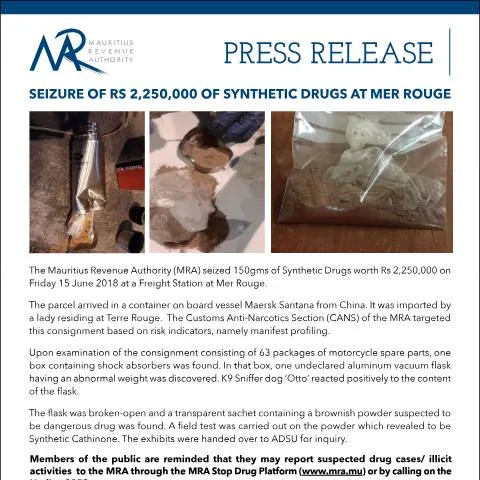
A Critical Document in Drug Enforcement: The Seizure Report for Rs 2,250,000 of Synthetic Drugs
This document, officially titled Seizure of Rs 2,250,000 of Synthetic Drugs at Mer Rouge (15.06.18), holds significant importance within the framework of drug enforcement in Mauritius. It provides a detailed account of a high-profile seizure conducted by the Mauritius Revenue Authority (MRA) and serves as a vital record for subsequent legal and administrative procedures.
Understanding the Context of the Seizure
On June 15, 2018, the MRA's Customs Anti-Narcotics Section (CANS) executed a seizure operation at a Freight Station at Mer Rouge. This was not a random act but was informed by meticulous risk profiling methods and intelligence gathering. The imported parcel, initially appearing to contain motorcycle spare parts, was flagged for inspection. Upon examination, it was discovered to include synthetic drugs concealed within what was purported to be an aluminum vacuum flask.
The Role of Risk Indicators in Seizure Operations
The proactive measures employed by the MRA underscore a crucial element in drug enforcement strategies: the use of risk indicators. These indicators can include shipping routes, historical data on illegal imports, and profiling of suspicious consignments.
- Manifest Profiling: This involves analyzing shipping documents for anomalies.
- Intelligence Sharing: Collaborating with international customs to identify high-risk shipments.
- Canine Units: Utilizing trained K9 dogs like 'Otto' to detect narcotics and illegal substances.
Detailed Breakdown of the Seizure: From Detection to Documentation
Initial Discovery and Identification
The operation commenced with the detection of an unusually dense object during a routine inspection. The combination of manifest profiling and canine assistance led to the identification of the suspicious flask. Once discovered, the MRA officers utilized field testing to confirm the contents of the flask—Synthetic Cathinone, a potent synthetic drug.
Legal Documentation and Chain of Custody
The successful seizure of such a significant quantity of drugs necessitated thorough documentation. The Seizure Report represents more than just a record of events; it is an integral part of the legal framework that underpins drug enforcement actions.
- Chain of Custody: Ensures that the evidence remains intact and unaltered.
- Documentation Requirements: Accurate recording of the seizure process, including times, dates, and personnel involved.
The Stakeholders Involved in the Seizure Process
This operation involves multiple parties, each with distinct roles and responsibilities. Understanding these stakeholders provides clarity on how drug enforcement operates in Mauritius.
The Mauritius Revenue Authority (MRA)
Responsible for the enforcement of customs and tax laws, the MRA plays a pivotal role in detecting and preventing the illegal trade of controlled substances. Their operations are critical not only for law enforcement but also for public health and safety.
Local Law Enforcement Agencies
Once the drugs are seized, the Anti-Drug and Smuggling Unit (ADSU) takes over the investigation. They analyze the seized items, work on tracing the origins, and track down the responsible parties. Collaboration with international drug enforcement agencies is also essential for addressing cross-border trafficking.
Challenges and Considerations in Documenting Drug Seizures
Filling out the Seizure Report accurately is paramount, as any discrepancies can compromise legal proceedings. Here, we examine common challenges faced by officials during the documentation process.
Ensuring Accuracy in Reporting
To maintain the integrity of the report, every detail must be scrutinized closely. Officials must ensure that:
- All items are described accurately, including weight and quantity.
- Witnesses are listed and their statements attached where necessary.
- Time-stamped photographs of the seized items are included.
Legal Ramifications of Errors
Even minor inaccuracies can lead to significant legal complications. Defendants may exploit these errors to challenge the validity of the evidence in court, thus necessitating meticulous attention to detail in documentation.
Comparative Analysis: Seizure Report vs. Other Related Documents
It is important to differentiate this specific seizure report from other documentation that may be utilized in similar contexts, such as the Customs Declaration Form or the Notice of Seizure.
| Document Type | Purpose | Key Features |
|---|---|---|
| Seizure Report | Documenting drug seizures for legal purposes | Details of the seizure, chain of custody, and evidence |
| Customs Declaration Form | Declaring imported goods to customs | Information on goods, importers, and duties |
| Notice of Seizure | Informing parties of seized goods | Information on the reason for seizure and next steps |
Next Steps: From Seizure to Prosecution
Upon the completion of the seizure report, the documentation is forwarded to the relevant authorities for further investigation and potential prosecution. The subsequent steps often include:
Investigative Procedures
ADSU will take the lead in investigating the origins of the drugs and identifying the individuals involved. This might require:
- Interviews with the consignee and potential witnesses.
- Forensic analysis of the seized substances.
- Coordination with international drug enforcement agencies if cross-border trafficking is suspected.
Legal Proceedings
If sufficient evidence is gathered, legal proceedings will commence. The evidence documented in the Seizure Report will play a critical role in the prosecution's case, ensuring that justice is served while adhering to legal standards.
Public Involvement and Reporting Suspected Drug Activity
Members of the public are encouraged to play an active role in drug enforcement. The MRA has implemented several channels for citizens to report suspected drug activity. This communal effort can significantly enhance the effectiveness of drug enforcement initiatives.
Reporting Mechanisms
The MRA provides a dedicated platform for the public to report illicit activities:
- Online submissions via the MRA Stop Drug Platform.
- A hotline (8958) for immediate reporting of suspected drug trafficking.
These reporting mechanisms foster a proactive stance against drug-related crimes, facilitating quicker action and potentially leading to more successful seizure operations.
Impact of Seizures on Community Health and Safety
Ultimately, the successful execution and documentation of seizures such as the one at Mer Rouge play a crucial role in safeguarding the health and safety of the community. By effectively removing dangerous substances from circulation, authorities send a strong message to would-be traffickers while promoting community awareness about the dangers of drug abuse.
As efforts continue to combat drug trafficking in Mauritius, the importance of meticulous documentation and community involvement remains paramount. The Seizure Report of Rs 2,250,000 of Synthetic Drugs is not merely a procedural document; it is a testament to the ongoing battle against drug abuse and the commitment of law enforcement agencies to protect the citizens of Mauritius.
Understanding the Legal Framework for Drug Seizures in Mauritius
The seizure of synthetic drugs, such as the Rs 2,250,000 worth of substances confiscated at Mer Rouge on June 15, 2018, falls under several legal provisions within the Mauritian legal system. The Narcotic Drugs and Psychotropic Substances Act, which specifies the legal repercussions for possession, trafficking, and production of illegal substances, serves as the primary legislation governing drug-related offenses.
Fill in your form directly online
No printing: type your details into the boxes of the official form, tick, then download the PDF ready to send.
- 1Type into the form boxes
- 2Tick in one click
- 3Save and download the PDF
Under this Act, law enforcement agencies are empowered to conduct searches and seizures without a warrant if they possess reasonable grounds to believe that a violation is occurring. The procedures outlined in this legislation aim to balance the need for public safety with the rights of individuals. Additionally, the Police Force operates under stringent protocols to ensure that evidence is collected legally to maintain its admissibility in court.
Moreover, the hybrid legal system of Mauritius, combining French civil law with English common law, introduces complexities in how drug-related cases are prosecuted. This duality requires law enforcement and judicial bodies to navigate both procedural traditions, particularly in matters concerning the rights of the accused and the evidentiary standards required for conviction.
The Role of the National Drug Control Committee in Combating Drug Trafficking
The National Drug Control Committee (NDCC) plays a crucial role in formulating and implementing strategies to combat drug trafficking and abuse in Mauritius. Established in accordance with national policies aimed at addressing drug-related issues, the NDCC coordinates with various governmental and non-governmental agencies to tackle the challenges posed by synthetic drugs and other narcotics.
Following the significant seizure at Mer Rouge, the NDCC intensified efforts in public awareness campaigns, aimed at educating the populace about the dangers of synthetic drugs. Collaboration with international organizations has also been a pivotal aspect of their strategy, facilitating training programs for law enforcement officers and the sharing of intelligence to curb trafficking networks.
The committee's initiatives include outreach programs in schools and communities, as well as the promotion of rehabilitation programs for those struggling with addiction. An emphasis on prevention and education seeks not only to reduce the demand for illicit substances but also to foster a comprehensive understanding of the societal impact of drug abuse.
The Economic Implications of Drug Seizure on Local Communities
The ramifications of drug seizures extend beyond legal and enforcement contexts; they significantly impact local economies and communities. The confiscation of Rs 2,250,000 worth of synthetic drugs at Mer Rouge not only disrupts the supply chain of illegal substances but also sets off a ripple effect across various sectors.
One critical aspect is the impact on local law enforcement resources. Significant drug seizures necessitate increased funding and personnel devoted to address the growing incidence of drug-related crimes. This situation can divert resources from other essential community services, potentially leading to a strain on public safety and health services.
Moreover, drug trafficking often intertwines with other illegal activities, creating an underground economy that can undermine legitimate businesses. The disruption of drug networks can temporarily boost local communities by reducing drug availability, yet it can also lead to retaliatory violence or an uptick in criminal activities as traffickers seek to reclaim lost territory.
To mitigate these economic implications, community engagement and economic development initiatives become paramount. Local governments are encouraged to develop programs that support alternative livelihoods for those previously engaged in the drug trade, fostering a sustainable economic environment that thrives on legitimate commerce rather than illicit activities.