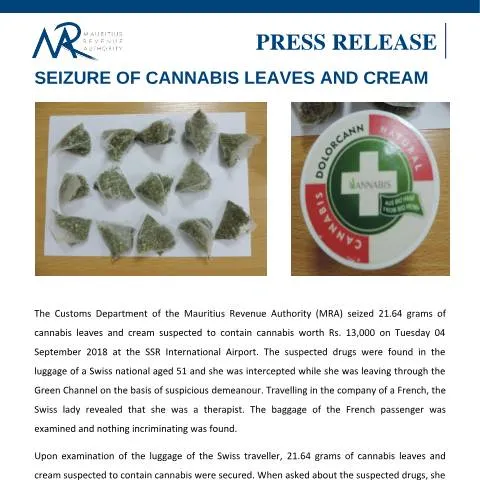
Understanding the Procedure for Document Submission: Seizure of Cannabis Leaves and Cream
In the context of Mauritius, the administration of seized items, particularly narcotics, follows strict guidelines to ensure compliance with local laws. The official document pertaining to the seizure of cannabis leaves and cream, referenced as SeizureCannabis040918, plays a crucial role in this process. This document must be carefully filled out and submitted by the relevant parties in connection with any seizures made by the Mauritius Revenue Authority (MRA) or other associated law enforcement agencies. To navigate this maze effectively, understanding the nuances of this document, the required procedures, and the implications it holds is essential.
The Incident That Triggered the Documentation
The documentation process began following an incident on 04 September 2018, when the Customs Department of the MRA seized a total of 21.64 grams of cannabis leaves and cream. This seizure occurred at the SSR International Airport when a Swiss national was found carrying these substances in her luggage while attempting to exit the country. The customs officers, acting on their duty, intercepted her due to her suspicious demeanor while passing through the Green Channel.
Following the initial seizure, the customs officers conducted a thorough examination, leading to the discovery of the illicit items. Notably, the passenger claimed that the leaves were medical herbs and asserted that the cream was merely a painkiller intended for personal use. The involvement of a K9 sniffer dog confirmed the presence of the suspected drugs, resulting in the transfer of the passenger and her belongings to the Anti-Drug and Smuggling Unit (ADSU) for further investigation.
Who is Responsible for Document Submission?
Document submission in cases of seizures, such as the cannabis incident, is typically the responsibility of law enforcement officials who conducted the seizure. In this instance, the Customs Department of the MRA is tasked with completing the Seizure document, which will subsequently be used in legal proceedings or further investigations.
However, individuals or entities that report illicit activities or suspected drug cases also have the option to engage with the MRA through various reporting channels, including the MRA Stop Drug Platform or the hotline number 8958. This creates a feedback loop between the public and law enforcement, ultimately enhancing community safety.
Filling Out the Form: Key Information Required
When preparing the Seizure of Cannabis document, accurate and thorough completion is paramount. Key information to include encompasses:
- Details of the Seizure: Date, time, and exact location of the seizure.
- Information on Suspect: Personal details of the individual from whom the items were seized, including nationality, age, and any relevant identification details.
- Description of the Items: Clear identification of the seized items, namely cannabis leaves and cream, including weight and estimated value.
- Reason for Seizure: Justification for the seizure based on observed behavior or intelligence reports.
- Involvement of Law Enforcement: Details of the officers present and their actions during the seizure.
Submission Channels: Online, Paper, and In-person
Once the document is filled out, the next step is determining the most appropriate method for submission. In Mauritius, the MRA encourages the use of digital platforms to expedite processing. Here’s a breakdown of the available submission channels:
| Submission Channel | Description | Advantages |
|---|---|---|
| Online Submission | Documents can be submitted via the MRA's online portal. | Fast processing, convenient tracking of application status. |
| Paper Submission | Physical documents can be sent via postal services or delivered to MRA offices. | Preferred by those who may not have reliable internet access. |
| In-person Submission | Documents can be submitted directly at the MRA office. | Immediate feedback and clarification on any issues. |
It is critical to note that regardless of the submission method, ensuring that all required information is accurately filled out will significantly affect the processing time and outcome.
Following Up on Your Submission: What Comes Next?
After the submission of the Seizure document, what should be expected? The process typically involves several stages:
- Initial Review: The MRA will conduct an initial review of the submitted documents to verify completeness and accuracy.
- Investigation: If necessary, an investigation may be launched, particularly if further evidence or clarification is needed concerning the seizure.
- Legal Proceedings: Depending on the findings and the nature of the seizure, legal proceedings might ensue, and relevant parties will be notified accordingly.
- Outcome Notification: Once a decision has been made, all involved parties will receive a formal notification detailing the outcome.
Legal Framework Surrounding Seizure Procedures
The process surrounding the seizure of cannabis in Mauritius is governed by comprehensive legal frameworks that aim to regulate drug-related offenses while ensuring due process. Predominantly, laws and regulations related to narcotics are entrenched in both the Constitution of 1968 and the various Acts that align with the country's hybrid legal system.
For seizures specifically, the Dangerous Drugs Act plays a pivotal role, outlining the permissible actions that law enforcement can take in relation to controlled substances. This includes the authority to seize, detain, and investigate cases involving illicit drugs, thereby reinforcing the need for proper documentation and adherence to procedures as outlined in the respective regulations.
Preparation of Supporting Documents: Contextual Variations
In conjunction with the Seizure document, additional supporting documents may be required based on the context of the seizure. Individuals or authorities must prepare these in advance to streamline the process:
- Identification Documents: National ID cards or passports of the suspect may be required to establish identity.
- Proof of Ownership: If applicable, documents proving ownership of the seized items, particularly if they claim medical usage.
- Medical Documentation: Any pertinent medical prescriptions or documentation supporting the claim of personal use for medical purposes.
It is advisable to collect these documents prior to the submission of the Seizure document to preemptively address any concerns that may arise during the review process.
Engaging with Law Enforcement: Reporting and Accountability
Members of the public play an active role in combating illegal drug activities in Mauritius. Through community engagement and collaboration with law enforcement agencies, citizens can report suspicious activities or suspected drug-related cases. The MRA provides various channels for reporting, including:
- MRA Stop Drug Platform: An online platform for reporting illicit activities.
- Hotline: A dedicated hotline 8958 for immediate reporting.
Engagement via these platforms not only supports law enforcement efforts but also fosters a community-based approach to safety and accountability. Citizens can feel empowered to take action while remaining anonymous if desired.
Staying Informed: Resources and Contact Details
For those involved directly or indirectly with the seizure process, remaining informed is crucial. The MRA offers resources and contact avenues for inquiries related to the seizure of cannabis leaves and cream:
Contact Information:
Taxpayer Education and Communication Department Ehram Court, Port-Louis, Mauritius Telephone: +230 207 6000 Fax: +230 207 6033 Hotline: +230 207 6010 Email: [email protected] Website: www.mra.mu
Staying in touch with the MRA and participating in educational programs can elucidate further nuances of the process, enhancing public understanding and compliance.
In conclusion, navigating the complexities of the Seizure of Cannabis Leaves and Cream document ensures a transparent and structured approach to addressing illicit narcotic seizure cases in Mauritius. Engaging with local authorities, understanding the procedures, and being proactive in community reporting can significantly enhance the effectiveness of law enforcement efforts in this domain.
Legal Framework Surrounding Cannabis Seizures in Mauritius
The legal landscape governing the seizure of cannabis leaves and cream in Mauritius is multifaceted, driven by the interplay of both international obligations and the local legislative framework. The Dangerous Drugs Act 1988 remains the primary legislation regulating the possession, cultivation, and trafficking of controlled substances, including cannabis. Under this Act, cannabis is classified as a prohibited drug, leading to stringent penalties for possession and distribution.
Fill in your form directly online
No printing: type your details into the boxes of the official form, tick, then download the PDF ready to send.
- 1Type into the form boxes
- 2Tick in one click
- 3Save and download the PDF
When authorities initiate a seizure operation, they must adhere strictly to procedural guidelines outlined in the Act as well as the principles of due process. This includes securing a warrant for search and seizure from a magistrate, unless the circumstances fall under exigent circumstances where immediate action is justified. Officers from the Mauritius Police Force's Anti-Drug and Smuggling Unit (ADSU) are primarily responsible for enforcing these regulations. They undergo rigorous training to understand the legalities involved in performing seizures, ensuring compliance with the law and protection of citizens' rights during these operations.
Moreover, the legal system allows for individuals affected by seizures to challenge the actions of law enforcement through judicial review. This process provides an avenue for defendants to contest the legality of the seizure, question the procedures followed, and potentially seek restitution for unlawfully seized property. Understanding the nuances of legal redress is crucial for individuals involved in such circumstances, and seeking legal counsel from professionals experienced in drug law can significantly influence the outcome of these cases.
Impact of Cannabis Seizures on Society and Public Health
The seizures of cannabis leaves and cream can have profound implications on both society and public health in Mauritius. On one hand, the government's strict enforcement of drug laws aims to deter drug-related crime and protect public health by minimizing the availability of cannabis, viewed by many as a gateway drug. However, this approach has sparked a robust debate regarding its societal impact, particularly considering the growing discourse around the medicinal use of cannabis.
Studies suggest that the prohibition of cannabis may contribute to stigmatization and marginalization of individuals who use cannabis for medicinal purposes, such as managing chronic pain or alleviating symptoms related to various medical conditions. The stigma surrounding drug use can deter individuals from seeking help, thereby exacerbating public health issues. Conversely, indiscriminate seizures can lead to the destruction of valuable medicinal plants, raising concerns about the balance between enforcing the law and acknowledging the therapeutic potential of cannabis.
Furthermore, the socio-economic implications are considerable, especially in communities where cannabis cultivation is a source of income. The sudden seizure of cannabis leaves can destabilize local economies, leading to increased unemployment and social unrest. Policymakers are encouraged to consider these factors when developing strategies that address drug use, public safety, and economic stability, potentially shifting the focus towards harm reduction and education rather than solely punitive measures.
Procedures Following Cannabis Seizures: What Citizens Should Know
In the wake of cannabis seizures, it is imperative for affected individuals to understand the procedures that follow, as these can significantly affect the management of their cases. Initially, upon seizure, individuals are typically provided with a seizure notice outlining the details of the incident, including the date, time, location, and the quantity of cannabis confiscated. This document serves as a critical reference point for further legal proceedings.
Individuals have the right to contest the seizure and must act promptly to initiate this process. This is usually done by submitting a formal application to the relevant authorities, such as the ADSU or the Ministry of Health and Quality of Life, depending on the nature of the seizure. Applicants are advised to include any supporting documentation, such as medical prescriptions if applicable, to reinforce their case. Additionally, it is crucial to adhere to specified timelines outlined in the notice to avoid forfeiture of rights.
Furthermore, the potential for penalties or legal repercussions hinges on various factors, including the amount of cannabis seized and the intent behind possession. For instance, possession for personal use may lead to different legal ramifications than possession with the intent to distribute. Consequently, engaging legal experts well-versed in drug law can greatly enhance an individual's ability to navigate the complexities of these proceedings.
Lastly, individuals should also be aware of the support resources available, including local NGOs and community organizations focused on drug policy reform and support for those affected by drug laws. These organizations often provide guidance, legal assistance, and advocacy services that can prove invaluable during the aftermath of a seizure.