The Significance of Form CommuniqueQ12of2018 in Mauritius
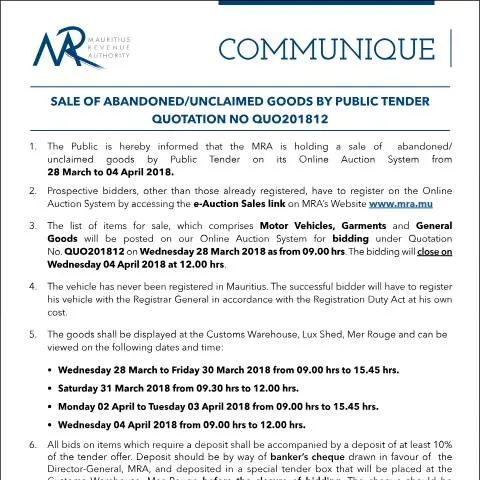
In the context of Mauritius' ever-evolving regulatory landscape, the Form CommuniqueQ12of2018 plays a crucial role in the management of abandoned and unclaimed goods. This official document, issued by the Mauritius Revenue Authority (MRA), outlines the procedure for participating in public tenders for these goods. Understanding this form is essential for potential bidders, as it not only facilitates access to unique opportunities but also entails a set of responsibilities that must be carefully navigated.
Navigating the Tender Process: A Step-by-Step Guide
For those who wish to engage in the tendering process for abandoned or unclaimed goods, it is vital to comprehend the chronological steps involved. The entire process unfolds from initial registration to the final bidding submission.
- Initial Registration: Interested bidders must first register on the Online Auction System managed by the MRA. This can be accomplished by accessing the e-Auction Sales link on the MRA's website.
- Review of Goods: Following successful registration, bidders should examine the list of available items, which includes various categories such as motor vehicles, garments, and general goods. This list will be made available on the Online Auction System starting from 09:00 hrs on 28 March 2018.
- Viewing Period: It's advisable for prospective bidders to visit the Customs Warehouse at Mer Rouge during the designated viewing days, allowing them to inspect the goods before placing bids.
- Placing Bids: Bidding opens on 28 March and closes on 04 April 2018 at 12:00 hrs. Bidders must ensure their offers are competitive.
- Submission of Deposits: For items requiring deposits, a minimum of 10% of the tender offer must accompany the bid in the form of a banker’s cheque, placed in a designated tender box.
Critical Dates: A Timeline for Bidders
The timeline associated with the CommuniqueQ12of2018 is integral to ensuring that all participants are aligned with the requirements and deadlines. Here’s a detailed breakdown:
| Date | Event |
|---|---|
| 28 March 2018 | Opening of the bidding process at 09:00 hrs. |
| 30 March 2018 | Last day for good viewing from 09:00 hrs to 15:45 hrs. |
| 31 March 2018 | Viewing available from 09:30 hrs to 12:00 hrs. |
| 02-03 April 2018 | Final viewing days from 09:00 hrs to 15:45 hrs. |
| 04 April 2018 | Bid submission closes at 12:00 hrs. |
Understanding the Bidding Requirements and Procedures
Once a bidder has decided to participate, it is essential to be aware of the specific requirements outlined in the Communique. These requirements ensure a fair and orderly auction process.
- Deposit Requirements: All bids on items requiring a deposit must include at least 10% of the tender offer, payable via a banker’s cheque made out to the Director-General of the MRA. Personal cheques will not be accepted.
- Identification: Visitors attending the viewing or bidding events are required to present their Identity Cards for security purposes.
What If You Encounter Issues? Handling Errors and Missing Documentation
In the event of complications such as missing documents or errors in the submission, it is crucial for bidders to understand their recourse options. Potential scenarios may include:
- Missing Deposit: If a deposit is not submitted with the bid, that bid will be disqualified. It is imperative to double-check the completeness of all submissions before the deadline.
- Errors in Bidding: Should a bidder realize an error in their submitted bid, they should immediately contact the MRA for guidance. Depending on the situation, it may be possible to amend the bid, although this is at the discretion of the authority.
Comparing Similar Forms: What Makes Form CommuniqueQ12of2018 Unique?
While there are various forms associated with the MRA and public tenders, CommuniqueQ12of2018 holds specific characteristics that set it apart. Understanding these differences can prevent confusion and ensure compliance.
| Form/Procedure | Purpose | Unique Aspects |
|---|---|---|
| Form CommuniqueQ12of2018 | Sale of abandoned/unclaimed goods | Public tender format with deposit requirement |
| LGSC Form 7 | Local government service recruitment | Focus on employment and public service roles |
| PSC Form 7 | Public service recruitment and applications | Application for civil service positions |
Post-Tender Process: What Happens After Bidding?
After the bidding process concludes, successful bidders must navigate a series of next steps to finalize their acquisition of goods:
- Notification of Winning Bids: The MRA will notify bidders of their success post-closing of bids.
- Payment Procedures: Winning bidders are responsible for making payments as per the terms set forth in the tender documents.
- Registration of Vehicles: For motor vehicles, the successful bidder must register their vehicle with the Registrar General under the Registration Duty Act.
- Collection of Goods: Bidders must collect their purchased goods from the designated Customs Warehouse within the stipulated timeframe set by the MRA.
Preparing Supporting Documentation for Success
A smooth tendering process hinges on adequately preparing your supporting documents. Here’s a checklist to ensure that every aspect is covered:
- Identity Documents: Ensure your Identity Card is ready for presentation during the bidding and collection phases.
- Banker’s Cheque: Make arrangements for obtaining a banker’s cheque for the required deposit to avoid last-minute complications.
- Contact Information: Provide accurate contact details during registration to facilitate smooth communication with the MRA.
Engaging with the tender process for abandoned and unclaimed goods through the CommuniqueQ12of2018 can present a unique opportunity for individuals looking to acquire valuable items. By understanding the nuances of the form and the process it governs, potential bidders can navigate the complexities with confidence and foresight.
Legal Framework Governing the Sale of Abandoned or Unclaimed Goods
The sale of abandoned or unclaimed goods in Mauritius is primarily governed by the provisions outlined in the Public Procurement Act and relevant regulations stipulated for public tenders. Under these legal frameworks, it is crucial for entities involved in the disposal of such goods to adhere to strict guidelines ensuring transparency, fairness, and accountability throughout the process. The Public Procurement Act provides essential definitions, procedures, and responsibilities for various stakeholders engaged in the sale of unclaimed goods.
Particularly, Section 4 of the Act mandates that public bodies must ensure that the tender process is conducted in a manner that is competitive and open, allowing for maximum participation from potential bidders. This aligns with the principles of good governance, as outlined in the Constitution of Mauritius, reinforcing the need for statutory compliance in all procurement activities.
Moreover, public entities must also consult the directives issued by the Ministry of Finance and Economic Development. These guidelines specify the necessary actions to be taken to ensure that the abandoned goods are appropriately cataloged, valued, and advertised to attract potential buyers. It is important to note that local government bodies, in addition to general requirements, may have specific stipulations under the Local Government Act, particularly pertaining to goods that have been abandoned on public property.
Process of Selling Abandoned Goods through Public Tender
The process for selling abandoned or unclaimed goods via public tender in Mauritius involves several well-defined stages to ensure both compliance with legal requirements and to maximize the recovery of asset value for the government or local authority involved.
1. Identification and Inventory: The first step involves identifying the abandoned or unclaimed goods in question. This process typically includes compiling a detailed inventory, which should document the nature, condition, and estimated value of each item. It is advisable for the responsible entity to conduct comprehensive assessments, possibly involving professional appraisers, to accurately reflect the value of the items to avoid undervaluation.
2. Public Notification: Following the inventory process, public notification is a crucial aspect. The entity must advertise the upcoming tender extensively, which may include announcements in local newspapers, online platforms, and through official government channels. Such announcements should clearly specify the date, time, and location of the tender, as well as provide detailed instructions on how interested parties can participate.
3. Tender Submission: Interested bidders must prepare their submissions as per the guidelines provided, which often include the completion of specific tender forms (e.g., Tender Form 1), submission of deposits, and compliance with any stipulated conditions. The deadline for submissions should be clearly stated, and late submissions typically are not considered.
4. Evaluation and Award: Once the tender submissions are received, a dedicated evaluation committee is responsible for assessing each bid based on criteria such as price, financial standing, and compliance with tender requirements. It is crucial for the committee to maintain impartiality and document their decision-making process adequately. After evaluation, the successful bidder is notified, and an award notification is issued.
Fill in your form directly online
No printing: type your details into the boxes of the official form, tick, then download the PDF ready to send.
- 1Type into the form boxes
- 2Tick in one click
- 3Save and download the PDF
5. Transaction and Transfer of Ownership: Finally, upon successful completion of the tender process, the ownership of the abandoned goods is formally transferred to the successful bidder. This requires the execution of a sale agreement that details the terms of sale, including payment schedules and conditions for collection. The financial transaction is typically managed through a designated account, ensuring all proceeds are accurately recorded and reported as required by the MRA and other relevant authorities.
Challenges and Best Practices in the Sale of Unclaimed Goods
While the framework and processes surrounding the sale of abandoned or unclaimed goods are well-outlined, various challenges can arise that may hinder effective execution. Understanding these challenges is essential for public entities to develop best practices that can improve the efficiency and transparency of the process.
1. Legal and Regulatory Compliance: One of the most significant challenges is ensuring compliance with legal and regulatory requirements. Entities must remain updated on changes to laws and regulations to avoid possible disputes or legal challenges post-sale. Regular training and workshops for procurement officers can enhance their understanding of the procedural and compliance aspects of the sale of unclaimed goods.
2. Transparency and Public Trust: Public confidence in the tendering process is paramount. To enhance transparency, public authorities should provide detailed feedback to unsuccessful bidders and clarify the reasons for their non-selection. Implementing a public audit mechanism can also help in reinforcing accountability and credibility in the procurement process.
3. Market Fluctuations: The value of goods can fluctuate significantly based on market demand. Public entities should consider using more dynamic valuation methods, possibly leveraging online platforms for real-time market analysis, to set reserve prices that reflect current market conditions. This can enhance the potential revenue generated from the sale of abandoned goods.
4. Engagement with Bidders: Building relationships with potential bidders can help to increase participation in tenders. Public authorities may consider hosting open forums or information sessions to explain their tendering processes and engage with the community. This proactive approach can demystify the tender process and encourage greater public involvement.
5. Utilization of Technology: Embracing technology can streamline many aspects of the tendering process. Utilizing e-tendering platforms allows for greater accessibility and can simplify bid submission and evaluation. Additionally, maintaining an online inventory of unclaimed goods can keep potential bidders informed and engaged.