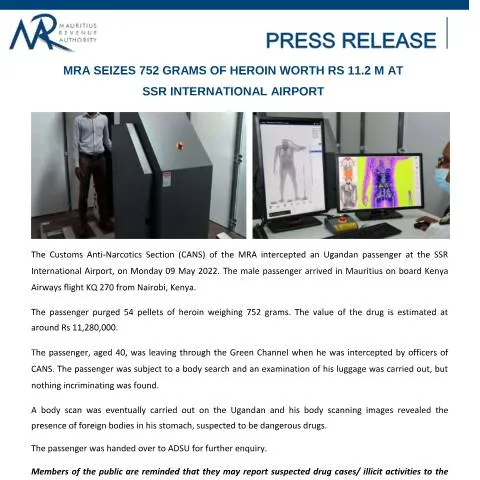
Contextualizing the Official Press Release on Narcotics Interception
The recent press release issued by the Mauritius Revenue Authority (MRA) shedding light on the interception of heroin at SSR International Airport is not merely an announcement; it serves as a critical document in the fight against drug trafficking in Mauritius. On 21 May 2022, the MRA detailed how Customs Anti-Narcotics Section (CANS) officials successfully seized 752 grams of heroin, valued at approximately Rs 11.2 million, from an Ugandan passenger traveling from Nairobi, Kenya. This incident highlights the diligence of law enforcement agencies and the importance of public cooperation in combating illicit drug activities.
Decoding the Significance of This Document
This official press release plays a multifaceted role in the broader context of Mauritius' national security and public health policies. It not only informs the public about specific narcotics-related incidents but also raises awareness regarding the severity of drug-related crimes. Additionally, it underscores the efficacy of surveillance and customs operations at the airport, aiming to bolster public confidence in government institutions. The release serves several purposes:
- Public Awareness: The document draws attention to the ongoing drug trafficking issues, encouraging vigilance within the community.
- Reporting Mechanisms: It emphasizes how individuals can report suspicious activities, reinforcing community involvement in law enforcement.
- Deterrent Effect: By publicizing successful interceptions, the MRA aims to deter potential traffickers by highlighting the risks involved.
Who is Responsible for Submitting Corresponding Documentation?
In cases of narcotics interception like the one reported, the documentation is primarily managed by law enforcement agencies, specifically the MRA and the Anti-Drug and Smuggling Unit (ADSU). However, laypersons can also play a crucial part by reporting any suspicious activities to the authorities. The roles are as follows:
- MRA Officials: They process and archive press releases, which detail findings, measures taken, and public safety advisories.
- Law Enforcement Agencies: ADSU conducts follow-up investigations and may initiate further actions against suspects.
- Citizens: The public can report drug-related activities through the MRA Stop Drug Platform or the dedicated hotline.
Understanding the Procedure Following a Drug Seizure
Each interception of illegal substances initiates a specified sequence of procedures governed by Mauritian law. The following steps outline the typical process that unfolds after a drug seizure, as evidenced in the case of the Ugandan passenger:
| Step | Description |
|---|---|
| 1. Initial Interception | Officers conduct a preliminary search based on profiling and suspicious behavior. |
| 2. Body Scan | If necessary, a body scan is performed to check for concealed illicit substances. |
| 3. Legal Proceedings | Should incriminating evidence be found, the individual is placed into custody for further investigation. |
| 4. Public Notification | The MRA issues a public press release summarizing the incident and outcomes. |
| 5. Investigation Follow-up | ADSU investigates further, gathering evidence and witness statements for possible legal actions. |
Essential Documentation and Public Reporting Mechanisms
When publicizing incidents of drug seizures, the MRA encourages community involvement by providing clear avenues for reporting suspicious activities. The following documentation and channels are relevant:
- MRA Stop Drug Platform: An online facility where citizens can report drug-related activities anonymously.
- Hotline Number: A dedicated line, 8958, available for immediate reporting of drug trafficking or suspicious behavior.
- Awareness Campaigns: Regular educational initiatives aimed at informing the public about recognizing and reporting drug-related issues.
Challenges Faced in Drug Enforcement and Reporting
Despite the rigorous measures in place, challenges persist in drug enforcement. The MRA's press release serves not only as a record of success but also as a reminder of the complexities involved in counter-narcotics operations. These challenges include:
- Concealment Techniques: Traffickers are continually developing new methods to evade detection, which complicates interception efforts.
- Resource Allocation: Limited resources can hinder the extent of surveillance and enforcement operations.
- Public Cooperation: The success of drug enforcement depends significantly on the willingness of citizens to report suspicious activities.
The Road Ahead: Continuous Improvement and Community Engagement
As Mauritius navigates the challenges of drug trafficking, continuous improvement in its strategies and community engagement will be crucial. The MRA aims to enhance its operational capabilities through the following means:
- Training Programs: Regular training for officers on the latest detection techniques and legal updates.
- Public Information Campaigns: Ongoing efforts to educate the public about the dangers of drugs and the importance of reporting suspicious activities.
- Partnerships: Collaboration with international law enforcement agencies to share intelligence and resources.
How to Stay Informed and Contribute to Drug Prevention Efforts
Staying informed about drug-related issues and contributing to community safety is vital for all Mauritians. Here are some practical ways individuals can engage:
- Participate in Workshops: Engage in community workshops organized by local authorities or NGOs focused on drug awareness.
- Utilize Reporting Channels: Familiarize yourself with MRA’s Stop Drug Platform and use it proactively to report suspicious activities.
- Support Local Initiatives: Get involved with local organizations working on drug prevention and rehabilitation programs.
This official document by the MRA is more than a record of an event; it encapsulates the ongoing struggle against narcotics trafficking in Mauritius. By understanding its implications, roles, and reporting mechanisms, citizens can better engage in the fight against drugs and contribute to their community's safety and security.
Understanding the Impact of Drug Seizures on Local Communities
The seizure of 752 grams of heroin valued at Rs 11.2 million at Sir Seewoosagur Ramgoolam International Airport (SSRIA) is not just a simple law enforcement success; it also reflects the wider implications of drug trafficking on Mauritian society. Drug trafficking has significant socioeconomic impacts, affecting everything from public health to local crime rates.
Communities devastated by drug abuse often witness a rise in crime, increased healthcare costs, and a breakdown of family structures. It is essential for local authorities, including the Mauritius Revenue Authority (MRA) and the Police Force, to collaborate with healthcare providers and community organizations. These partnerships can facilitate programs focused on rehabilitation and education, enabling communities to recover from the negative impacts of drug-related issues.
Moreover, public awareness initiatives can play a crucial role in preventing drug abuse by educating citizens, particularly the youth, about the dangers of drugs. The MRA's efforts to intercept and prevent drug trafficking are vital, but addressing the root causes of drug abuse is equally important. This requires a multi-faceted approach that goes beyond law enforcement and engages community stakeholders for a holistic solution.
The Role of Technology in Combating Drug Trafficking
As global drug trafficking networks become increasingly sophisticated, the role of technology in combating such activities cannot be overstated. The MRA's effective seizure of a substantial quantity of heroin at SSR International Airport illustrates the importance of modern technological methods in customs and border protection. Surveillance systems, advanced scanning technologies, and data analytics play crucial roles in identifying suspicious activities and patterns.
For instance, the integration of artificial intelligence (AI) in drug detection processes can enhance the identification of potentially harmful substances. Moreover, the use of drones and automated systems can help authorities monitor remote areas that are often exploited by traffickers. These technological advancements offer significant advantages in accuracy and efficiency, allowing law enforcement agencies to stay one step ahead of traffickers.
Fill in your form directly online
No printing: type your details into the boxes of the official form, tick, then download the PDF ready to send.
- 1Type into the form boxes
- 2Tick in one click
- 3Save and download the PDF
Additionally, the MRA has been investing in training its officers to utilize these technological tools effectively. Continuous updates on the latest trends in drug trafficking and related criminal activities are also essential. This knowledge equips officers to better anticipate and respond to emerging threats. As such, leveraging technology is crucial to enhancing the capabilities of the MRA and other law enforcement agencies in safeguarding the nation.
Legal Framework Surrounding Drug Seizures in Mauritius
The legal framework governing drug seizures in Mauritius is integral to the efficacy of the MRA and law enforcement agencies in managing incidents involving illicit substances. The Dangerous Drugs Act, which categorizes drugs and prescribes penalties for violations, serves as the cornerstone of this legal framework. This legislation empowers authorities to take necessary actions in relation to drug enforcement and to prosecute offenders.
Upon the seizure of drugs like heroin, the MRA is responsible for documenting the evidence meticulously. This includes detailing the circumstances surrounding the seizure, tracking the chain of custody, and ensuring that all procedures align with the legal requirements. Such thorough documentation is crucial in court proceedings, where the prosecution must demonstrate that the seizure was lawful and well-founded.
Furthermore, the legal process involves various stakeholders, including the judiciary, which plays a critical role in adjudicating drug-related cases. The courts are tasked with interpreting and enforcing the law, ensuring that justice is served while also considering rehabilitation options for first-time offenders. In addition, legal safeguards are essential to protect the rights of individuals involved in drug-related offenses, thereby maintaining the balance between enforcement and civil liberties.
In conclusion, the legal framework surrounding drug seizures in Mauritius is complex and multifaceted. It encompasses not only the enforcement of legislation but also the broader implications for individuals and society at large. Continued reviews and amendments to existing laws may be necessary to adapt to the evolving nature of drug-related crimes while ensuring public safety and justice.