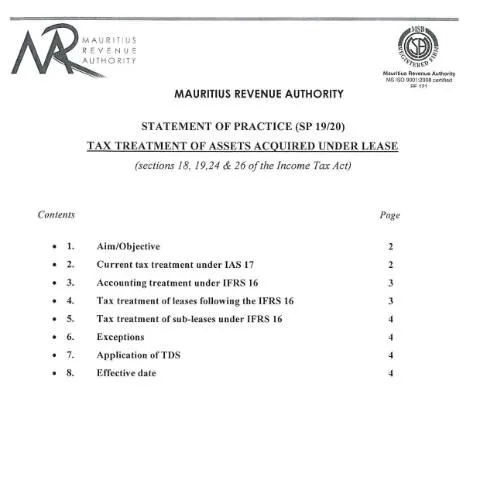
Navigating the Complexities of SP 19/20: Tax Treatment of Assets Acquired Under Lease
In the ever-evolving landscape of tax regulations, the Statement of Practice (SP 19/20) provided by the Mauritius Revenue Authority (MRA) stands as a pivotal document for businesses and individuals dealing with assets obtained through leasing. Understanding this document is crucial, as it orchestrates the tax treatment of assets acquired under lease agreements, ensuring compliance while optimizing financial outcomes. This article explores the intricate details of SP 19/20, including its role, the correct process for filling it out, and its implications for lessees and lessors alike.
Unpacking the Foundation: The Legal Context of SP 19/20
The SP 19/20 is anchored in the broader legal framework of Mauritius, governed by the Income Tax Act. Specifically, this document clarifies the applications of sections 18, 19, 24, and 26 of the Act, which regulate the treatment of leased assets. The transition from International Accounting Standard (IAS) 17 to International Financial Reporting Standard (IFRS) 16 necessitated the update reflected in SP 19/20.
Key Factors Influencing the Document:
- The adoption of IFRS 16 as of January 1, 2019, reshaping how entities account for leases.
- Aimed at enhancing transparency and comparability, the IFRS 16 has removed the distinction between operating and finance leases for lessees.
- The SP guides users through the shifts in tax treatment that accompany these accounting changes.
Who Needs to Engage with SP 19/20?
This document is particularly relevant for:
- Lessees: Businesses or individuals leasing assets who must understand their tax obligations regarding both operating and finance leases.
- Lessors: Entities providing leased assets that need to navigate their tax implications under the updated standards.
- Tax Consultants: Professionals who assist clients in maintaining compliance with taxation laws and optimizing tax strategies.
Breaking Down the Document: What’s Inside SP 19/20?
SP 19/20 comprises several crucial sections that break down the framework for tax treatment of leased assets. Each section serves a distinct purpose and requires careful attention when completing the relevant forms.
1. Aim and Objectives
This section sets the stage for the operational context of SP 19/20. It specifies that the aim is to clarify the tax treatment for assets obtained under lease, providing a framework for compliance and aiding in accurate reporting.
2. Current Tax Treatment Under IAS 17
Understanding how the tax treatment was structured under IAS 17 holds significance for those transitioning to IFRS 16. It delineates the tax obligations concerning:
| Classification of Lease | Current Tax Treatment for Lessor | Current Tax Treatment for Lessee |
|---|---|---|
| Operating Lease | Subject to tax when lease income accrues. Annual allowance permitted. | Contractual lease payments can be claimed as deductions. |
| Finance Lease | Not allowed to claim annual allowance; taxed on interest income. | Annual allowance allowed; principal repayment not deductible. |
3. Accounting Treatment Under IFRS 16
The transition to IFRS 16 introduces a single lessee accounting model, fundamentally altering how leases are recorded. This section emphasizes:
- The necessity for lessees to recognize a Right of Use (ROU) asset.
- The implications of lease liabilities that reflect the obligation to make lease payments.
- The depreciation of the ROU asset over the lease term.
4. Tax Treatment of Leases Following IFRS 16
This portion of SP 19/20 offers a concise guide on the distinct tax treatments applicable under the new IFRS regime:
- By Lessor: Maintains previous tax treatment, allowing for continuity in tax obligations.
- By Lessee: Must now determine the relevance of finance leases versus operating leases based on how they are classified under IFRS 16.
5. Potential Exceptions and Considerations
This section directs attention to specific exceptions that may apply, especially for short-term leases or those involving low-value assets. Understanding these nuances can significantly impact tax reporting and compliance.
The Process: Filling Out SP 19/20
Filling out the SP 19/20 form requires meticulous attention to detail. Here's a step-by-step guide to ensure compliance:
Step 1: Gather Necessary Documents
- Lease agreements detailing the terms and conditions.
- Financial statements that outline the implications of the lease on the balance sheet.
Step 2: Complete the Form Accurately
Each section of the form must be completed with precision:
- Ensure all lease classifications are correctly identified.
- Apply the correct tax treatment based on the lease type, as delineated in SP 19/20.
Step 3: Submit the Form
Once completed, the form should be submitted to the relevant authorities within the stipulated timeframes to avoid penalties and ensure compliance.
Implications of Non-compliance: What’s at Stake?
Failing to adhere to the requirements outlined in SP 19/20 can have serious repercussions:
- Financial Penalties: Non-compliance may lead to significant fines imposed by the MRA.
- Legal Consequences: In extreme cases, issues related to tax evasion may arise, leading to legal action.
- Loss of Credibility: Companies may find their reputations tarnished, impacting future business prospects.
Looking Ahead: The Future of Leasing and Tax Treatment in Mauritius
The SP 19/20 lays the groundwork for future enhancements in tax treatment related to leases. As Mauritius continues to adapt to international standards, staying abreast of these developments is vital for businesses.
Leasing remains a popular method of asset acquisition, and understanding the regulatory environment surrounding tax treatment will empower lessees and lessors to make informed decisions.
The ongoing dialogue between the MRA and stakeholders will likely lead to further refinements in the process, making compliance easier and more efficient over time.
A Final Word: The Importance of Expertise
Engaging with SP 19/20 requires not only careful attention to detail but also a deep understanding of the underlying regulatory framework. It is advisable to consult with tax professionals who can provide insights tailored to specific situations, ensuring compliance while maximizing the benefits associated with leasing assets.
In navigating the complexities of leasing and tax treatment, staying informed and proactive can make all the difference in achieving favorable outcomes.
Understanding the SP 19/20 Framework for Public Sector Recruitment
The SP 19/20 framework is a critical component of public sector recruitment and administration in Mauritius. It outlines the guidelines and procedures for filling vacancies within the public service and local government sectors. Understanding the nuances of this framework is essential for applicants, as it dictates the eligibility criteria, the application process, and the assessment methodologies used by the Public Service Commission (PSC) and Local Government Service Commission (LGSC).
Fill in your form directly online
No printing: type your details into the boxes of the official form, tick, then download the PDF ready to send.
- 1Type into the form boxes
- 2Tick in one click
- 3Save and download the PDF
In essence, the SP 19/20 framework aims to streamline the recruitment process, ensuring transparency, fairness, and equal opportunity for all candidates. Applicants must be aware that recruitment is governed not only by the PSC Act 1955 and the principles of meritocracy, but also by the overarching goal of fostering a diverse and inclusive workforce. Therefore, understanding the specific recruitment cycles, which typically align with the fiscal year (1 July – 30 June), becomes paramount.
Moreover, candidates must keep in mind that specific criteria may vary between different positions and departments. For instance, roles in technical fields may require additional qualifications or experience compared to administrative positions. Hence, prospective applicants are encouraged to thoroughly review the job descriptions listed on the official PSC and LGSC portals before applying.
Furthermore, it is pertinent for applicants to familiarize themselves with the online application system, which is linked to the MauPass single-sign-on feature associated with the National ID Card. This not only ensures a secure method of submitting applications but also allows for easy tracking of application status post-submission.
Additional resources, including informational webinars and guidance documents, are often made available during the recruitment periods, providing invaluable insights into the expectations and requirements of the application process.
Key Documentation and Supporting Materials Required for SP 19/20 Applications
When applying under the SP 19/20 framework, understanding the necessary documentation is crucial for a successful application. Applicants are often required to submit a comprehensive set of documents to substantiate their qualifications and to comply with the administrative requirements set by the PSC and LGSC.
Typically, the following documents are required:
- Application Form: Candidates must complete the relevant application form, such as PSC Form 7 or LGSC Form 7a, ensuring all information is accurate and up-to-date.
- Curriculum Vitae (CV): A detailed CV that outlines educational qualifications, professional experience, and relevant skills is essential. Ensure that it adheres to any specific formatting guidelines provided by the PSC or LGSC.
- Certified Copies of Educational Certificates: Applicants must provide certified copies of their educational qualifications, which may include diplomas, degrees, and other relevant certificates. It is advisable to have these documents certified by a recognized authority to ensure authenticity.
- Identity Verification: A copy of the National Identity Card or a valid passport is typically required. This serves to verify the identity of the applicant and confirm eligibility for public sector employment.
- Recommendation Letters: While not always mandatory, letters of recommendation from previous employers or educational institutions can enhance an applicant’s profile and demonstrate their suitability for the position.
- Additional Documentation: Depending on the role, there may be additional documents required, such as proof of previous employment, professional licenses, or specialized training certificates. It is advisable to consult the specific job announcement for any additional requirements.
It is crucial to submit all required documentation by the specified deadlines to avoid disqualification from the recruitment process. Submissions are typically made electronically through the government portal, and applicants must ensure that all files are correctly uploaded and formatted according to the guidelines provided.
Moreover, applicants should keep copies of all submitted documents and confirmations for their records. In the event of any discrepancies or follow-up inquiries, having these records will facilitate smoother communication with the PSC or LGSC.
Given the competitive nature of public sector positions, ensuring that all documentation is complete and accurately reflects the applicant's qualifications plays a significant role in enhancing one’s chances of success.