Navigating the Annual Return of a Deceased Person’s Estate: A Step-by-Step Guide
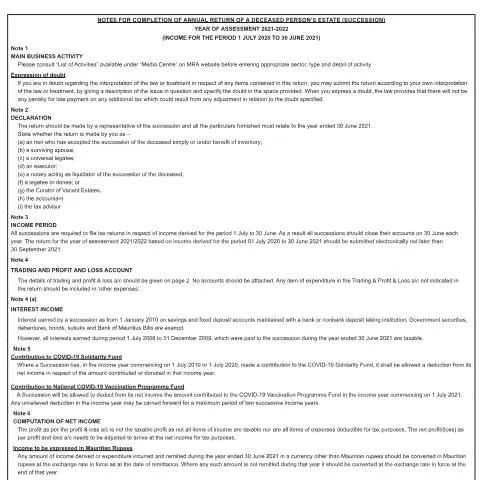
The process of managing a deceased person’s estate can be daunting, especially when it comes to submitting the Annual Return of the estate for the year 2021/2022. Engaging with the Mauritius Revenue Authority (MRA) requires thorough understanding and precise execution to ensure compliance and avoid penalties.
In Mauritius, the return covers income for the period 1 July 2020 to 30 June 2021, and it must be submitted electronically by 30 September 2021. Let’s delve into the intricacies of this document, exploring who is responsible for filing, how to accurately complete it, and the implications of various scenarios.
The Role of the Return: Clarifying Responsibilities
This return is not just a bureaucratic formality; it serves as a critical accountability tool for the representatives of the deceased's estate. The responsibility of filing lies with individuals such as heirs, surviving spouses, executors, and notaries. Each role comes with unique obligations regarding the information disclosed in the return.
- Heirs: They must indicate if they accept the succession simply or under inventory.
- Surviving Spouse: They are permitted to file on behalf of the estate, clarifying their relationship to the deceased.
- Executors and Notaries: Often serve as the primary point of contact in ensuring the estate is settled in accordance with the law.
Understanding the Classification of Income
It is essential to accurately declare the income derived during the specified period. Familiarising oneself with the classification of income will streamline the completion of the return. The MRA provides a “List of Activities” that can help identify the appropriate sector for the income generated by the estate.
The income declaration should align with the business activities carried out during the fiscal year, as this will determine tax obligations and potential deductions.
Filling Out the Form: Best Practices for Accuracy
Completing the return accurately is imperative to avoid unwanted penalties or complications. Here are several tips to assist in the correct filling of the Annual Return:
- Gather Documentation: Collect all relevant financial records, including income statements, bank statements, and investment records. These documents will provide a clear overview of the estate’s financial status.
- Use the Correct Format: Ensure that monetary values are expressed in Mauritian Rupees (MUR). If income or expenses were in another currency, conversion at the appropriate exchange rates is required.
- Declare All Income: Even income from exempt sources like dividends must be accounted for, while ensuring that related expenses are accurately recorded.
- Profits and Losses: Include a detailed profit and loss account on the designated page, but refrain from attaching additional accounts.
Addressing Income Periods and Relevant Dates
All estates need to adhere to the accounting year ending on 30 June. Understanding this timeline is crucial, as it dictates when income is recognized and assessed for tax purposes. The return for 2021/2022, based on the income from 1 July 2020 to 30 June 2021, must be submitted electronically, highlighting the push for digital compliance.
The specified completion date of 30 September 2021 is non-negotiable, and missing this deadline could result in penalties.
The Implications of Income Type on Taxation
It is vital to differentiate between the types of income, as this affects taxation significantly. For instance, interest income generated from certain accounts established post-2010 is generally exempt from taxation. However, income accrued from before this period may still be liable.
| Income Type | Tax Status | Notes |
|---|---|---|
| Interest Income Post-2010 | Exempt | Applicable on savings and fixed deposits. |
| Interest Income Pre-2010 | Taxable | Tax must be paid on income received during the year ended 30 June 2021. |
| Dividends | Exempt | Expenses related to generating this income must be added back. |
Managing Deductions: Contributions and Exemptions
Understanding what deductions can be claimed is vital for an accurate return. Two key contributions to consider are:
- COVID-19 Solidarity Fund: Contributions made in the income year beginning on 1 July 2019 or 1 July 2020 can be deducted from net income.
- Vaccination Programme Fund: Contributions to this fund during the income year beginning on 1 July 2021 are also deductible.
These allowable deductions can significantly reduce taxable income, hence improving the overall tax position of the estate.
Potential Challenges: Errors and Missing Documents
One of the most common pitfalls is the submission of incomplete or incorrect information. If errors are discovered after submission, it is advisable to consult directly with the MRA for guidance on rectifying filings. Documentation supporting the return is critical; if necessary, additional documents can be requested during the review process.
In the event that the return is refused or a penalty is imposed, the representative should be prepared to provide a clear explanation or amendment. Expressing uncertainties during the filing by including a description in the designated area can safeguard against late penalties on additional taxes that may arise from interpretations.
Consequences of Non-Compliance
Failure to submit the return on time or providing incorrect information can lead to financial penalties and legal ramifications. It is imperative to maintain diligent records and consult with a tax advisor if complexities arise. Understanding the obligations ensures compliance and protects the estate’s value from unnecessary taxation or penalties.
The Bigger Picture: The Role of the Annual Return in Estate Management
While completing the Annual Return of a Deceased Person’s Estate might seem like a solitary task, it is part of a larger framework of estate management and taxation in Mauritius. The return not only provides financial transparency but also ensures that the deceased’s wishes are honored in the distribution of assets.
Representatives must view this form as a pivotal component in settling the estate and should maintain ongoing communication with financial institutions, tax advisors, and legal representatives to navigate the complexities involved. Each step taken in accurately completing this form contributes to a smoother transition of the estate to the rightful heirs.
Final Tips for Successful Submission
Here are some effective strategies to conclude the filing process successfully:
- Start Early: Begin collecting documents and preparing the return well in advance of the 30 September deadline.
- Seek Professional Guidance: Engage with a tax advisor for clarity on specific issues or uncertainties regarding income interpretation.
- Double-Check Information: Ensure all figures are correctly represented, and that the return corresponds accurately with supporting documentation.
By adhering to these guidelines, individuals responsible for submitting the Annual Return can navigate the complexities of estate management effectively, ensuring compliance and honoring the legacy of the deceased.
Understanding the Mauritian Education System: Key Reforms and Policies (2021-2022)
The education system in Mauritius has undergone significant transformations in recent years, particularly during the 2021-2022 academic years. The government has focused on enhancing accessibility, quality, and relevance of education to meet the demands of a rapidly changing global economy. The implementation of the Nine-Year Schooling (NYS) policy, aimed at providing inclusive education for all, has been a cornerstone of these reforms.
One of the major initiatives was the introduction of a new curriculum framework that emphasizes critical thinking, creativity, and lifelong learning. Schools were encouraged to integrate technology into their teaching methodologies, ensuring that students are equipped with the necessary digital skills for the future. The Ministry of Education has also prioritized teacher training programs to ensure educators possess the skills required to deliver this new curriculum effectively.
Moreover, increased funding for vocational education and training (VET) has been established, aligning educational outcomes with labor market needs. The aim is to bridge the skills gap that has persisted in various sectors. Partnerships with private industries have been fostered to enhance internship opportunities for students, which can lead to better employment prospects post-education.
In 2022, the government launched the National Digital Education Strategy, focusing on providing digital resources and infrastructure to schools, especially in rural areas. This initiative is part of a broader plan to ensure equitable access to quality education across the nation. By investing in e-learning platforms and digital tools, the Mauritian education sector strives to modernize and adapt to the challenges posed by the COVID-19 pandemic and beyond.
Fiscal Management and Economic Strategies: Navigating Recovery Post-COVID-19 (2021-2022)
The economic landscape in Mauritius has seen notable changes in the wake of the COVID-19 pandemic, with the fiscal management strategy for 2021 and 2022 focused heavily on recovery and sustainability. The government’s approach involved implementing a series of stimulus packages aimed at revitalizing key sectors such as tourism, agriculture, and manufacturing, which were heavily impacted during the pandemic.
In 2021, the introduction of the “Economic Recovery Plan” set forth specific measures designed to stimulate growth and attract foreign investments. One of the key components of this plan was the provision of tax incentives for businesses, encouraging them to innovate and expand. The Mauritius Revenue Authority (MRA) played a pivotal role in this process by simplifying tax compliance and enhancing e-filing systems, making it easier for businesses to operate efficiently in a digital-first environment.
The government also placed significant emphasis on sustainable practices, incorporating green technologies and promoting environmental sustainability within its economic recovery framework. This was evidenced by the launch of initiatives focused on renewable energy and sustainable tourism practices, aligning with global efforts towards climate change mitigation.
Financial literacy programs were intensified as part of a nationwide effort to educate citizens about responsible financial management, especially in light of the economic uncertainties spurred by the pandemic. This initiative was crucial in ensuring that individuals and businesses could make informed decisions, thereby enhancing the overall economic resilience of the nation.
Enhancing Public Health: Responses to Global Health Challenges (2021-2022)
Public health initiatives in Mauritius during 2021 and 2022 were primarily shaped by the challenges brought on by the COVID-19 pandemic. The Ministry of Health and Wellness implemented a comprehensive response strategy to safeguard the population and manage public health effectively. This involved enhanced surveillance systems, widespread vaccination campaigns, and public health education aimed at minimizing the spread of the virus.
Throughout 2021, as vaccines became available, the government prioritized vaccination for frontline workers, vulnerable populations, and eventually extended eligibility to the general public. The launch of the national vaccination drive was crucial in restoring confidence within the country, ensuring that businesses could operate safely and that schools could resume regular activities.
In parallel, the government also focused on strengthening healthcare infrastructure by investing in hospitals and health centers, particularly in rural and underserved areas. The aim was not only to address immediate needs due to the pandemic but also to enhance the overall capacity of the healthcare system to respond to future health emergencies.
Mental health emerged as a significant focus during this period, with various campaigns aimed at raising awareness and reducing stigma associated with mental health issues. The government collaborated with non-governmental organizations (NGOs) to provide support services, counseling, and resources to individuals affected by the socio-economic stresses brought about by the pandemic.
By the end of 2022, the emphasis shifted toward building a resilient health system capable of responding to future challenges, with a focus on holistic health strategies that included preventive care, healthy lifestyles, and mental well-being as integral components of public health policy.