The Critical Role of the Annual Income Return in Tax Compliance
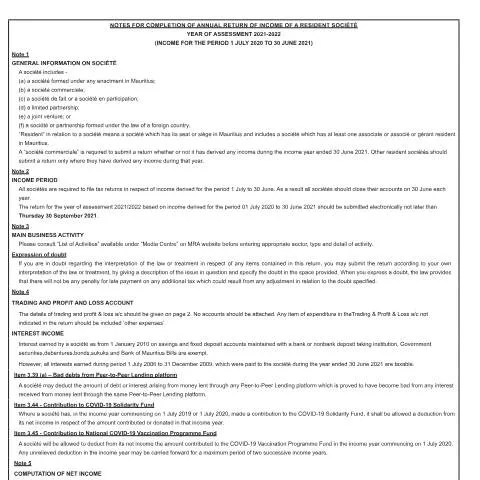
Filing an Annual Return of Income is a pivotal obligation for resident sociétés in Mauritius, particularly for the year of assessment 2021-2022. This document ensures that sociétés report their earnings derived from the financial period spanning from 1 July 2020 to 30 June 2021. The completion and submission of this return are mandatory for maintaining compliance with tax regulations, and understanding its nuances is essential for every business entity operating in the region.
Who is Responsible for Filing?
The responsibility to submit the Annual Return of Income falls on all resident sociétés. This classification encompasses a variety of entities including:
- Sociétés formed under Mauritian laws
- Commercial sociétés
- Sociétés de fait or sociétés en participation
- Limited partnerships
- Joint ventures
- Sociétés formed under foreign laws but operating in Mauritius
It is crucial to note that while all sociétés must file a return, only those that have derived income during the specified period are required to submit comprehensive details, whereas other entities may submit minimal information establishing their status.
Understanding the Filing Timeline
The filing deadline is set for 30 September 2021, marking the end of the submission window for the annual return for the 2021-2022 assessment. This tight timeline necessitates a well-informed and timely approach to ensure compliance. Any business entity failing to meet this deadline may subject itself to penalties or complications related to its tax obligations.
Document Completion: A Step-by-Step Guide
Completing the Annual Return of Income involves meticulous attention to detail. Here’s how to approach filling out the document effectively:
- Identification of Main Business Activity: Before commencing with the form, it is advisable to consult the “List of Activities” available on the MRA website. This ensures that the appropriate sector and activity type are accurately detailed.
- Filling in Financial Data: Provide comprehensive financial information on page 2 of the form. This includes the Trading and Profit & Loss account, which should not have any supporting documents attached. All expenses that do not fit other categories should be labelled as ‘other expenses’.
- Declaration of Income: Accurately report income in Mauritian Rupees (MUR), adhering to the general rule where amounts should reflect the prevailing exchange rate at the time of remittance.
- Adjustment for Tax Purposes: Keep in mind that the profit figures from the Profit & Loss account may not equate to taxable profit. Certain income items may be exempt, and not all expenses will be deductible.
- Consideration of Deductions: Document any qualified deductions, such as contributions made to the COVID-19 Solidarity Fund or Vaccination Programme Fund, which may influence net income calculations.
Submission Channels: Navigating Your Options
Once the document is completed, the next step is the submission process. The options for filing the Annual Return of Income include:
- Online Submission: The preferred method is via the MRA e-filing system, providing a streamlined approach for documentation.
- Paper Submission: Alternatively, businesses can submit their returns through physical mail or by dropping off at designated MRA offices. This traditional method may be less efficient but remains available for those who prefer it.
- Assistance Through Guichet: For those seeking guidance, visiting a local MRA guichet can provide the necessary assistance in ensuring correct completion and submission of the document.
Common Challenges in the Filing Process
Many sociétés encounter specific challenges while preparing their Annual Return of Income. Understanding these hurdles can facilitate a smoother filing process:
- Interpretation of Tax Laws: Businesses often find themselves uncertain regarding tax regulations. In cases of ambiguity, the return can still be filed based on the entity's interpretation, accompanied by an explanation of doubts.
- Complex Income Structures: Entities with diverse or complex income streams may struggle to classify and report their earnings accurately.
- Record Keeping: Maintaining adequate records is essential to substantiate claims and deductions. Businesses should ensure their financial records are thorough and up-to-date.
Understanding the Consequences of Non-Compliance
Failure to file the Annual Return of Income not only leads to potential penalties but can also complicate the operational status of a société. The tax authorities may impose fines for late submissions, which can escalate based on the duration of the delay. Moreover, non-compliance can result in audits or increased scrutiny of the company’s finances, leading to further complications and possible reputational damage.
The Bigger Picture: Integration within Broader Tax Obligations
This annual return is a component of a broader fiscal strategy for businesses in Mauritius. Understanding its implications within the framework of overall tax compliance is vital:
| Document Type | Filing Frequency | Related Forms |
|---|---|---|
| Annual Return of Income | Annually by 30 September | PSC Form 7, LGSC Form 7a |
| Quarterly Tax Returns | Quarterly | MRA Quarterly Forms |
| VAT Returns | Monthly or Quarterly | MRA VAT Forms |
Every document interrelates, forming a comprehensive compliance strategy essential for smooth business operations.
Final Considerations for a Successful Submission
As the deadline approaches, societies must remain vigilant in their preparation. Here are crucial takeaways to ensure successful submission:
- Review and Verification: Prior to submission, conduct a thorough review to ensure all entries are accurate and substantiated.
- Utilize Available Resources: Leverage resources such as tax consultants or MRA assistance to navigate complex requirements.
- Be Proactive: Engage in early preparation to avoid last-minute challenges that may arise as deadlines loom.
By adhering to these guidelines and leveraging the detailed information provided here, sociétés can achieve compliance and mitigate the risks associated with the annual income return filing process.