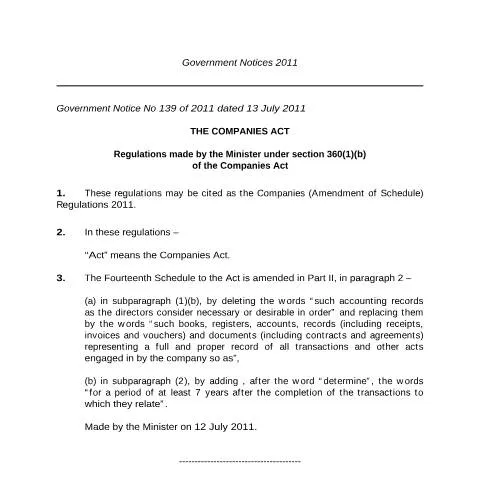
Understanding GN1392011: A Key Document in Company Regulations
The GN1392011 document holds significant importance in the corporate landscape of Mauritius, specifically under the Companies Act. Its historical context and regulatory framework help in understanding its purpose and necessity within the administrative processes. The regulations cited within this document reflect an evolution in corporate governance, ensuring that companies maintain transparency and accountability through proper record-keeping.
Historical Context and Regulatory Framework
Instituted under the Companies Act, the GN1392011 document includes amendments to the Fourteenth Schedule, enhancing requirements for accounting records. The Companies Act itself was designed to provide a structured legal framework for company operations in Mauritius, which has been instrumental in fostering a conducive business environment.
- Initial Framework: The Companies Act was established to streamline the registration and regulation of companies, ensuring compliance with local laws.
- Amendments: The GN1392011 amendment, made on 12 July 2011, reflects the need for more rigorous documentation processes, aligning with international best practices.
The Role of GN1392011 in Corporate Governance
GN1392011 is not merely a form; it plays a crucial role in the overarching framework of corporate governance in Mauritius. This is especially true for companies operating within increasingly complex environments, where transparency is paramount.
Key Elements of GN1392011
This document outlines several key amendments relevant to companies:
- The necessity for detailed accounting records that capture all transactions.
- The stipulation that companies retain these records for at least seven years.
These requirements are designed to promote accuracy in financial reporting, which is critical for both regulatory compliance and building stakeholder trust.
Filing and Submission Process for GN1392011
The filing process for GN1392011 involves several steps that must be followed meticulously to ensure compliance with the Companies Act.
Step-by-Step Filing Instructions
- Gather Necessary Documents: Ensure that you have all related accounting records, including receipts, invoices, and contracts.
- Complete the Form: Fill out GN1392011 with accurate and comprehensive information reflecting the company's transactions.
- Submission: Submit the form electronically via the designated government portal or physically at the relevant government office.
It is essential to retain a copy of the submitted document for your own records, as this may be required for future reference or audits.
Importance of Accurate Record-Keeping
The significance of accurate record-keeping cannot be overstated. Companies are not only required to comply with GN1392011 but also to implement best practices for maintaining their financial integrity.
Consequences of Non-Compliance
Failure to adhere to GN1392011 can result in several consequences:
- Legal Repercussions: Companies may face fines or penalties as imposed by the regulatory authorities.
- Operational Challenges: Incomplete records can hinder a company's ability to make informed decisions.
Maintaining proper documentation ensures that companies remain compliant with local laws, safeguarding them against potential legal issues.
Comparing GN1392011 with Other Related Forms
It is imperative to distinguish GN1392011 from other related documents used within the corporate environment of Mauritius. Understanding these distinctions helps in navigating the regulatory landscape effectively.
Key Differences with Similar Forms
| Document | Purpose | Retention Period |
|---|---|---|
| GN1392011 | Amendments to accounting records requirements | At least 7 years |
| GN1402011 | Guidelines for annual returns of companies | Until filing of next return |
| GN1412011 | Compliance certificate requirements | 5 years after issuance |
Each document serves a unique purpose within the regulatory framework, and understanding these differences is crucial for compliance.
Post-Submission Process and Follow-Up
Once the GN1392011 has been submitted, it is important to understand what to expect in terms of processing and follow-up actions.
Tracking Your Submission
After filing, tracking the status of your submission is essential. Here’s how you can do it:
- Log into your account on the government portal using your MauPass credentials.
- Check the status of submitted documents under your profile section.
If there are any issues or additional documentation required, the relevant authorities will contact you via the registered email associated with your company.
Conclusion: The Path Forward
The GN1392011 document is a cornerstone in ensuring that companies in Mauritius uphold the principles of transparency and accountability. By following the outlined procedures and maintaining diligence in their record-keeping practices, businesses can navigate the complexities of corporate governance with confidence.
Understanding GN1392011: Context and Importance
GN1392011 refers to a specific governmental notification that plays a critical role in the administrative framework of Mauritius. This notification, part of the broader legal landscape, serves to guide citizens, businesses, and public officials regarding various regulatory measures and operational procedures. To comprehend its significance, it is crucial to explore the context of its issuance, the stakeholders involved, and the implications for compliance.
Issued by relevant authorities, GN1392011 encapsulates directives that often emerge in response to evolving socio-economic conditions or administrative needs. For instance, during periods of economic adjustment or public health crises, such notifications might detail exemptions, procedural alterations, or new compliance requirements that individuals and organizations must observe. Understanding these nuances can significantly assist both public and private sectors in aligning their practices with the latest governmental expectations.
Stakeholders impacted by GN1392011 include public service employees, local government entities, and the general populace. For public service career aspirants, it may include specific eligibility criteria or modifications to application processes. Conversely, for local businesses, GN1392011 could outline new fiscal obligations or regulatory compliance updates that must be monitored closely.
Moreover, this notification might affect the operational capacity of various governmental agencies, prompting them to recalibrate their strategies and resource allocations. Thus, a thorough understanding of GN1392011 is essential for all stakeholders as it directly influences the functioning of public services and overall governance in Mauritius.
Fill in your form directly online
No printing: type your details into the boxes of the official form, tick, then download the PDF ready to send.
- 1Type into the form boxes
- 2Tick in one click
- 3Save and download the PDF
Compliance and Practical Steps for Stakeholders
Adhering to GN1392011 requires stakeholders to take specific practical steps to ensure compliance. First, stakeholders must familiarize themselves with the contents of the notification. This can be achieved by accessing official government portals, where the notification is typically available in detail. Stakeholders should consider subscribing to relevant newsletters or alerts from the Public Service Commission (PSC) or local government offices to remain informed about updates and amendments applicable to GN1392011.
After gaining a comprehensive understanding of the notification, stakeholders should assess how its provisions impact their operations or personal obligations. For instance, public service applicants must ensure their documentation aligns with the eligibility criteria laid out in GN1392011. This could involve gathering necessary paperwork such as PSC Form 7, which is essential for job applications within the public sector.
Moreover, local businesses should evaluate their financial reporting and compliance structures to ensure they meet any new regulatory requirements stemming from GN1392011. This may necessitate consultations with legal or financial advisors to adapt to any changes in tax obligations or operational mandates.
Additionally, engaging with government workshops or informational sessions can provide invaluable insights into GN1392011. These sessions often allow stakeholders to ask questions and seek clarification, fostering a more profound understanding of compliance requirements. Participation in such initiatives not only helps in individual understanding but also promotes a culture of compliance and transparency within the community.
Potential Challenges and Mitigation Strategies
While GN1392011 provides a framework for governance and compliance, stakeholders may face several challenges in aligning with its directives. One major issue is the complexity of the regulations involved, which can sometimes lead to confusion among citizens and businesses alike. To mitigate this challenge, it is essential for stakeholders to seek clarification and guidance from relevant authorities. Engaging with the PSC or local government offices directly can provide insights that help navigate the complexities of the notification.
In addition to seeking guidance, stakeholders should consider forming collaborative networks. For example, local businesses can band together to share resources and information regarding compliance strategies. This can create a shared repository of knowledge that can be particularly beneficial for smaller enterprises that may lack dedicated legal or administrative personnel.
Another potential challenge is the technological aspect, especially with the government's push for digital applications and e-services. Stakeholders may encounter difficulties in navigating these digital platforms, leading to delays or errors in meeting compliance deadlines. To address this, participating in training sessions offered by the government or community organizations can enhance digital literacy and ease the navigation of online submission processes associated with GN1392011.
Ultimately, being proactive in understanding potential challenges and implementing strategies for mitigation can significantly ease compliance burdens associated with GN1392011 and promote a more effective governance structure within Mauritius.