Unveiling the Significance of the Annual Return of Income for Companies
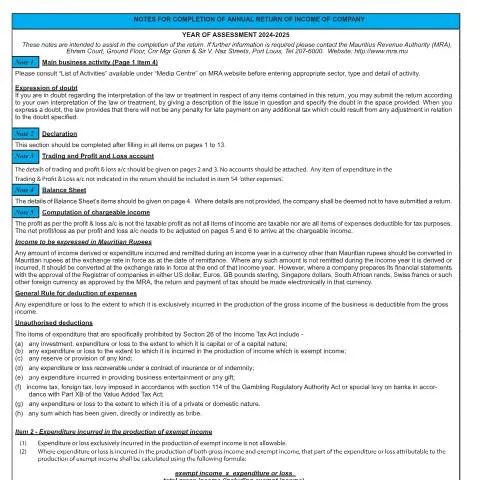
The Annual Return of Income is an essential document for companies in Mauritius, designed to facilitate compliance with the Income Tax Act. This return acts as a critical interface between businesses and the Mauritius Revenue Authority (MRA), ensuring that companies report their financial activities transparently for the assessment year 2024–2025. The ultimate goal is to ascertain the tax obligations of the company based on its declared income and allowable deductions, thereby fostering a compliant and responsible corporate environment.
Understanding the Filing Obligations: Who Should Submit?
All registered companies in Mauritius, including those that operate in various sectors, are required to submit this annual return. Companies engaging in diverse activities must ensure they accurately represent their main business activities as stipulated in Page 1, Item 4 of the return. This includes referencing the “List of Activities” provided by the MRA to prevent any misclassification that could lead to complications during processing.
Categories of Companies Required to File
- Private Limited Companies
- Public Limited Companies
- Sole Proprietorships (if registered as a company)
- Foreign Companies operating in Mauritius
Each category must adhere to specific guidelines tailored to its operational framework, ensuring compliance with Mauritian tax laws.
Key Steps for Completing the Form: A Comprehensive Guide
Completing the Annual Return of Income is a meticulous process that demands careful attention to detail. Companies must provide comprehensive financial data across multiple sections of the form, covering both operational revenue and expenses.
Section Breakdown and Entry Instructions
- Trading and Profit & Loss Account: Companies must populate the details on Pages 2 and 3. Although financial statements aren’t to be attached, all relevant data must be included directly on the form.
- Balance Sheet Details: Found on Page 4, it is critical to provide accurate balance sheet entries; failure to do so will result in the tax return being deemed incomplete.
- Computation of Chargeable Income: This section requires the adjustment of net profit/loss as per the profit and loss account. Key items such as non-taxable income and non-deductible expenses must be meticulously outlined on Pages 5 and 6.
Strategic Considerations for Accurate Reporting
When filling out the return, companies must be aware of certain strategic considerations that can impact their tax liabilities significantly.
Adjustments for Non-Taxable Income
It is crucial for companies to differentiate between taxable and non-taxable income. As highlighted in Note 5, the profit reported is not necessarily the taxable profit. Companies must adjust their financial figures, accounting for items that are exempt from tax. This includes revenue derived from certain exempt activities and specific capital expenditures that do not qualify for deductions.
Foreign Currency Transactions
If a company has engaged in transactions in currencies other than the Mauritian Rupee, it must convert these amounts using the exchange rate applicable at the time of remittance or at the fiscal year-end. This is outlined in the guidelines and is crucial for ensuring that all income and expenses are reported in the correct currency.
Navigating Common Pitfalls: What to Avoid
Completing the Annual Return of Income can be fraught with challenges. Understanding common pitfalls can help to navigate these effectively.
Unauthorized Deductions
Companies must be vigilant regarding the types of expenses they attempt to claim as deductions. The Income Tax Act explicitly prohibits certain expenditures from being deducted. These include:
- Capital expenditures
- Expenditures related to exempt income
- Provisions or reserves
- Private or domestic expenses
Companies must ensure they are not overstepping these boundaries, as such claims could lead to penalties.
Expressing Doubts Appropriately
If uncertainty arises regarding the interpretation of law or reporting guidelines, companies are encouraged to submit their return based on their interpretation, explicitly noting the issues in the designated section of the form. This approach mitigates the risk of incurring late payment penalties due to adjustments made following MRA scrutiny.
Important Documentation and Records: Preparing for Submission
The successful completion of the Annual Return of Income hinges on diligent documentation practices. Companies should prepare their records comprehensively to streamline the reporting process.
Essential Records to Maintain
- Annual financial statements
- Invoices and receipts for all business transactions
- Bank statements
- Documentation for any exempt income
Maintaining well-organized records facilitates not only compliance with the return but also enhances the company’s ability to respond to any queries raised by the MRA.
Submission Process: Safeguarding Your Filing
Once the return is completed, the next step is submission. Companies must ensure they are adhering to the submission guidelines established by the MRA for the 2024–2025 assessment year.
Online Submission via MauPass
With a strong push towards digital services, companies are encouraged to submit their returns electronically through the MauPass portal. This requires a valid National ID Card or access to the Central Population Database, ensuring a streamlined and efficient submission process.
Deadlines to Note
| Type of Submission | Deadline |
|---|---|
| Electronic Submission | 31 December 2024 |
| Paper Submission | 31 October 2024 |
Adhering to these deadlines is critical, as late submissions may incur penalties.
Post-Submission: Tracking the Progress
After successful submission, companies should monitor their filings to ensure compliance and address any potential follow-up queries from the MRA.
Follow-Up Procedures
- Maintain a copy of the submitted return for your records.
- Be prepared to provide additional documentation if requested by the MRA.
- Utilize the MRA online portal for tracking the status of your return.
Being proactive in following up can help resolve issues swiftly and maintain a good standing with tax authorities.
Special Cases: What If You’re an Expat or Facing Complexity?
Companies run by foreign nationals or those facing unique situations must navigate additional complexities in their tax obligations.
Filing for Non-Residents
Foreign companies or non-residents operating in Mauritius are still required to file the Annual Return of Income. However, they must be cognizant of local tax treaties and regulations that may affect their filings. Documentation proving residency status and applicable deductions should be prepared.
Handling Urgent or Complex Situations
In cases of urgent filings or those involving complex financial arrangements, seeking professional advice can be invaluable. Engaging with tax consultants familiar with Mauritius' tax system can facilitate smoother compliance and potentially minimize tax liabilities.
Final Touches: Ensuring Complete and Accurate Filing
As the 2024–2025 assessment year approaches, it is essential for companies to ensure their return is well-prepared, comprehensive, and submitted on time. This commitment to diligent tax reporting not only complies with legal obligations but also supports the broader economic framework of Mauritius.
Wrap-Up: The Importance of Diligence in Tax Filing
Filing the Annual Return of Income is more than a statutory obligation; it is a cornerstone of corporate governance that reflects a company's commitment to ethical practices. By taking the necessary steps to ensure accuracy and compliance, companies can contribute positively to the economic landscape of Mauritius while safeguarding their interests.
Understanding Employment Trends in 2024-2025 in Mauritius
As Mauritius approaches the fiscal year 2024-2025, it is crucial to examine the employment landscape that is expected to evolve due to various factors including economic policies, workforce demands, and the impact of global events. The government of Mauritius, through agencies such as the Public Service Commission (PSC) and the Local Government Service Commission (LGSC), plays a vital role in shaping the public sector workforce, ensuring that recruitment processes align with national objectives.
In 2024-2025, the focus will likely be on enhancing job opportunities in sustainable industries, particularly in sectors such as renewable energy, technology, and healthcare. This is in line with the government's commitment to promote sustainable development as outlined in the National Development Strategy. Furthermore, the trend towards digitization and e-services is expected to create a surge in demand for skilled workers in IT and digital services, prompting the PSC and LGSC to prioritize hiring in these sectors.
As a prospective job seeker, it is essential to stay informed about these trends. Utilizing platforms like govmu.org can facilitate access to job vacancies and application procedures. Applicants should prepare to showcase not only their qualifications but also their adaptability to evolving industry needs. The upcoming data from the Labour Market Information System will provide insights on the skills gap and help candidates align their skillsets accordingly.
The Role of E-Government in Enhancing Public Service Efficiency
The 2024-2025 fiscal year witnesses a significant shift towards e-government initiatives in Mauritius, aiming to streamline administrative processes and enhance public service delivery. The advent of an e-governance framework facilitates a smoother interaction between citizens and government agencies, reducing the bureaucratic burden on both sides. This shift is critical as it aligns with global practices while enhancing transparency and accountability in the public sector.
For example, the implementation of the MauPass single-sign-on system linked to the National ID Card/Central Population Database has simplified access to various government services online. Citizens can now utilize this system to submit applications for public service positions, access tax-related services from the MRA (Mauritius Revenue Authority), and manage local government interactions more efficiently.
As Mauritius transitions towards this digital governance model, citizens must familiarize themselves with the online platforms available. Understanding how to navigate the e-filing system with the MRA or applying for public service positions via the PSC portal will be essential for timely and effective applications. The government is also actively seeking feedback from users to improve these digital services, ensuring they meet the needs of the population.
Fiscal Policy Changes and Their Implications for Businesses and Citizens
As the 2024-2025 fiscal year approaches, the Mauritian government is expected to introduce significant changes to its fiscal policies, aimed at stimulating economic growth and addressing social disparities. These policies will impact both businesses and individual citizens significantly, especially around tax regulations and public spending allocations.
One of the anticipated changes is the potential revision of income tax brackets and corporate tax rates, which can influence disposable income levels and spending habits among citizens. Understanding these changes is crucial for effective financial planning, whether you are an employee or a business owner. The Mauritius Revenue Authority (MRA) will provide updated guidelines and information through their platforms, ensuring that everyone remains compliant with the new regulations.
Moreover, the government is also expected to increase investment in public infrastructure, healthcare, and education, which will stimulate job creation and enhance overall living standards. Citizens should remain informed about how these investments may translate into opportunities for employment and business growth. Local government bodies will play a key role in managing these initiatives at the communal level, and citizens are encouraged to engage with their local representatives to understand how they can benefit from these developments.