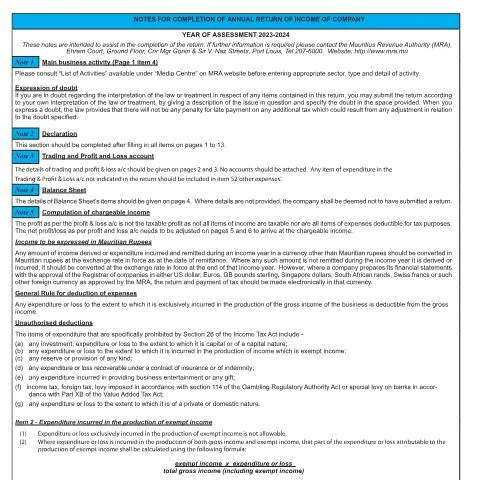
Understanding the 2023-2024 Company Income Return Document
Filing an annual return for company income can be a daunting task for many business owners in Mauritius. The 2023-2024 Company Income Return, referenced as NotesCT03_2324, plays a pivotal role in the annual regulatory compliance of companies, ensuring that the Government of Mauritius receives accurate and timely tax information. This document isn't merely a formality; it is a crucial tool for the Mauritius Revenue Authority (MRA) to assess the tax liabilities of companies, contributing to the nation's economy.
The Context Behind the Document
The obligations surrounding company income returns are enshrined in the Income Tax Act, which operates under a hybrid legal system blending the principles of French civil law with English common law. The MRA enforces these regulations to uphold financial integrity and transparency within the corporate sector. Annually, businesses are required to submit their returns, providing a comprehensive overview of their financial activities during the fiscal year, which runs from July 1 to June 30.
The 2023-2024 Company Income Return is specifically designed to capture all relevant financial details necessary for the MRA to determine tax liabilities. Understanding how to accurately complete this document can significantly affect a company's financial standing and its relationship with the tax authorities.
Navigating the Form: Step-by-Step Guidance
Completing the Company Income Return requires careful attention to detail. The following sections break down the essential components of the form, elucidating the necessary information and common pitfalls that filers may encounter.
Main Business Activity
At the outset of the form, preparers must indicate their company's main business activity. This section is marked as Page 1, Item 4. Prior to filling out this information, it is imperative to consult the List of Activities available on the MRA website. This ensures that the chosen sector accurately reflects the nature of business operations.
- Accuracy is key: Misrepresentation can lead to incorrect tax assessments.
- Consult the guidelines if unsure about your sector classification.
Declarations: Final Checks Before Submission
Once all sections of the form have been meticulously completed, the declaration section should be filled out. This crucial step affirms that the provided information is accurate to the best of your knowledge. This declaration is essential, as it formalizes your submission.
Financial Statements: Detailed Breakdown
Pages 2 and 3 of the form are dedicated to the Trading and Profit and Loss Account. In this section, businesses are required to provide financial statements detailing their income and expenditures. No additional accounts should be attached; rather, the form must encapsulate everything succinctly.
Balance Sheet Implications
On Page 4, companies are prompted to provide balance sheet details. It is critical to note that any missing information can lead to the return being deemed incomplete, potentially incurring penalties. The balance sheet serves as a snapshot of a company's financial health at the end of the fiscal year, summarizing assets, liabilities, and equity.
Chargeable Income Computation: A Closer Look
Determining chargeable income is one of the most complex aspects of the return. Pages 5 and 6 guide the computation process, highlighting the necessity for adjustments based on the profit or loss reported. Here, it is essential to bear in mind:
- Not all income is taxable; deductions and allowances must be accurately calculated.
- Expenses must be exclusively incurred for generating gross income to qualify for deductions.
Authorized vs. Unauthorized Deductions
The form clearly delineates expenses that are authorized for deduction from taxable income. Understanding what constitutes unauthorized deductions is critical to avoid penalties:
- Capital expenditures are not deductible.
- Expenditures related to exempt income cannot be claimed.
Furthermore, it is crucial to note that specific expenditures outlined in Section 26 of the Income Tax Act are prohibited, including investments of a capital nature and any expenditure that relates to income exempt from tax.
Special Considerations and Industry-Specific Guidelines
Companies operating in specialized sectors may encounter unique guidelines when filling out the annual return. For example, businesses involved in peer-to-peer lending must understand how to treat unrelieved bad debts, as detailed in the document. This not only affects their immediate tax obligations but can also influence future financial strategies.
Foreign Currency Transactions
For companies that engage in international transactions, it is essential to be aware of how to convert foreign currency amounts into Mauritian Rupees. The document stipulates that any income derived in foreign currency must be converted at the exchange rate applicable at the time of remittance. Properly completing this section ensures compliance and accuracy in tax reporting.
Understanding Follow-Up Procedures
After submitting the annual return, businesses must be prepared to engage with the MRA should any discrepancies arise. Keeping lines of communication open is essential, as it allows for clarification on any doubts expressed during the submission process. The MRA encourages transparency and is willing to discuss specific issues if they are clearly articulated in the return.
How to Track the Progress of Your Submission
Utilizing the electronic services available through the government portal, filers can monitor the status of their submissions. Staying proactive by checking for updates or feedback from the MRA can significantly streamline the process and facilitate timely resolution of any issues that may arise.
Conclusion: Mastering Compliance for Corporate Success
Understanding and accurately completing the 2023-2024 Company Income Return is not just about meeting regulatory requirements; it is about empowering businesses to thrive in a competitive environment. By dedicating time and resources to navigate this process, companies can position themselves for financial success while contributing to the broader economic health of Mauritius.
In essence, the completion of this document is an opportunity for businesses to reflect on their financial performance and ensure they are prepared for future fiscal challenges. For additional guidance, companies are encouraged to contact the Mauritius Revenue Authority directly, thereby fostering a proactive relationship with the tax authorities.
Understanding the PSC and LGSC Application Process in 2023
The Public Service Commission (PSC) and Local Government Service Commission (LGSC) play crucial roles in recruitment for public sector positions in Mauritius. As we approach 2023-2024, applicants need to be aware of the specific procedures, timelines, and documentation required for a successful application. The application process primarily involves filling out the relevant forms—such as PSC Form 7 and LGSC Form 7a—available on their respective portals. Each form is tailored to specific types of positions, and applicants must ensure they are selecting the correct one based on their desired role.
For instance, before submitting an application, candidates should verify that they meet the eligibility criteria outlined in the accompanying guidelines. This includes educational qualifications, relevant experience, and any additional skills that may be necessary for the role. It is advisable to compile all necessary documentation before beginning the online application process to avoid delays. This documentation typically includes a certified copy of the National ID, educational certificates, and any references or testimonials relevant to the position. Applications must be submitted through the MauPass system, which securely ties the application process to the National ID Card, thus streamlining the verification of identities and documents. Applicants should also familiarize themselves with the deadlines set out by the PSC and LGSC, as late submissions are typically not accepted.
Critical Updates to E-Services and Digital Applications
In 2023, the Mauritian government has significantly enhanced its e-services platform to facilitate smoother and faster interactions with public services. The emphasis on digital applications aligns with the government's broader strategy to promote efficiency, transparency, and accessibility in public administration. Applicants are encouraged to utilize the e-filing systems available on government websites, including govmu.org, where they can find not only recruitment forms but also updates on job vacancies, application statuses, and feedback mechanisms.
The transition to digital applications requires applicants to have a functional understanding of the MauPass platform, which integrates various government services into a single sign-on experience linked to the Central Population Database. Additionally, it is essential for applicants to ensure that they have stable internet access and the necessary digital literacy to navigate the e-services effectively. Feedback from previous applicants indicates that while the online system is generally user-friendly, there can be occasional technical issues. Therefore, it is recommended to commence applications well ahead of deadlines to accommodate any unforeseen complications.
Moreover, the government is continuously seeking to improve the user experience by gathering feedback and implementing user-friendly features such as mobile-friendly interfaces and multilingual options. This focus on enhancing digital services not only serves to make the application process more convenient but also aims to encourage greater participation from the public in governance and public service roles.
Preparation for Interviews and Selection Processes
Once applications are submitted and shortlisted candidates are notified, the next stage is the interview process. Understanding the interview format, potential questions, and the evaluation criteria can significantly improve an applicant's chances of success. In 2023-2024, candidates can expect interviews to be structured around competencies and behavioral assessments, reflecting the skills required for the position they applied for. The selection panels may include representatives from relevant departments, thus ensuring a fair and transparent evaluation process.
Preparing for these interviews involves not only reviewing the job description and qualifications but also engaging in mock interviews, researching common interview questions, and practicing answers. Candidates should be prepared to discuss their experiences, competencies, and how they align with the values and objectives of the public service in Mauritius. Additionally, it is advisable for candidates to dress appropriately, arrive on time, and convey a professional demeanor throughout the interview.
Furthermore, applicants should be aware of the potential for assessment centers, which may be part of the selection process for certain high-level positions. These assessment centers often evaluate teamwork, problem-solving skills, and leadership capabilities through group exercises and individual tasks. Familiarizing oneself with these formats can provide a competitive edge. In conclusion, thorough preparation for the interview process—along with a solid understanding of the application and e-service frameworks—will be critical for applicants navigating the public sector recruitment process in 2023-2024.