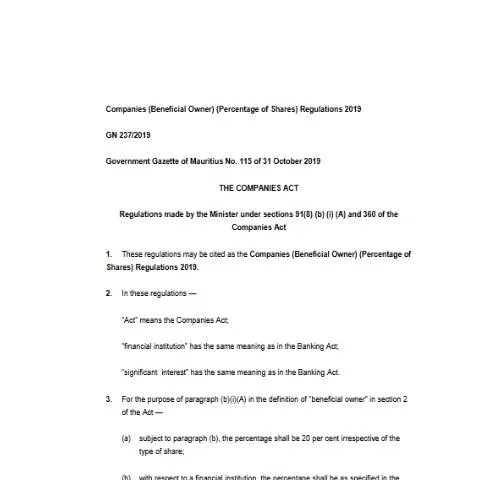
Overview of the Companies (Beneficial Owner) (Percentage of Shares) Regulations 2019 (Updated)
The Companies (Beneficial Owner) (Percentage of Shares) Regulations 2019 (Updated) constitute a key regulatory framework aimed at enhancing transparency within the corporate sector of Mauritius. Enacted under the authority of the Companies Act and aligned with the broader objectives of anti-money laundering and counter-terrorism financing measures, these regulations impose specific obligations on companies to disclose the ownership structure of their shareholdings. This guide provides an overview of the regulation’s scope, its implications for companies and beneficial owners, and the procedures for compliance.
Context and Purpose of the Regulations
In recent years, Mauritius has intensified efforts to combat financial crimes by implementing measures that promote transparency and accountability in corporate ownership. The Companies (Beneficial Owner) (Percentage of Shares) Regulations 2019 (Updated) are part of this initiative, requiring companies to identify and disclose their beneficial owners—individuals who ultimately own or control a significant share of the company.
The regulations are designed to align with international standards, including those set by the Financial Action Task Force (FATF), to prevent misuse of corporate entities for illicit activities such as money laundering, terrorist financing, and proliferation financing. The updated version of these regulations reflects ongoing efforts to strengthen corporate governance and ensure that beneficial ownership information is accurate, complete, and accessible to relevant authorities.
Who Is Affected by These Regulations?
All companies incorporated or registered under the Mauritian Companies Act are subject to these regulations. This includes:
- Private companies;
- Public companies;
- Holding companies and subsidiaries;
- Foreign companies operating within Mauritius.
Furthermore, the regulations extend to beneficial owners—individuals who ultimately own or control at least 25% of the shares or voting rights of the company, or who otherwise exercise control over the company’s decisions.
Key Provisions and Compliance Requirements
Identification and Disclosure of Beneficial Owners
Companies are required to identify their beneficial owners and maintain up-to-date records of ownership structures. This includes details such as the full name, nationality, residential address, date of birth, and the nature and extent of ownership or control.
Submission of Beneficial Ownership Information
Companies must submit their beneficial ownership information via the online portal managed by the Registrar of Companies. This process involves accessing the government’s electronic services platform, where a secure login is facilitated through the Mauritian National ID Card or the Central Population Database, ensuring a single sign-on experience.
It is mandatory to update this information within a specified period following any change in ownership or control, typically within 30 days of such change. Failure to comply may attract penalties or sanctions as prescribed under the relevant legislation.
Record-Keeping and Confidentiality
Companies are obliged to keep accurate and current records of their beneficial owners and must make this information available to authorities upon request. However, confidentiality provisions ensure that such information is protected and only accessible to designated regulatory and enforcement agencies.
Fill in your form directly online
No printing: type your details into the boxes of the official form, tick, then download the PDF ready to send.
- 1Type into the form boxes
- 2Tick in one click
- 3Save and download the PDF
References and Regulatory Authority
The implementation and enforcement of these regulations are overseen by the Corporate and Business Registration Department under the Ministry of Financial Services and Good Governance. The regulations are published as part of the legal framework aimed at strengthening anti-money laundering measures and are accessible through official government portals.
For detailed guidance, companies are advised to consult the official documentation available on the government’s e-services platform, which provides comprehensive instructions on registration procedures, required documentation, and compliance deadlines.
Conclusion
The Companies (Beneficial Owner) (Percentage of Shares) Regulations 2019 (Updated) represent a significant step toward ensuring transparency and integrity in Mauritius’s corporate environment. Companies must proactively identify and disclose their beneficial owners, maintaining compliance with legal obligations to avoid penalties and contribute to the country’s anti-money laundering efforts. Leveraging the government’s digital platforms facilitates a streamlined process, emphasizing Mauritius’s commitment to modern, effective regulation in the digital age.