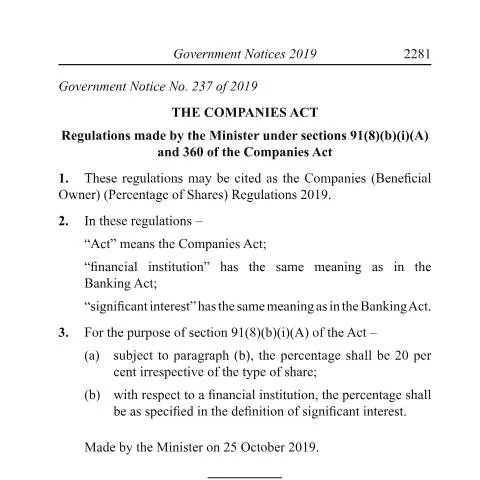
Overview of the Companies Act (Beneficial Owner) (Percentage of Shares) Regulations 2019
The Companies Act (Beneficial Owner) (Percentage of Shares) Regulations 2019 constitute a significant legal framework in Mauritius aimed at enhancing transparency in corporate ownership. These regulations, issued by the Minister and published as Government Notice No. 237 of 2019, are designed to specify the percentage of shares that constitute a "beneficial owner" in accordance with the provisions of the Companies Act. Their primary objective is to identify individuals or entities that ultimately control or benefit from a company's shares, thereby promoting good governance and compliance with anti-money laundering standards.
Scope and Legal Context
The regulations are made under sections 91(8)(b)(i)(A) and 360 of the Companies Act, which empower the Minister to prescribe rules concerning beneficial ownership and related disclosures. They apply broadly to companies registered in Mauritius, including both local and foreign entities operating within the jurisdiction. The legal framework aligns with international standards aimed at combating financial crimes by ensuring transparency of ownership structures.
Specifically, these regulations clarify the threshold percentage of shares that qualify an individual or entity as a beneficial owner. This threshold is crucial for companies, financial institutions, and regulatory authorities to determine when disclosure obligations are triggered.
Key Provisions and Definitions
Threshold Percentage of Shares
- The regulations establish that, generally, a person who holds at least 20% of the shares in a company is considered a beneficial owner, regardless of the share class.
- In the case of a financial institution, the percentage of shares that constitute a significant interest is defined separately, aligning with the relevant provisions of the Banking Act.
Important Definitions
| Term | Definition |
|---|---|
| Act | The Companies Act of Mauritius. |
| Financial institution | As defined in the Banking Act, includes banks, non-bank financial institutions, and other entities regulated under banking legislation. |
| Significant interest | The threshold for controlling or benefiting from a financial institution, as specified in the Banking Act. |
Implications for Companies and Financial Institutions
Companies registered in Mauritius are required to identify and disclose their beneficial owners based on these thresholds. This process involves maintaining accurate records of individuals or entities holding the specified percentage of shares, which may include direct or indirect holdings.
Financial institutions, on their part, must incorporate these thresholds into their due diligence procedures, particularly when assessing clients or counterparties. They should verify whether their clients or beneficial owners meet the criteria set out in the regulations, especially concerning significant interests.
Enforcement and Compliance
The regulations emphasize the importance of transparency and accountability in corporate ownership structures. While specific enforcement mechanisms are detailed in the Companies Act, companies and financial institutions are encouraged to establish internal policies to identify, record, and report beneficial owners accurately.
Failure to comply with these disclosure obligations may result in penalties, including fines or other sanctions as provided under the Companies Act and related legislation.
Fill in your form directly online
No printing: type your details into the boxes of the official form, tick, then download the PDF ready to send.
- 1Type into the form boxes
- 2Tick in one click
- 3Save and download the PDF
References and Authority
The Companies Act (Beneficial Owner) (Percentage of Shares) Regulations 2019 are made under the authority granted to the Minister by the Companies Act, specifically sections 91(8)(b)(i)(A) and 360. They are part of Mauritius's broader efforts to align with international standards on transparency and anti-money laundering measures.
For further details, companies and financial institutions should consult the official government publication of the regulations, available through the Government Printing Department or the official government portals dedicated to legal and regulatory information.