Unlocking Opportunities: The Role of Tender022017 in Public Auctions
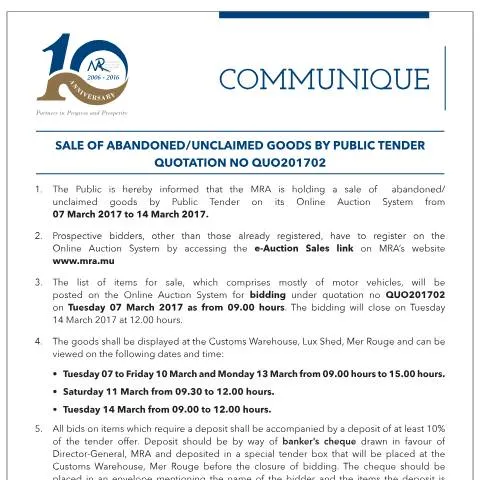
Public tenders serve as a vital channel for citizens to acquire assets that have been abandoned or unclaimed. Specifically, Tender022017, issued by the Mauritius Revenue Authority (MRA), facilitates a unique opportunity for prospective bidders to bid on a variety of goods, predominantly motor vehicles. The significance of this process goes far beyond simple transactions; it represents the efficiency of public resource management while engaging the community in productive economic activities.
Understanding the Tender Process: A Step-by-Step Overview
The sale of abandoned or unclaimed goods is executed through a systematic process that involves several key steps. Understanding this sequence is crucial for anyone looking to participate in the bidding.
- Announcement of the Sale: Public notices, such as the one for Tender022017, are disseminated to inform potential bidders about the upcoming auction.
- Registration: Interested bidders must register on the MRA’s Online Auction System, accessible via the government portal.
- Viewing of Items: The goods available for bidding are displayed at a designated location, allowing bidders to assess their condition.
- Submission of Bids: Bidders submit their tender offers, along with any required deposit, within the allocated timeframe.
- Awarding of Items: After the bidding period concludes, successful bids are announced, and the items are awarded accordingly.
Channels for Submitting Tender022017: Digital vs. Traditional
The submission methods for Tender022017 significantly influence the accessibility of the auction for bidders. There are two primary avenues: online and physical submissions.
Online Submission
Prospective bidders are encouraged to utilize the Online Auction System. This method offers numerous advantages:
- Convenience: Bidders can place their bids from the comfort of their homes.
- Real-Time Updates: The system provides immediate information on current bids and remaining time.
- Wide Reach: It opens up the auction to a broader audience beyond geographical constraints.
Physical Submission at Customs Warehouse
For those who may not have internet access, MRA provides physical bidding booths at the Customs Warehouse, Mer Rouge. This option caters to older populations or those less familiar with digital platforms. The key points to note include:
- Availability of Assistance: Staff can assist with the bidding process.
- Immediate Interaction: Bidders can ask questions and receive instant responses.
- Accessibility: Bidding booths are specifically designed to be user-friendly.
Essential Components of Tender022017: Navigating the Form
Understanding the components of the Tender022017 form is essential for successful completion. Each section demands careful consideration to avoid missteps.
Bidder Information
This section requires detailed personal information, including:
- Name
- Identification Number (National ID)
- Contact Information
Caution: Ensure that the information provided matches official records to avoid complications during validation.
Item Details and Tender Offer
Here, bidders must specify the items they wish to bid on and the offered amount. Potential pitfalls include:
- Inaccurate item identification, which could lead to disqualification.
- Offering an amount below the minimum requirement, which is typically set at a minimum percentage of the item's value.
The Bid Deposit: What You Need to Know
As part of the bidding process, participants are often required to submit a deposit. For Tender022017, the details are notably stringent:
- The deposit must be at least 10% of the tender offer.
- Only banker’s cheques are accepted, drawn in favour of the Director-General, MRA.
- Personal cheques will result in immediate disqualification.
Moreover, it is vital that the cheque is placed in an envelope clearly marked with the bidder's name and the specific items corresponding to the deposit.
Timing is Everything: Key Dates in the Tender022017 Process
Understanding the timeline associated with Tender022017 is crucial for successful participation. Key dates include:
| Date | Activity |
|---|---|
| 07 March 2017 | Start of the public tender; items posted for bidding. |
| 14 March 2017, 12:00 hours | Closure of bidding; no further bids will be accepted. |
| 07 March to 14 March | Viewing period for items at Customs Warehouse. |
It is advisable to keep these dates in mind to ensure full participation in the auction process.
Who Benefits from Tender022017? Understanding the Participant Profile
The Tender022017 auction is not limited to a specific demographic; rather, it appeals to a diverse group of potential bidders. Here are some profiles of individuals who may engage in this public tender:
- Car Enthusiasts: Individuals looking for unique or vintage vehicles at competitive prices.
- Small Business Owners: Entrepreneurs seeking to acquire vehicles for business use without significant capital outlay.
- Individuals in Need: Those who may require affordable transportation options.
Each participant may have their own motivations and goals, but the common thread is the pursuit of value through public auction.
Post-Tender Steps: Following Through After the Bid
Once the bidding concludes, successful bidders must be aware of the subsequent steps to finalize their purchases. This includes:
- Payment of Balance: Successful bidders must pay the remaining amount after the tender offer is accepted.
- Asset Collection: Instructions on how to collect the purchased goods will be provided.
- Documentation: Proper documentation must be completed to transfer ownership legally.
Being proactive about these steps ensures a smooth conclusion to the bidding process.
Legal Framework and Regulations Governing Tender022017
The Tender022017 process is anchored in established laws that guide public tenders in Mauritius, particularly through the Mauritius Revenue Authority. The relevant laws include:
- Constitution of 1968: Establishes the legal framework for public sector operations.
- PSC Act of 1955: Governs the conduct of public service recruitment and tender processes.
Understanding these regulations can empower bidders to navigate the tendering process more effectively and ensure compliance throughout.
Final Thoughts: Engaging with Tender022017 for Community Benefit
Participating in the Tender022017 auction not only provides individual bidders with the opportunity to acquire valuable assets but also contributes to the efficient use of unclaimed goods within the community. By understanding the nuances of the process, individuals can maximize their participation while supporting broader economic objectives in Mauritius. As the MRA continues to enhance the transparency and efficiency of public tenders, bidders are encouraged to engage actively and responsibly in the process.