Navigating the 2025/2026 Annual Return for a Deceased Person's Estate
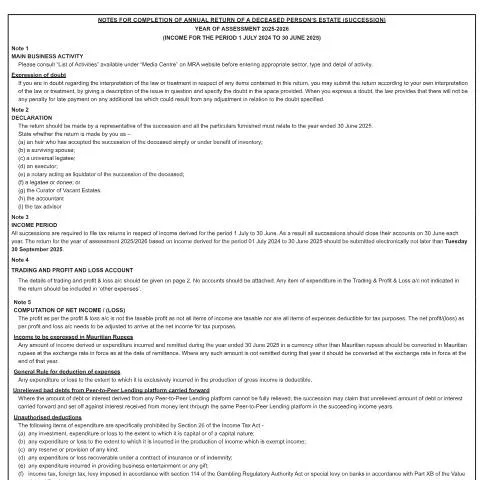
When handling the affairs of a deceased individual, one of the most critical documents an executor or representative must complete is the Annual Return of a Deceased Person's Estate for the year of assessment 2025/2026. This document, referenced as NotesIT09-2025, plays a vital role in ensuring that the estate's financial activities during the specified period are reported accurately to the Mauritius Revenue Authority (MRA). Understanding not only how to fill out this document but also its implications can significantly affect the management of the estate.
The Importance of Timely Submission
Submitting the Annual Return is not merely a bureaucratic exercise; it is a legal obligation that impacts the heirs and the estate's compliance with tax regulations. The deadline for submission is set for Tuesday, September 30, 2025. Failing to meet this deadline can lead to penalties, making timely submission essential.
Consequences of Delays
- Legal Penalties: Late submissions may incur interest or penalties based on the additional tax owed due to late filing.
- Impact on Heirs: Delays in filing can complicate the distribution of the estate, affecting beneficiaries who may be waiting for their inheritance.
- Increased Scrutiny: Late returns might prompt closer examination by the MRA, potentially leading to audits or additional inquiries.
Who is Responsible for Filing?
Understanding who is authorized to submit the Annual Return is crucial. The return must be filed by a designated representative, which can include:
- An heir who has accepted the succession either simply or under benefit of inventory
- A surviving spouse
- A universal legatee
- An appointed executor
- A notary acting as the liquidator of the estate
- A legatee or donee
- The Curator of Vacant Estates
- The accountant
- The tax advisor
Each of these representatives is equipped with the authority to complete the form, but they must ensure that all details pertain strictly to the estate's financial activities for the period ending June 30, 2025.
Understanding the Income Period
The return covers income generated during the fiscal year from July 1, 2024, to June 30, 2025. All estates are required to finalize their accounts on June 30 each year, which is crucial for accurate financial reporting. This specific timeframe is set in accordance with the fiscal year, which runs from July 1 to June 30.
Filing Cycle
- Prepare Documentation: Gather all necessary records of income and expenditures for the specified period.
- Complete the Return: Fill in the Annual Return accurately, reflecting all income and allowable expenditures.
- Submit by Deadline: Ensure the return is filed electronically by the end of September 2025.
- Await Assessment: Monitor the progress of your submission and be prepared for any inquiries from the MRA.
Filling Out the Return: Key Considerations
Completing the Annual Return requires careful attention to various sections, which define the estate's financial activities. One of the essential components is the declaration field, where the representative must indicate their relationship to the deceased and the capacity in which they are filing the return.
Documenting Income and Expenditures
Accurate reporting of income derived from the estate is vital. The following guidelines must be adhered to:
- Use Mauritian Rupees for all income amounts; conversions must be done if other currencies are involved.
- All items must be reported in the context of the Trading and Profit & Loss Account, which should be summarized without attaching detailed accounts.
- Specify any expenditures not included in the return as 'other expenses' to ensure clarity.
Understanding Deductions and Exemptions
It’s paramount to differentiate between allowable deductions and those that are unauthorized under the Income Tax Act. Generally, any expenditure directly associated with the production of taxable income is deductible. However, the following are explicitly disallowed:
- Capital expenditures or losses
- Expenses related to exempt income
- Provisions or reserves of any kind
- Expenditures recoverable under insurance
- Gifts or business entertainment costs
Exploring the Chain of Administrative Steps
Beyond merely filling out the Annual Return, understanding its place within the broader set of administrative tasks is crucial. The completion and submission of this document often align with other procedures related to the administration of the estate, such as the appointment of an executor and the distribution of assets.
Timeline of Responsibilities
| Task | Responsible Party | Deadline |
|---|---|---|
| Finalizing accounts | Executor | June 30, 2025 |
| Complete Annual Return | Representative | September 30, 2025 |
| Distribution to heirs | Executor/Heirs | Post-assessment |
Where and How to Submit the Document
Submission of the Annual Return can be conducted through various channels, each offering distinct advantages. In line with the government's e-services push, electronic submissions are encouraged.
Submission Channels
- Online Submission: Utilizing the e-filing portal on the MRA website ensures efficiency and immediate acknowledgment of submission.
- Papers Submission: For those preferring traditional methods, paper forms can be submitted at authorized MRA offices, though this may involve longer processing times.
- Guichet Services: Physical submission at the MRA can provide immediate assistance, although it may necessitate waiting in line.
Tracking the Status of Your Submission
After submission, it is critical to monitor the status of your Annual Return. The MRA provides channels for tracking, which can help in resolving any potential issues before they escalate.
Monitoring Channels
- Use the MRA e-filing portal to check the status of your submission.
- Contact the MRA's customer service for any inquiries regarding processing times or required documentation.
- Keep copies of all submitted documents and acknowledgments for your records.
Preparing for Possible Inquiries
Upon review of the Annual Return, the MRA may reach out for additional information or clarification. Being prepared for these inquiries can facilitate a smoother resolution process.
Anticipating Questions
Common areas of inquiry may include:
- Clarifications on income sources and calculations of taxable income
- Deductions claimed and their justification
- Details related to assets and liabilities of the estate
Having thorough documentation and clear records will aid in addressing any queries promptly.
Final Notes on Navigating the Process
Engaging with the Annual Return of a Deceased Person's Estate is undoubtedly intricate, yet understanding its components and implications enables representatives to approach this responsibility with greater confidence. Diligence in preparation, timely submission, and proactive tracking of the return will ease the pathway to fulfilling legal obligations and ensuring the smooth management of the estate for beneficiaries.
Understanding the Upcoming Changes in Public Service Recruitment
The Public Service Commission (PSC) of Mauritius is set to implement several transformative changes in its recruitment process for the fiscal years 2025 and 2026. These changes aim to enhance transparency, efficiency, and accessibility to job seekers in the public sector. As the PSC continues to adapt to technological advancements, prospective candidates will need to familiarize themselves with the new application procedures, which will largely be facilitated through the online platform, govmu.org.
One of the main shifts will be the introduction of enhanced digital verification processes that will streamline the application workflow. Candidates are advised to ensure that their National ID Card information is current and accurately reflected in the Central Population Database. This is critical as the MauPass single-sign-on feature will play a pivotal role in verifying applicants’ identities. Failure to comply with these new protocols could result in application delays or rejections.
Moreover, the PSC will focus on increasing diversity within the public service by launching targeted recruitment campaigns aimed at underrepresented groups. This initiative is designed to create a more inclusive workforce and reflect the demographic makeup of Mauritius. Detailed information regarding these campaigns and specific recruitment drives will be regularly updated on the PSC's official website, ensuring that potential applicants are well-informed of their opportunities.
Financial Planning for Public Sector Employment
As Mauritius prepares for the fiscal years 2025 and 2026, prospective public sector employees should consider the implications of salary structures and taxation policies that may evolve during this period. The Mauritius Revenue Authority (MRA) is expected to revise tax brackets and introduce measures that could affect net income for public servants. Staying informed about these changes is essential for effective financial planning.
Applicants should familiarize themselves with the current tax regulations and be prepared to adapt to any new policies that may emerge. The MRA regularly updates its guidelines and information on the official MRA website, where individuals can access e-filing services and ensure compliance with the necessary tax obligations.
In addition, candidates should consider the benefits that come with public sector employment, such as pension schemes, health insurance options, and other allowances. The specific entitlements may vary depending on the role and level within the public service, so it is advisable to inquire about these during the job application process.
Understanding these financial aspects not only helps applicants make informed decisions but also prepares them for a successful transition into public service roles. Regular engagement with financial advisors or workshops offered by the PSC can provide valuable insights into navigating these opportunities effectively.
Enhancing Skills and Qualifications for the Public Service Workforce
As Mauritius progresses towards 2025 and 2026, there is a growing emphasis on the need for continuous professional development among public service employees. The evolving nature of work in the public sector demands that candidates not only possess academic qualifications but also demonstrate relevant skills that align with the government's strategic objectives.
To boost employability, prospective applicants are encouraged to pursue additional training programs and certifications that are aligned with the competencies required in public administration. Institutions offering courses in project management, public policy, and information technology are particularly relevant as these skills are increasingly sought after in the government workforce. The PSC will provide information about accredited programs and partnerships with educational institutions through its portals.
Furthermore, individuals seeking employment in the local government sector should consider engaging in community service or volunteer programs. Such experiences not only enhance one’s resume but also demonstrate a commitment to public service values. These initiatives will be highlighted during recruitment campaigns by the Local Government Service Commission (LGSC), which aims to attract candidates who have positively impacted their communities.
In conclusion, as Mauritius prepares for the forthcoming fiscal years, understanding the recruitment landscape, financial considerations, and the importance of skill enhancement are essential for anyone aspiring to a career in the public sector. Staying informed and proactive will greatly increase one’s chances of securing a position and thriving within the public service framework.