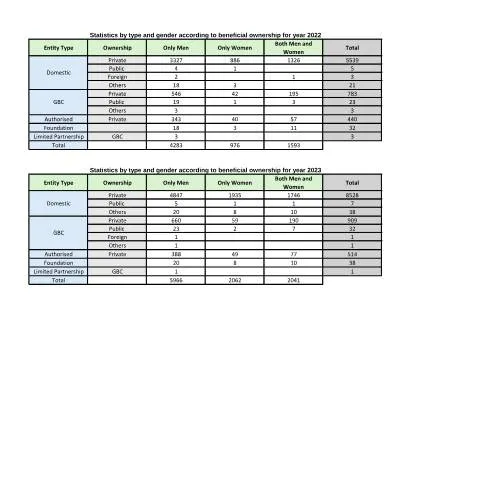
Understanding the Statistics by Type and Gender According to Beneficial Ownership
In the ever-evolving landscape of corporate governance and compliance, the Statistics by type and gender according to beneficial ownership for year 2022 to year 2024 document serves a crucial role in enabling stakeholders to grasp the distribution of beneficial ownership across different entity types. This official document, published by the relevant authorities, aims to shed light on gender representation within beneficial ownership, thus informing policy decisions and corporate practices.
Who is Required to Submit This Document?
The obligation to submit this document falls on various entities operating within Mauritius that possess beneficial ownership. These include:
- Private Companies
- Public Entities
- Foreign Entities
- Foundations and Limited Partnerships
Each entity type is required to report its ownership structure, detailing how many beneficial owners are men, women, or a combination of both. This information is critical for supporting transparency and equality in business practices.
Decoding the Form: Sections and Instructions
Completing the Statistics document entails navigating through several sections. Here’s a detailed breakdown:
Section 1: Entity Identification
This section requires you to provide the official name of the entity, registration number, and type (e.g., private, public). Ensure accuracy, as discrepancies can lead to delays in processing.
Section 2: Beneficial Ownership Breakdown
You must categorize the beneficial owners by gender and entity type as indicated in the example below:
| Entity Type | Ownership | Only Men | Only Women | Both Men and Women | Total |
|---|---|---|---|---|---|
| Private | 3327 | 886 | 1326 | 5539 | |
| Public | 4 | 1 | 5 | 10 |
It’s essential to ensure the data is up-to-date and reflective of actual ownership, as inaccuracies may lead to potential fines or legal issues.
Section 3: Verification and Declaration
In this final section, the entity's authorized representative must validate the information provided. This involves signing and dating the form, confirming that all details are true to the best of their knowledge.
Key Documentation Required for Submission
When preparing to submit the Statistics document, ensure that you gather the following essential documents:
- Copy of the entity's registration certificate.
- Identification documents for all beneficial owners.
- Proof of address for the entity and beneficial owners.
These documents must be submitted alongside the Statistics document to ensure compliance with local regulations.
Timelines: When to Submit The Document
The submission of this document is aligned with the fiscal year, which runs from 1 July to 30 June. The deadlines for submission are as follows:
- For the year 2022: Deadline was 30 September 2022.
- For the year 2023: Deadline is 30 September 2023.
- For the year 2024: Deadline is anticipated to be 30 September 2024.
Late submissions can incur penalties, so it is vital to adhere to these deadlines. After the submission, businesses can expect a confirmation of receipt, followed by any requests for clarifications or additional information if necessary.
Comparing the Statistics Document with Other Forms
It’s important to distinguish the Statistics document from other forms often encountered in corporate governance:
- PSC Form 7: Focuses on public service recruitment and is unrelated to beneficial ownership.
- LGSC Form 7a: Concerns local government service recruitment and does not involve ownership statistics.
The Statistics document specifically targets the analysis of gender in ownership, making it unique in its function and implications. This targeted focus aids in fostering a culture of accountability and equitable representation in business.
Understanding the Impact of Ownership Statistics
The consequences of accurately reporting ownership statistics are far-reaching:
- Enhances transparency in corporate governance.
- Supports gender equality initiatives within businesses.
- Informs policy-making related to economic and social governance.
Failure to comply with the submission of this form can lead to repercussions such as administrative penalties, damage to the entity’s reputation, and challenges in securing future contracts or partnerships.
Special Cases and Unique Considerations
There are particular situations where entities might face unique challenges in completing the Statistics document:
- Foreign Entities: Must provide additional documentation to verify ownership structures in compliance with local regulations.
- Minor Beneficial Owners: Special consideration must be given to identify legal guardians who can represent them in ownership declarations.
- Complex Structures: Entities with intricate ownership structures may require legal consultation to ensure accurate representation.
Each of these situations necessitates careful attention to detail and may require additional time to gather the necessary information for accurate completion of the document.
The Submission Process: A Step-by-Step Guide
The journey from gathering information to submitting the Statistics document involves several key steps:
- Gather Required Information: Collect all necessary details about beneficial owners.
- Complete the Form: Fill in the Statistics document accurately, according to the sections outlined above.
- Attach Supporting Documents: Ensure all supplementary materials are included.
- Review and Sign: Have the authorized representative review the document for accuracy and sign it.
- Submit the Document: Upload the completed Statistics document through the official government portal or submit in person.
Following this systematic approach will help streamline the submission process and mitigate the risk of errors that could lead to complications.
Navigating Post-Submission Procedures
After submission, entities should be aware of the follow-up procedures:
- Look out for a confirmation notice indicating that the document has been received.
- Be prepared to respond to any queries from the authorities related to the submitted information.
- Stay informed of updates regarding any changes in legislation or submission processes in future years.
By remaining proactive post-submission, entities can ensure compliance and maintain good standing with regulatory authorities.
Understanding the Current Landscape of Beneficial Ownership in Mauritius (2022-2024)
In recent years, Mauritius has undertaken significant reforms aimed at enhancing corporate transparency, especially concerning beneficial ownership. This movement aligns with international standards and recommendations, particularly those from the Financial Action Task Force (FATF). The overarching goal is to curb illicit financial activities, promote a legitimate business environment, and strengthen the reputation of Mauritius as a competitive jurisdiction. To achieve this, the government has made strides in deploying robust regulatory frameworks, enhancing data collection on beneficial ownership, and fostering a culture of compliance among businesses.
Fill in your form directly online
No printing: type your details into the boxes of the official form, tick, then download the PDF ready to send.
- 1Type into the form boxes
- 2Tick in one click
- 3Save and download the PDF
From 2022 to 2024, the data collected by the Registrar of Companies and the Financial Services Commission (FSC) reflect a marked increase in the registration of beneficial owners. The statistics reveal that there is a notable gender disparity, with male owners comprising a larger percentage of registered entities compared to their female counterparts. The data demonstrates that efforts to engage women in business ownership are ongoing, although the pace of change may require accelerated measures to achieve parity.
In this evolving landscape, it is crucial for stakeholders, including prospective investors and entrepreneurs, to understand the implications of beneficial ownership data. The statistics not only reflect ownership dynamics but also provide insights into the broader socio-economic trends in Mauritius. As such, the government encourages the utilization of the online portals for registration and compliance, ensuring that every beneficial owner is correctly recorded and monitored.
Gender Analysis of Beneficial Ownership: Trends and Implications (2022-2024)
The gender analysis of beneficial ownership in Mauritius from 2022 to 2024 presents a compelling narrative about the challenges and opportunities faced by women in entrepreneurship. According to the latest reports, while there has been an increase in female beneficial owners, the percentage remains disproportionately low compared to males. As of 2023, female ownership accounts for approximately 30% of the total registered beneficial owners, indicating a persistent gap that calls for targeted interventions.
This disparity is not merely a statistical anomaly but reflects deeper social, economic, and cultural factors that influence women's participation in the business sector. One of the primary barriers identified is access to finance. Women entrepreneurs often face challenges in securing loans and funding compared to their male counterparts, limiting their ability to start or expand their businesses. Additionally, societal norms and expectations may hinder women from pursuing business opportunities aggressively.
Recognizing these challenges, various government and non-governmental initiatives have been launched to empower women in entrepreneurship. Programs that provide training, mentorship, and financial support are crucial in bridging the gender gap in beneficial ownership. Moreover, there is an increasing emphasis on creating awareness about the importance of women's contributions to the economy, thereby fostering a more inclusive environment for business ownership.
Stakeholders are encouraged to assess these trends and implement policies aimed at fostering gender equality in business ownership. Enhanced reporting and transparency measures can also help to track progress, ensuring that both male and female beneficial owners have equal opportunities in the economic landscape.
Future Projections and Policy Recommendations for Beneficial Ownership Reporting (2024 and Beyond)
Looking ahead to 2024 and beyond, it is essential to consider the future projections for beneficial ownership in Mauritius. The regulatory framework surrounding beneficial ownership is expected to continue evolving, particularly with the anticipated integration of advanced technologies that facilitate compliance and data reporting. As Mauritius aligns itself with global best practices, the expectation is for a more streamlined process that enhances accuracy in reporting while simultaneously protecting the privacy of beneficial owners.
Policy recommendations for the government include the introduction of mandatory training programs for company secretaries and directors on the importance of accurate beneficial ownership reporting. Additionally, there should be increased collaboration between public and private sectors to create an ecosystem that supports transparency and compliance. The adoption of blockchain technology could also be explored as a means to maintain an immutable record of beneficial ownership, enhancing trust in the system.
Furthermore, to address the gender disparities identified in current statistics, targeted policies should be developed that specifically support female entrepreneurs. This could include financial incentives for companies that actively promote female ownership or initiatives that provide training in business management for women. Such measures will not only improve the representation of women in beneficial ownership but will also enrich the overall economic landscape of Mauritius.
In summary, as Mauritius moves forward into a new era of corporate governance, the emphasis on beneficial ownership must remain a priority. Understanding the gender dynamics and implementing strategic policies will be crucial in fostering an inclusive business environment that benefits all citizens.