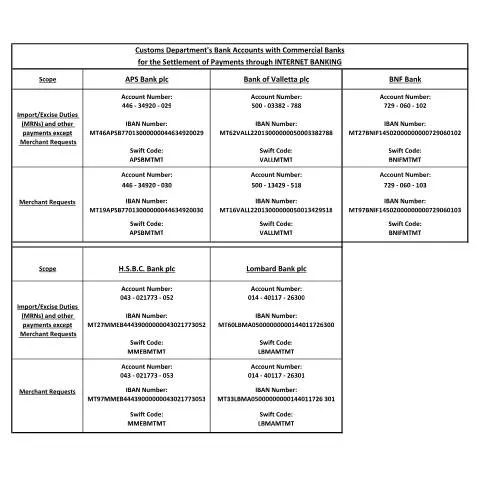
Understanding the Importance of the Payment Facilities Form
When it comes to managing your financial obligations, having the right banking information is essential. The Payment Facilities — bank-account-numbers-(internet-banking) form is an integral part of the tax reporting process in Malta, particularly under the authority of the income_tax department. This document is designed for individuals and entities who need to provide their banking details to facilitate tax payments or refunds through online banking channels.
The Regulatory Framework Behind the Document
Malta's tax system is governed by various laws and regulations, including provisions within the Public Administration Act (Cap. 595 of the Laws of Malta). The requirement for taxpayers to supply their banking details stems from the necessity for transparency and efficiency in tax collection. This form embodies the government's commitment to streamlining the payment processes, reducing administrative burdens, and enhancing compliance.
Clarifying the Role of the Payment Facilities Form
The purpose of the Payment Facilities — bank-account-numbers-(internet-banking) form is to enable taxpayers to communicate their banking information securely. This communication facilitates the following:
- Direct debit arrangements for tax payments
- Processing of tax refunds directly into the taxpayer’s bank account
- Ensuring compliance with tax obligations while minimizing delays
It is crucial to note that this form is not a tax return or an assessment form; rather, it acts as a supplementary document that supports the overall tax process.
Differentiating Between Related Forms
While several forms exist within the tax administration spectrum, each serves a distinct purpose. For example, the tax return form is used to declare income and calculate tax liability, whereas the Payment Facilities form specifically addresses the provision of banking details. Understanding this distinction is key to ensuring that you submit the correct documentation for your circumstances.
Submitting the Payment Facilities Form
When it comes to submitting the Payment Facilities — bank-account-numbers-(internet-banking) form, you have multiple options:
- Online Submission: Using the e-ID system to authenticate your identity, you can fill out the form and submit it electronically. This method is generally faster and allows for immediate processing.
- Paper Submission: Alternatively, you can download the form, fill it out manually, and submit it via postal mail or in person at your local tax office.
Each method has its own nuances, with electronic submissions often leading to quicker responses from the tax authorities.
Required Documentation for Accurate Submission
Completing the Payment Facilities form accurately is vital for avoiding issues down the line. While no additional documents are required for this specific form, you may want to prepare the following:
- Your Maltese ID card for identity verification
- Details of your bank account (IBAN, account number)
- Any prior tax correspondence if applicable
Ensuring that this information is correct can help facilitate the processing of your tax duties, including payments and refunds.
Processing and Tracking Your Submission
After you submit your Payment Facilities form, you may wonder about the subsequent steps. Generally, the processing timeline can vary based on the volume of submissions and the method used for submission:
| Method of Submission | Estimated Processing Time |
|---|---|
| Online Submission | 1-2 business days |
| Paper Submission | 5-10 business days |
If you wish to track your submission, you can contact the income_tax department directly or check through your e-ID account if applicable.
Addressing Potential Issues After Submission
In the event of a refusal or a need for corrections post-submission, it is essential to know how to address these concerns:
- If your form is denied, review the stated reasons and ensure you have provided accurate banking details.
- In case of missing documents or information, promptly gather the necessary paperwork and resubmit your form.
- For discrepancies, contact the income_tax department to clarify your situation and rectify any issues.
Timely action can prevent delays in tax payments and refunds, which can have downstream effects on your financial situation.
Implications of Non-compliance or Delays
Failing to submit the Payment Facilities form or providing incorrect information can lead to several consequences:
- Delayed tax refunds, potentially impacting your cash flow
- Complications with future payments, including penalties
- Increased scrutiny from tax authorities, possibly prompting further audits
Understanding your obligations in this matter is crucial for maintaining good standing with the income_tax department.
The Practical Impact on the User's Financial Obligations
By filling out the Payment Facilities — bank-account-numbers-(internet-banking) form, users take an important step in managing their tax responsibilities effectively. Accurate submission opens up various facilities:
- Facilitated digital payments, reducing the need for in-person visits to tax offices
- Streamlined processes for refunds, allowing for quicker access to funds
- Enhanced record-keeping due to improved digital tracking of payments and submissions
The proactive management of your banking information contributes to a smoother tax experience and can significantly mitigate financial stress.
Understanding the Use of Bank Account Numbers in Malta
In Malta, the structure of bank account numbers is crucial for both personal and business transactions. The format used here follows International Bank Account Number (IBAN) standards, which ensures that account numbers are unique and standardized across the banking sector. A standard Maltese IBAN consists of 31 characters, beginning with the country code 'MT', followed by two check digits, and then the basic bank account number. This uniformity facilitates easier and more secure transactions, particularly for international transfers.
When you open a bank account in Malta, you will receive your IBAN, which is essential for various transactions such as salary deposits, utility payments, and other financial activities. It is important to keep this number confidential and secure, as unauthorized access may lead to fraud or financial loss. Moreover, in the context of internet banking, having a clear understanding of your IBAN and how it operates can assist you in managing your finances effectively and responsibly.
Internet Banking Services in Malta: A Practical Guide
Internet banking in Malta has evolved significantly, with most banks offering a comprehensive range of services that cater to individual and corporate needs. To access these services, you must ensure that you have your e-ID linked to your bank account, as this is a common security measure across financial institutions. Online services typically include fund transfers, bill payments, and account management features that can be accessed via both desktop and mobile platforms.
Users should be aware that different banks may have varying levels of online functionality. Some may provide enhanced features such as real-time transaction notifications, budgeting tools, and investment options, while others may have more limited offerings. Familiarizing yourself with your bank's online services can enhance your banking experience and make financial management more efficient.
To get started with internet banking, you'll first need to register for online access through your bank's website. This process may include setting up a secure password and possibly answering security questions to verify your identity. Once registered, you can log in to perform transactions safely from the comfort of your home or on the go. Remember to always log out after your session to protect your account from unauthorized access.
Security Measures for Online Banking in Malta
As online banking becomes more prevalent, the importance of maintaining security cannot be overstated. In Malta, banks are required to implement robust security protocols to protect users from fraud and identity theft. When using internet banking services, it is essential to be aware of the various security measures in place and how you can further safeguard your information.
Multi-factor authentication (MFA) is increasingly common among banks in Malta. This involves a combination of something you know (like your password) and something you have (like a mobile device for receiving authentication codes). Users are strongly encouraged to enable MFA where available to add an additional layer of security to their accounts.
Moreover, users should regularly monitor their bank statements for any unauthorized transactions. Reporting discrepancies promptly can help mitigate potential losses and enable your bank to take swift action. Furthermore, ensuring that your computer or mobile device is equipped with updated antivirus software can prevent malware that might compromise your banking information.
Another critical aspect of security is ensuring you are using a secure internet connection. Avoid accessing your bank account over public Wi-Fi networks, as these can be susceptible to hacking. Instead, use a secure, private network whenever possible, particularly for sensitive transactions. By taking these precautions, you can enjoy the convenience of internet banking while minimizing the risks associated with online financial activities.