Understanding the Value Added Tax on Supply of Financial Services (VATFS) for 2022/2023
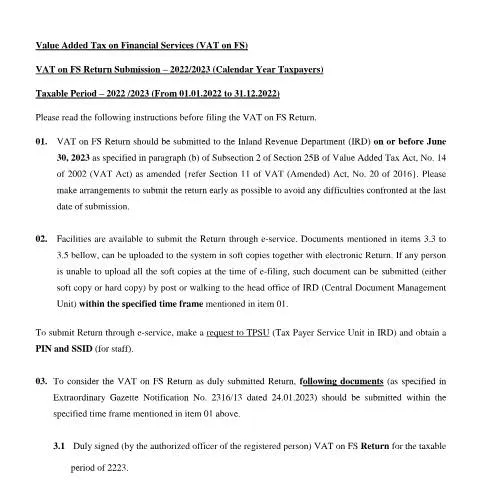
The Value Added Tax on Supply of Financial Services (VATFS) is a critical aspect for businesses operating in the financial services sector in Sri Lanka. If you are a taxpayer bound by the provisions of the VAT Act, understanding the nuances of your tax return submission is essential to ensure compliance and optimal financial management. The document titled Instructions for VAT on FS Return submission - 2223 - AY Taxpayers (Code: Asmt_VATFS_003_2223) provides comprehensive guidance for the submission of VAT for the fiscal year 2022/2023.
Key Deadlines and Submission Requirements
One of the most crucial points highlighted in the instructions is the submission deadline. The VAT on FS Return must be submitted to the Inland Revenue Department (IRD) by June 30, 2023. This deadline is specified under Section 25B of the VAT Act, No. 14 of 2002 as amended, as well as in the VAT (Amended) Act, No. 20 of 2016. Late submissions can lead to complications, hence early preparations are encouraged.
Electronic Submission Process
The document specifies that taxpayers have the option to submit their VAT FS Return electronically. This process can streamline your submission significantly, allowing you to upload relevant documents directly through the e-service platform. Should you opt for this route, you must first contact the Tax Payer Service Unit (TPSU) at the IRD to obtain a PIN and SSID for staff members, which are essential for accessing the e-service.
Necessary Documentation and Verification
For the VAT on FS Return to be considered duly submitted, several documents must accompany your return:
- A duly signed VAT on FS Return for the taxable period of 2022/2023.
- Three specific schedules:
- Schedule 01: Emoluments
- Schedule 02: Economic Depreciation
- Schedule 03: Classification of Turnover
- Audited Statements of Accounts for the year 2022/2023.
- Detailed profit or loss account (Income Statement) for the same year.
- Breakdown of value of supply declared in the VAT return as per Section 21 of the VAT Act.
It is important that these documents, whether submitted in hard copy or electronically, are certified by an auditor or managing director, ensuring that the IRD can validate your submission's authenticity.
Avoiding Common Pitfalls in VAT FS Return Submission
Taxpayers frequently encounter errors during the submission process. The document addresses several common mistakes to help you avoid them:
- Duplicate Codes: Ensure that no code in the emoluments (Schedule 01) or turnover (Schedule 03) is repeated. Aggregate values should be entered in the relevant schedule.
- Year of Purchase Entries: In Schedule 02, the third column "Year of purchased/constructed" must begin with the latest financial year (2022/2023). If space is insufficient, aggregate values for prior financial years should be indicated in the last row.
- Total Values Accuracy: Double-check total values entered in the relevant fields of the return.
- Social Security Contribution Levy (SSCL) Consideration: With the SSCL imposed from October 1, 2022, ensure that the calculation for this levy is accurately reflected in the return. The applicable entry for SSCL should be made in cage 100.
Detailed Tax Calculation Steps
When calculating tax for the VAT on FS Return, it is imperative to segregate the value addition attributed to financial services:
| Period | Action | Cage Reference | Calculation Method |
|---|---|---|---|
| 01.01.2022 - 30.09.2022 | Value Added Tax Calculation | Cage 90 | 18/118 on the relevant value addition |
| 01.10.2022 - 31.12.2022 | Value Added Tax Calculation | Cage 90 | 18/120.5 on the relevant value addition |
| 01.10.2022 - 31.12.2022 | Social Security Contribution Levy Calculation | Cage 100 | 2.5/120.5 on the relevant value addition |
Ensure that the values for cages 90 and 100 are calculated separately for the two periods. The sum of the calculations for Cage 90 should be entered into the relevant field, and the total for Cage 100 must reflect the SSCL due only for period two.
Final Submission Process
Once you have gathered all necessary documents and ensured accuracy in your calculations, it is time to submit your VAT on FS Return. The completed return, along with the accompanying documents, can either be submitted to the Central Document Management Unit (CDMU) at the IRD Head Office or any IRD regional office. This submission can also include electronic documentation if you have utilized the e-service.
Support and Guidance from the IRD
For any queries or assistance regarding the VAT on FS Return submission, you can contact the respective IRD officer allocated to your Taxpayer Identification Number (TIN) by calling 0112135135. This personalized guidance can be invaluable, especially if you encounter complex situations during the submission process.
Conclusion: The Importance of Compliance and Accuracy
Ensuring a thorough understanding of the VAT on FS Return submission process is crucial for all involved in the financial services sector. The outlined instructions serve as a roadmap for compliance, helping to navigate the often complex landscape of taxation in Sri Lanka. By adhering to the guidelines laid out in the Instructions for VAT on FS Return submission - 2223 - AY Taxpayers, businesses can mitigate risks associated with tax non-compliance while optimizing their financial operations.
Understanding the VAT Framework for Financial Services in Sri Lanka
In Sri Lanka, the Value Added Tax (VAT) on Financial Services (VATFS) is defined within a unique framework that caters specifically to the nuances of financial transactions. This framework is crucial for taxpayers operating within the financial sector, as it delineates the obligations and rights concerning VAT reporting and remittance. Financial services encompass a wide range of activities, including banking, insurance, and capital market operations. Understanding these distinctions is critical for proper compliance.
According to the Value Added Tax Act No. 14 of 2002, financial services generally include lending, borrowing, and the provision of guarantees, among others. Notably, the VAT does not apply to most financial services; therefore, careful consideration of which services are exempt is essential for proper VAT return submissions. Taxpayers must familiarize themselves with the definitions and guidelines provided by the Department of Inland Revenue (DIR) to navigate this complex landscape effectively. This understanding aids in avoiding common pitfalls, such as misclassifying services or failing to identify exemptions.
Key Deadlines and Important Dates for AY Taxpayers
Timely submissions are crucial for staying compliant with the tax regulations surrounding VATFS returns. The tax year in Sri Lanka runs from April 1 to March 31, and various deadlines apply throughout this period. For Assessment Year (AY) Taxpayers, the VAT returns must typically be filed within a specific timeframe after the end of each quarter, which requires meticulous record-keeping and planning.
For instance, the VAT returns for the first quarter ending June 30 must be submitted by July 20. Subsequent deadlines follow similarly for the remaining quarters, with quarterly returns due by the 20th of the following month after each quarter's closure. Additionally, it is crucial to stay abreast of any announcements from the DIR concerning extensions or changes to deadlines, especially in light of extraordinary circumstances that may affect operational capacities.
Taxpayers should establish a calendar to track these key dates effectively. Incorporating reminders can mitigate the risks associated with late submissions, which may incur penalties and interest on unpaid taxes. For those with digital capabilities, utilizing e-services through the ICTA (Information and Communication Technology Agency) can streamline the submission process and ensure compliance with established timelines.
Common Challenges Faced by AY Taxpayers in VATFS Submission
While the VATFS framework is designed to guide taxpayers, several challenges frequently arise during the submission of VAT returns. Firstly, the inherent complexity of distinguishing between taxable and exempt services can lead to errors. Taxpayers often misinterpret the definitions provided by the DIR, resulting in inaccurate returns. For example, transactions involving mixed services where both taxable and exempt elements exist can complicate the VAT calculation process.
Moreover, maintaining accurate records is essential yet often challenging for financial institutions operating at a high volume of transactions. Missing or incomplete documentation can hinder the ability to substantiate claims during audits or assessments. Therefore, robust accounting and record-keeping systems are non-negotiable for AY Taxpayers to facilitate precise VAT calculations and submissions.
Additionally, changes in legislation or administrative practices can create uncertainty among taxpayers. As regulations evolve, staying informed of updates through official communications from the DIR is critical. Taxpayers must be proactive in seeking guidance, whether through direct consultation with tax professionals or by attending workshops organized by the DIR aimed at educating taxpayers about their obligations under the VATFS framework.