Navigating the Tourist VAT Refund Scheme: Understanding the Guide for Authorized Retailers
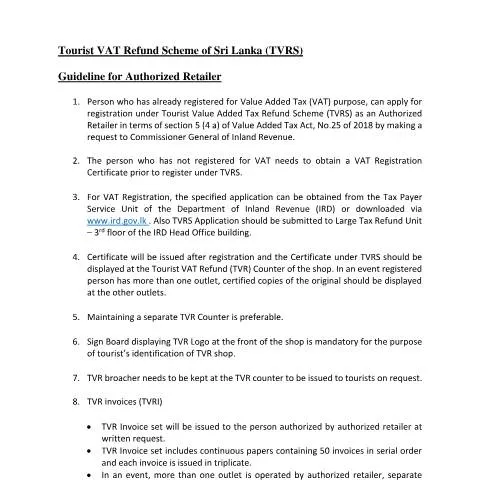
The Tourist VAT Refund Scheme (TVRS) in Sri Lanka is an initiative that aims to promote tourism by allowing foreign visitors to reclaim Value Added Tax (VAT) on qualifying purchases made during their stay. For retailers, understanding the intricacies of this scheme and the associated guidelines is essential for compliance and to facilitate a smooth experience for tourists. The official Guideline for Authorized Retailers serves as a comprehensive resource for these retailers, outlining the necessary steps, responsibilities, and best practices to adhere to the TVRS requirements. This guide delves into the critical aspects of the document, helping authorized retailers navigate the VAT refund process effectively.
Key Definitions and Concepts: Building a Solid Foundation
To engage fully with the TVRS, retailers must familiarize themselves with certain key terms and conditions outlined in the guideline. Understanding these concepts is crucial to ensuring compliance and successfully facilitating VAT refunds for tourists.
VAT Registration and Eligibility
- Authorized Retailer: Any individual or entity registered for VAT that wishes to participate in the TVRS must first apply to the Commissioner General of Inland Revenue.
- Value Added Tax (VAT): A tax on the value added to goods and services during their production and distribution. The current applicable VAT rate in Sri Lanka is subject to change based on government policy.
- Tourist Eligibility: To be eligible for VAT refunds, tourists must meet specific criteria, including being a non-citizen or non-resident, holding a valid visitor visa, and not being a dual citizen of Sri Lanka.
Retailers should prioritize understanding these foundational terms, as they form the basis of the operational framework within which the TVRS functions.
Operational Guidelines for Authorized Retailers
The Guideline for Authorized Retailers outlines a series of procedural steps that retailers must follow to ensure compliance with the TVRS requirements. The operational guidelines are structured to prevent misunderstandings and streamline the refund process for tourists.
Application Process for Retailers
Retailers interested in participating in the TVRS must adhere to the following steps:
- Registration for VAT: Retailers who are not currently registered for VAT must first acquire a VAT Registration Certificate from the Tax Payer Service Unit of the Department of Inland Revenue (IRD).
- Submitting the TVRS Application: Once VAT registration is confirmed, retailers must submit the TVRS application to the Large Tax Refund Unit, located on the 3rd floor of the IRD Head Office.
- Display Requirements: Upon successful registration, retailers are required to display their TVRS certificate prominently at the Tourist VAT Refund Counter within their establishment. In cases where a retailer operates multiple outlets, certified copies of the TVRS certificate must be displayed in each location.
Following these guidelines is imperative to maintain compliance and ensure that tourists can easily identify participating retailers during their shopping experience.
Facilitating the VAT Refund Process: Invoicing and Record Keeping
Once registered, authorized retailers must execute specific invoicing practices to facilitate VAT refunds for eligible tourists. Adhering to these invoicing guidelines not only supports compliance but also enhances the shopping experience for tourists.
Issuing VAT Refund Invoices
There are specific guidelines governing the issuance of TVR invoices (TVRI) to tourists:
- Invoice Quantity: Authorized retailers must issue TVRI in triplicate when a tourist makes a purchase exceeding LKR 50,000 (exclusive of VAT). The maximum number of invoices a retailer can issue is three per day per eligible tourist.
- Record Maintenance: Retailers must keep the third copy of each TVRI for their records and be prepared to submit these records to the IRD upon request.
- Commercial Invoices First: Prior to issuing a TVRI, retailers must first provide a standard commercial invoice corresponding to the purchase.
These requirements ensure that retailers maintain adequate records and provide tourists with the proper documentation needed to claim VAT refunds.
Eligibility Verification: Ensuring Compliance
Before issuing a VAT refund invoice, retailers must verify the eligibility of the tourist based on specific criteria. This step is critical to preventing fraudulent claims and ensuring that the refund process is legitimate.
Verification Checklist for Tourists
- Confirm that the tourist is a non-citizen or non-resident of Sri Lanka.
- Ensure that the tourist possesses a valid visitor visa as issued by the Controller General of Immigration and Emigration of Sri Lanka.
- Check the age of the tourist; they must be no less than eighteen years old at the time of purchase.
- Verify that the tourist’s stay in Sri Lanka is less than ninety days by the time the refund claim is made at the airport.
- Affirm that the tourist is not a Sri Lankan dual citizen.
This verification process is essential for maintaining the integrity of the TVRS and ensuring that only eligible tourists can reclaim VAT.
Understanding Goods and Services: What Qualifies for Refunds
Not all goods purchased by tourists are eligible for VAT refunds. The guideline outlines certain exclusions that retailers must be aware of to avoid complications during sales.
Exclusions from the VAT Refund Scheme
- VAT Exempt Goods: Some goods are exempt from VAT and thus do not qualify for refunds under the TVRS.
- Goods Consumed in Sri Lanka: Items that are either wholly or partially consumed within Sri Lanka, such as certain food items and beverages, do not qualify for VAT refunds.
- Services: Services, including hotel accommodations and other hospitality charges, are excluded from VAT refunds.
It is crucial for retailers to be aware of these exclusions to accurately guide tourists and prevent misunderstandings during the purchase process.
Compliance and Reporting: The Importance of Accuracy
Accurate compliance with the guidelines is not just about following the rules; it also involves meticulous reporting to the IRD. Retailers must uphold integrity in their practices to prevent potential legal repercussions.
Mandatory Reporting Obligations
- Invoice Submission: Images of TVRI and commercial invoices must be submitted to the IRD via email immediately after the sale has occurred.
- False Information Consequences: Issuing TVRS invoices with incorrect details can lead to registration cancellation and possible legal action against the retailer.
- Documentation for Customs: Retailers may also need to report certain transactions to other authorities, such as the Central Bank for foreign currency sales, depending on the nature of the goods sold.
Retailers must remain vigilant in maintaining accurate records and reporting to avoid penalties and ensure a seamless experience for tourists availing themselves of VAT refunds.
Special Considerations for Gem and Jewelry Sales
Given the prominence of the gemstone and jewelry industry in Sri Lanka, specific guidelines apply to retailers in this sector when engaging with the TVRS.
Enhanced Documentation Requirements
For gem and jewelry sales, additional documentation is required to ensure compliance with the TVRS:
- Retailers must include their National Gem and Jewellery Authority (NGJA) dealer license number and file number on the TVRI.
- For gem sales, the retailer must specify the type and weight of each gem variety sold, while for jewelry, the weight of the jewelry must also be indicated.
By adhering to these specific requirements, retailers in the gemstone and jewelry sectors can navigate the complexities of the TVRS while capitalizing on the international demand for Sri Lankan gems.
The Pathway to Compliance: Maintaining Good Standing with the IRD
Compliance with the guidelines laid out in the Guideline for Authorized Retailers is not merely a bureaucratic obligation but a pathway to fostering trust and integrity within the tourism and retail sectors. Retailers must recognize the importance of maintaining their TVRS registration and the repercussions of non-compliance.
Termination of Registration
Retailers must be aware that the IRD reserves the right to terminate their TVRS registration under specific circumstances outlined in the guidelines. These include:
- Violating any laws or regulations associated with VAT as per the Value Added Tax Act No. 14 of 2002.
- Failure to adhere to the stipulated guidelines concerning the issuance and maintenance of TVRI.
Maintaining compliance is therefore paramount, as it ensures ongoing participation in the TVRS and contributes to the overall promotion of tourism in Sri Lanka.
Voluntary Cancellation of TVRS Registration
In instances where a retailer wishes to discontinue their participation in the TVRS, the guidelines stipulate a process for voluntary cancellation. This is a straightforward procedure that can be initiated by the retailer at any time.
Steps for Voluntary Cancellation
- Retailers must return their TVRS certificate along with any remaining TVRI invoices to the IRD.
This step is essential for ensuring proper closure of the retailer's participation in the scheme and maintaining accurate records with the IRD.
Continuously Adapting to Regulatory Changes
The landscape of VAT regulations and tourism-related policies is subject to change based on government priorities and economic factors. As a result, retailers must stay informed about updates to the TVRS and the relevant guidelines.
Staying Updated with Official Announcements
- Authorized retailers should regularly check the IRD's official communications and gazette notifications regarding any changes to the TVRS.
- Engaging with industry associations and bodies can provide vital insights into best practices and changes in regulations affecting the tourism sector.
By remaining proactive and ensuring compliance with new regulations, authorized retailers can enhance their service offerings to tourists and contribute positively to Sri Lanka's tourism economy.
Understanding the Role of Authorized Retailers in Sri Lanka
Authorized retailers play a pivotal role in the distribution of goods and services in Sri Lanka, acting as intermediaries between manufacturers and consumers. These businesses are officially recognized by relevant authorities, such as the Department of Trade and the Consumer Affairs Authority, to ensure that they comply with local laws and regulations. Being designated as an authorized retailer not only enhances a business's reputation but also provides access to exclusive products and pricing structures from suppliers.
The functions of authorized retailers extend beyond mere sales; they are also responsible for maintaining product quality and consumer satisfaction. They are often required to undergo regular audits and provide comprehensive reports to the manufacturers and regulatory bodies. This ensures compliance with the standards set forth under the Consumer Protection Act of 2003, which aims to safeguard consumer rights while promoting fair trade practices.
Moreover, authorized retailers are expected to offer after-sales services, such as product warranties and customer support. This aspect of their role is crucial for building trust with consumers and maintaining a competitive edge in the marketplace. Additionally, authorized retailers may collaborate with manufacturers to host promotional events or product launches, further driving consumer engagement and brand loyalty.
Regulatory Compliance and Licensing Procedures
To operate as an authorized retailer in Sri Lanka, businesses must navigate a range of regulatory requirements and licensing procedures. The process begins with registering the business entity with the Department of the Registrar of Companies (DRC), an essential step for all commercial activities.
Once registered, retailers must apply for the necessary trade licenses from the local municipal council or relevant government body. Depending on the type of products sold, specific permits may also be required, particularly for regulated items such as pharmaceuticals, electronics, or alcohol. Compliance with the Excise Ordinance and other sector-specific legislation is crucial, and failure to obtain the appropriate licenses can result in penalties or closure of the business.
Additionally, retailers must adhere to the guidelines set forth by the Consumer Affairs Authority (CAA), which includes maintaining transparent pricing, proper labeling, and the right to return goods in accordance with consumer rights legislation. Regular audits by the CAA ensure that retailers remain compliant, and businesses should be prepared to demonstrate their adherence to these regulations through documented records.
In summary, while the journey to becoming an authorized retailer may seem daunting, it is a necessary path to ensure legitimacy and operational success in the Sri Lankan market. Businesses must stay updated on changes in regulations to avoid potential legal pitfalls and to provide customers with a reliable shopping experience.
Strategies for Successful Partnership with Manufacturers
Establishing a successful partnership with manufacturers is crucial for authorized retailers in Sri Lanka. A strong relationship not only leads to a steady supply of goods but also provides retailers with the leverage needed to negotiate favorable terms and conditions. To foster such partnerships, retailers should prioritize open communication and align their business objectives with those of the manufacturers.
One effective strategy is to conduct regular market research to understand consumer preferences and trends. By sharing these insights with manufacturers, retailers can help shape product offerings and marketing strategies, ensuring that both parties benefit from increased sales and customer satisfaction. Moreover, retailers should be proactive in providing feedback on product performance and customer inquiries, which can assist manufacturers in improving their products and services.
Another critical aspect is the establishment of clear contractual agreements that outline the terms of the partnership, including pricing, payment terms, delivery schedules, and responsibilities for marketing. Well-defined contracts protect both parties and provide a framework for addressing any disputes that may arise. Retailers should not hesitate to negotiate terms that serve their business interests while maintaining a fair partnership with manufacturers.
Finally, participating in joint marketing campaigns and training programs offered by manufacturers can strengthen the retailer-manufacturer relationship. Such initiatives not only enhance the retailer's knowledge of the products but also equip them with the tools needed to effectively promote and sell the items in their retail environments. This collaborative approach ultimately benefits consumers through better service and product availability.