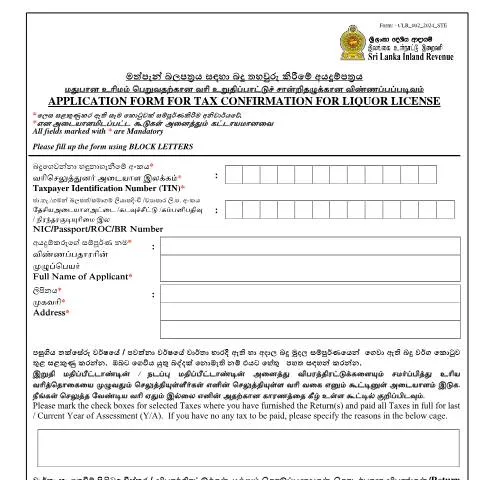
Navigating the Application Form for Tax Confirmation for Liquor License (CLR_002)
For businesses venturing into the liquor industry in Sri Lanka, securing the Tax Confirmation for Liquor License is an essential step to ensure compliance with local regulations. The completion of the Application Form for Tax Confirmation for Liquor License (CLR_002) is a prerequisite for obtaining necessary clearances. This form is not merely a bureaucratic step but a foundational document that verifies your business's tax obligations and payments.
Understanding the Role of the CLR_002 Form
The CLR_002 form serves as a formal declaration of your tax standing with the Department of Inland Revenue. By submitting this application, you affirm that your business complies with all tax laws, having paid the appropriate taxes related to liquor sales and operations. This form is crucial as it facilitates the licensing process, ensuring that only compliant businesses are authorized to operate within the liquor industry.
The importance of this form cannot be overstated. Failure to complete and submit the CLR_002 accurately can lead to delays in obtaining your liquor license, potentially jeopardizing your business's operations.
Who is Required to Submit This Form?
The CLR_002 form must be submitted by all entities seeking to acquire or renew a liquor license. This includes:
- Sole proprietorships: Individual business owners intending to sell liquor.
- Partnerships: Two or more individuals who have come together for business purposes.
- Corporations: Registered companies operating within the liquor sector.
- Foreign entities: Businesses established outside Sri Lanka wishing to enter the local liquor market.
Each applicant must ensure that they provide comprehensive and accurate information to avoid complications during the review process.
Completing the CLR_002 Form: A Detailed Examination
Completing the CLR_002 form requires careful attention to detail. Here, we will break down the critical sections of the application and the common pitfalls to avoid:
Section 1: Taxpayer Identification
In this section, you will be required to fill in your Taxpayer Identification Number (TIN). This is essential as it links your application to your tax records. Ensure that this number is accurate; discrepancies can lead to significant delays.
Section 2: Business Information
Applicants must provide details such as the National Identity Card (NIC) number, passport number for foreigners, or company registration number. This identification is vital for verifying the legal status of the applicant.
Section 3: Full Name and Address
Your full name and address must be filled in using BLOCK LETTERS. Accuracy in this section is critical because any errors can lead to miscommunication or failed applications. Additionally, all fields marked with * are mandatory.
Section 4: Tax Returns and Payments
This section requires checking boxes corresponding to the taxes for which you have submitted returns and made payments. Specifically, you will need to indicate:
- Income Tax: Have you submitted your Income Tax Return for the last or current year?
- Value Added Tax (VAT): Are your VAT returns filed?
- Social Security Contribution: Have you complied with social security contributions?
Fill in the amounts paid accurately in the specified fields to avoid any discrepancies during the evaluation process.
Essential Documents for Submission
Along with the CLR_002 form, applicants must prepare and submit supporting documents to validate their application. Here’s a list of essential documents:
| Document Type | Description | Required for |
|---|---|---|
| Tax Returns | Latest income tax returns and payment receipts. | All applicants |
| Company Registration | Certificate of incorporation for companies. | Corporations and partnerships |
| Identification | NIC or passport for identification verification. | All applicants |
| Previous License | Copy of the existing liquor license if applicable. | Renewal applicants |
Submission Process: Steps to Take
Once you have completed the CLR_002 form and gathered the required documents, the next step is to submit your application. Here’s a step-by-step guide:
- Review: Double-check every detail on your completed form and attachments for accuracy.
- Submission: Submit the application in person at the relevant Department of Inland Revenue office or via the online portal if available.
- Payment of Fees: Ensure to pay any processing fees associated with the application. Retain the payment receipt.
- Follow-Up: After submission, monitor the status of your application through the official channels.
What Happens After Submission?
Upon submission of your CLR_002 form, the review process begins. The Department of Inland Revenue will assess your application based on the information provided and the completeness of your supporting documents.
If your application is approved, you will receive a confirmation of your tax standing, which is a crucial document for finalizing your liquor license application with the relevant authorities.
Understanding the Implications of Your Application
Filing the CLR_002 is not just a procedural requirement; it carries significant implications for your business. Accurate completion and timely submission can open avenues for:
- Licensing: The ability to legally operate and sell liquor.
- Credibility: Establish your business as a compliant and responsible entity in the eyes of regulators.
- Operational Continuity: Avoid potential fines or legal issues that could arise from failure to apply correctly.
Conversely, failing to submit the form or providing inaccurate information can lead to license denial, operational disruptions, and potential legal consequences.
Key Dates and Timelines for Applicants
Understanding the timelines associated with the CLR_002 form is crucial for effective planning. Key dates include:
- Submission Deadline: Typically aligns with the fiscal year, end of March. Check with the Department of Inland Revenue for specific dates.
- Processing Time: Expect around 2-4 weeks for your application to be reviewed, depending on the volume of applications received.
- Renewal Deadlines: Existing licenses typically require renewal every year—plan to submit the CLR_002 at least one month prior to the renewal date.
Keeping a calendar of these important dates will help ensure that you remain compliant and avoid any disruptions in your business operations.
Final Considerations for Successful Navigation
Completing the Application Form for Tax Confirmation for Liquor License may appear daunting, but understanding each component and its importance can simplify the process significantly. Here are some practical tips to ensure smooth sailing:
- Seek Assistance: If you face complexities, consider consulting with a tax professional or legal advisor familiar with liquor licensing in Sri Lanka.
- Keep Records: Maintain copies of all submissions and correspondence related to your application.
- Stay Informed: Regularly check the official website of the Department of Inland Revenue for updates on policies and procedures.
By following these guidelines and ensuring thorough preparation, you can successfully navigate the CLR_002 application process and lay the groundwork for operating your business within the liquor industry legally and responsibly.
Understanding the Tax Confirmation Process for Liquor Licenses
In Sri Lanka, obtaining a liquor license is a multi-faceted process that is critical for businesses intending to sell alcoholic beverages legally. One of the essential components of this process is securing a Tax Confirmation, which serves as proof of compliance with local taxation laws. The Tax Confirmation for a liquor license is primarily regulated by the Department of Excise under the Ministry of Finance and is crucial for demonstrating that the applicant has fulfilled their tax obligations.
The application for Tax Confirmation must be aligned with the Excise Ordinance, which outlines the specific taxation parameters for various categories of liquor. Applicants are advised to familiarize themselves with these requirements, as any discrepancies can lead to delays or rejection of their application. It is beneficial to consult with a tax advisor or legal expert who specializes in excise law to ensure all aspects are covered meticulously.
To initiate the Tax Confirmation process, applicants must complete the relevant sections of the Application Form, which may require detailed financial statements and documentation regarding past tax payments. It's imperative to have your documents organized, as incomplete submissions will not only prolong the process but may also result in additional scrutiny by the authorities.
Essential Documentation for the Application
When applying for a Tax Confirmation for a liquor license, certain documents are indispensable. The following list outlines the essential documentation that must accompany the Application Form:
- National Identity Card (NIC): This is crucial for identification purposes. Ensure that the NIC is up-to-date and accurately reflects your personal details.
- Business Registration Documents: These must include your Certificate of Incorporation (for companies) or a Business Registration Certificate for sole proprietorships. This verifies the legal standing of your business.
- Financial Statements: Most recent financial statements must be submitted, showing revenue and tax obligations. This documentation is vital for demonstrating your financial health and your capability to meet tax liabilities.
- Tax Payment Receipts: Receipts of previous tax payments, especially those relating to excise taxes, are often required to validate your compliance with tax regulations.
- Detailed Business Plan: Particularly for new applicants, a detailed business plan outlining your projected sales and operations can substantiate your application.
- Compliance with Local Regulations: Any additional permits or compliance documents from local government entities may also be requested, affirming that your business adheres to local laws and regulations.
Each of these documents should be prepared and submitted in accordance with the guidelines specified by the Department of Excise. Failing to provide the necessary paperwork can result in delays and potential legal issues. Always ensure that you keep copies of all submissions for your records.
Common Challenges in the Application Process
While applying for a Tax Confirmation for a liquor license, applicants may encounter several challenges. Awareness of these potential hurdles can facilitate a smoother application process:
- Incomplete Documentation: As highlighted earlier, incomplete submissions are a primary reason for delays. It is essential to cross-check all requirements before submission.
- Regulatory Changes: Tax laws and regulations may change over time. Staying updated on any modifications in the Excise Ordinance or related taxation policies is crucial for compliance.
- Tax Assessment Discrepancies: If there are discrepancies in your previous tax assessments, it could lead to further investigations. Ensure your financial records are accurate and up to date.
- Communication Barriers: Understanding the formal language used in documentation and communication with government officials can be a hurdle. It might be beneficial to engage a local consultant or legal advisor who is fluent in the process.
- Delays in Processing: The processing of tax confirmations can take time, especially if additional reviews or inspections are deemed necessary by the authorities. Applicants should factor in potential delays when planning their business operations.
By identifying these challenges before beginning the application process, applicants can take proactive measures to mitigate risks and enhance their chances of securing the necessary Tax Confirmation without unnecessary delays.