Understanding the Statement of Assets and Liabilities: The Framework
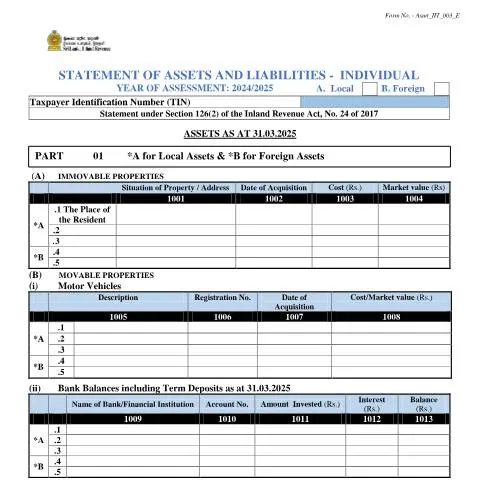
The Statement of Assets and Liabilities - Asmt_IIT_003_E is a crucial document for individuals in Sri Lanka, particularly for taxpayers involved in the annual assessment process. It plays a vital role in ensuring compliance with the Inland Revenue Act, No. 24 of 2017, specifically under Section 126(2) which mandates the disclosure of both movable and immovable properties.
This statement is not merely a formality; it is a comprehensive overview of an individual's financial standing as of 31st March 2025, and serves as a basis for tax assessments. Understanding its components is essential for individuals, especially when considering the implications of inaccuracies or omissions.
Dissecting the Components: What to Include
The form consists of multiple sections that require specific information regarding assets and liabilities, categorized under local and foreign headings. It is paramount to categorize assets correctly to ensure compliance. Below is a breakdown of the key sections:
| Category | Description | Considerations |
|---|---|---|
| Immovable Properties | Details of real estate owned | Include date of acquisition, cost, and market value |
| Movable Properties | Assets like vehicles and bank balances | Specify registration numbers and account details |
| Business Assets | Capital and current accounts related to business holdings | Report balances accurately |
| Liabilities | All debts including loans and credit card balances | Include security details and repayment history |
| Gifts and Acquisitions | Assets obtained through gifts or exchanges | Must indicate the nature of acquisition |
Immovable Properties: Detailed Breakdown
When filling out the section for Immovable Properties, individuals must ensure that they provide accurate and complete information regarding the properties owned as of the specified date. Each property should be listed with:
- Address of the Property: Exact location to avoid ambiguity.
- Date of Acquisition: Important for historical valuation.
- Cost and Market Value: Accurate estimation is crucial as it reflects on tax liabilities.
Movable Properties: Common Pitfalls
In the section concerning Movable Properties, taxpayers often overlook vital details. This includes:
- Accurate registration numbers for vehicles.
- Ensuring bank balances reflect the amounts as of 31st March 2025.
- Reporting any dividends from shares held, as this directly influences liabilities.
Being meticulous in these details can significantly impact the final assessment by tax authorities.
Special Circumstances: Who Needs to File?
While the form primarily caters to individuals, there are specific cases that warrant special attention. Foreign nationals residing in Sri Lanka must also complete this form, taking care to differentiate between local and foreign assets. Minors, or individuals lacking the capacity to file independently, should have their guardians or legal representatives submit the form on their behalf. It's essential for these representatives to provide accurate information to avoid legal repercussions.
Urgent Situations: What if You Miss the Deadline?
The submission of the Statement of Assets and Liabilities is strictly time-sensitive, with deadlines often set in alignment with the fiscal year. If you find yourself unable to submit by the deadline due to unforeseen circumstances, it is advisable to:
- Immediately contact the relevant tax authority for guidance.
- Document the reasons for the delay to provide context upon filing.
- Be prepared to face potential penalties for late submission.
Timelines and Scheduling: A Critical Overview
Taxpayers should be acutely aware of the timeline associated with the Statement of Assets and Liabilities. The fiscal year for many individuals aligns with the calendar year ending 31st March. Consequently, the form must typically be submitted within a specified timeframe following this date.
After submission, the Inland Revenue Department will review the statement, and assessments are generally communicated within a designated period. This review can lead to additional inquiries, requiring taxpayers to be prepared for potential follow-ups.
Consequences of Omission: Legal Implications and Responsibilities
It is of utmost importance to acknowledge the legal ramifications of failing to accurately report assets and liabilities. Under the Inland Revenue Act, providing false information can lead to:
- Penalties that include fines or further legal action.
- Potential audits, which could extend scrutiny to additional tax filings.
- Reassessment of tax obligations based on discovered discrepancies.
Thus, it is crucial for individuals to maintain comprehensive records and ensure that all entries on their statement are truthful and complete.
Integration into Broader Tax Processes: The Bigger Picture
The Statement of Assets and Liabilities does not exist in isolation; it forms part of a broader landscape of tax compliance and assessment in Sri Lanka. It is interconnected with:
- Income Tax Returns: The statement feeds directly into income tax evaluations.
- Wealth Tax Assessments: Accurate asset declarations influence wealth tax calculations.
- Audits and Investigations: Inconsistencies in this statement can trigger comprehensive audits.
Regulatory Framework: Historical Context
The inception of the Statement of Assets and Liabilities is rooted in Sri Lanka's commitment to enhancing transparency and accountability within its tax system. As part of the efforts to harmonize with international standards, the introduction of this requirement serves to combat tax evasion and promote a fair economic environment.
The legislative foundation, rooted in English common law principles via the Interpretation Ordinance, continues to shape the operational landscape, ensuring that tax regulations evolve in tandem with the country's socioeconomic dynamics.
Clarifying Distinctions: This Form vs. Others
Many individuals may confuse the Statement of Assets and Liabilities with similar forms, such as income declarations or business profit statements. However, the key distinction lies in the focus on comprehensive asset reporting rather than income generation.
This form specifically requires details of all assets and liabilities, offering a complete financial snapshot, as opposed to merely reporting income or profits. Understanding these nuances is critical for taxpayers to navigate their obligations effectively.
In summary, completing and filing the Statement of Assets and Liabilities is an essential aspect of tax compliance in Sri Lanka. It demands attention to detail, understanding of legal implications, and awareness of broader tax processes. Maintaining transparency and accuracy is not only a legal obligation but also a step towards establishing trust within the financial ecosystem.
Understanding the Importance of the Statement of Assets and Liabilities in Sri Lanka
The Statement of Assets and Liabilities serves as a fundamental financial instrument for various stakeholders in Sri Lanka, including individuals, businesses, and government agencies. It provides a clear overview of a person’s or an entity's financial position at a specific point in time, outlining their assets, liabilities, and net worth. This document is especially significant for compliance with legal regulations and financial management purposes. For instance, when applying for loans or credit, financial institutions often require a detailed Statement of Assets and Liabilities to assess creditworthiness.
Moreover, for professionals in public service or those managing public funds, the Statement of Assets and Liabilities is a vital tool to ensure transparency and accountability. According to the provisions of the Public Administration Circular No. 02/2019, public officials must declare their assets and liabilities to mitigate the risks of corruption and promote ethical governance.
Additionally, for entrepreneurs and business owners, this statement aids in tracking financial health and making informed decisions regarding investments, operational costs, and expansion plans. The process of preparing this statement can also facilitate discussions with financial advisors and stakeholders regarding potential growth strategies and risk management.
Common Pitfalls and Challenges in Preparing the Statement of Assets and Liabilities
While preparing a Statement of Assets and Liabilities may seem straightforward, several challenges could arise during the process. One prevalent issue is the accurate valuation of assets. Many individuals and businesses may struggle to determine the fair market value of their properties, investments, and other tangible assets. To mitigate this, it is advisable to consult with certified appraisers or financial experts who can provide an objective assessment of asset value.
Another common pitfall is the inclusion of liabilities. It’s vital to ensure that all debts—including loans, credit card balances, and potential future obligations—are disclosed. Omitting any liabilities could lead to significant legal repercussions, especially for public officials or those applying for financial assistance and loans. Furthermore, maintaining proper records and documentation throughout the year makes it easier to compile an accurate Statement of Assets and Liabilities.
Moreover, individuals may sometimes overlook the necessity of updating their Statements regularly. Sudden changes in financial situations, such as inheritance or major purchases, must be reflected promptly to provide a true financial picture. Maintaining an updated statement can help in audits, tax assessments, and compliance with financial regulations.
Digital Submission of the Statement of Assets and Liabilities: A Modern Approach
With the rapid advancement of technology, the digital submission of the Statement of Assets and Liabilities has become a viable option in Sri Lanka. The ICTA (Information and Communication Technology Agency of Sri Lanka) promotes e-services and digital government forms to streamline various administrative processes. As a result, individuals and businesses can now utilize online platforms to submit their Statements electronically, enhancing convenience and efficiency.
The online process generally involves visiting the designated portal, filling out the required forms, and uploading supporting documents. This method not only reduces paperwork but also minimizes the chances of errors that can occur during manual entries. Digital submissions can also expedite processing times, leading to quicker feedback from the relevant authorities.
However, it is crucial to ensure that all data is entered accurately and that all necessary documents are attached, as incomplete submissions can result in delays or rejections. The Electronic Transaction Act provides the legal framework to support these digital submissions, ensuring that electronic records are considered valid and binding.
Furthermore, as awareness grows regarding the importance of digitalization in administrative processes, stakeholders are encouraged to familiarize themselves with the online submission system. Educational workshops and resources provided by government entities can assist in mitigating any challenges faced during the transition from paper to digital formats.