Understanding the Statement of Assets and Liabilities: A Comprehensive Guide
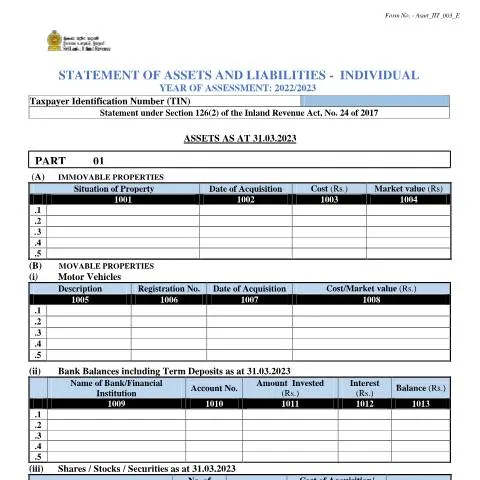
In the realm of financial compliance, the Statement of Assets and Liabilities - Form Asmt_IIT_003_E holds significant importance for individuals in Sri Lanka. This document necessitates meticulous attention, reflecting one's financial landscape for the assessment year 2022/2023. The completion of this form is not merely a bureaucratic task; it plays a pivotal role in determining one’s tax obligations and financial transparency.
Who Is Obligated to Submit This Statement?
The Statement of Assets and Liabilities is required from individuals whose financial activities exceed prescribed thresholds or who engage in certain types of transactions as outlined by the Inland Revenue Act, No. 24 of 2017. Specifically, individuals must declare:
- Assets acquired during the assessment year.
- Movable and immovable properties owned as of March 31, 2023.
- Liabilities incurred that affect one’s net worth.
This form is particularly pertinent for individuals engaged in business activities, as the declaration of business-related assets and liabilities is crucial for accurate tax reporting.
The Chronology of Submission: From Preparation to Filing
Completing the Statement of Assets and Liabilities entails a structured approach. Here is a chronological outline of the process:
- Gathering Documentation: Begin by collecting all relevant documents, including property deeds, bank statements, and evidence of shareholdings.
- Completing the Form: Fill out each section of the form accurately, ensuring that each asset and liability is documented as of March 31, 2023.
- Verification: Review the completed form for accuracy. A declaration of incorrect information can lead to penalties.
- Choice of Submission Channel: Decide whether to submit online through the digital government portal or in person at your local Inland Revenue office.
- Submission: Submit the completed form along with any necessary supporting documentation.
- Await Confirmation: After submission, allow time for processing and await any official correspondence regarding your submission.
Dissecting the Form: Key Sections Explored
The Statement of Assets and Liabilities consists of several critical sections, each requiring attention to detail:
A. Immovable Properties
In this section, list all real estate properties. Include:
- Property description.
- Date of acquisition.
- Cost and current market value.
Failure to provide accurate market values can misrepresent your financial standing.
B. Movable Properties
This encompasses various assets, including motor vehicles, bank balances, and securities. Particular attention should be given to:
- Motor Vehicles: Ensure you provide registration numbers and acquisition dates.
- Bank Balances: Detail all accounts, including interest accrued up to March 31, 2023.
- Securities: List shares and their current market values accurately.
C. Liabilities
Declare all liabilities incurred during the financial year, detailing:
- Nature of the liability.
- Amount outstanding as of March 31, 2023.
- Payments made during the assessment year.
Choosing Your Submission Channel: Digital vs. Paper
The advent of digital platforms has transformed the process of submitting the Statement of Assets and Liabilities. There are primarily three methods:
1. Online Submission
Utilizing the online portal provided by ICTA (Information and Communication Technology Agency) ensures a streamlined, efficient process. The advantages include:
- Immediate confirmation of submission.
- Accessibility from anywhere, reducing the need for physical travel.
- Potential for quicker processing times.
2. Paper Submission
Some may prefer hand-delivering their forms to local Inland Revenue offices. This method allows for direct interaction but might come with longer processing times.
3. Kiosk Submission
In select locations, self-service kiosks are available for form submissions. This method combines aspects of both online and paper submissions, providing a unique approach for users preferring a tactile experience.
What’s at Stake: Consequences of Non-Compliance
Submitting the Statement of Assets and Liabilities is not merely a formality; it carries substantial weight in terms of legal compliance and financial repercussions:
- Legal Implications: Failing to submit or providing inaccurate information can result in penalties as per the Inland Revenue Act.
- Tax Audits: Non-compliance may trigger audits, leading to more extensive scrutiny of one's financial activities.
- Financial Transparency: Accurate reporting fosters trust with financial institutions, which can be crucial for future credit applications.
Preparing the Necessary Documentation: A Checklist
Preparation is key to a smooth submission process. Below is a checklist of documents to gather:
| Document Type | Purpose |
|---|---|
| Property Deeds | To verify ownership and value of immovable properties. |
| Bank Statements | To confirm bank balances and interest accrued. |
| Share Certificates | To substantiate claims regarding investments in securities. |
| Loan Agreements | To declare outstanding liabilities accurately. |
| Income Statements | For verifying income sources and amounts. |
The Regulatory Framework: Significance of Compliance
Understanding the context of the Statement of Assets and Liabilities is crucial. Under the Inland Revenue Act, No. 24 of 2017, individuals are compelled to maintain transparency regarding their financial status. This act is designed not only for taxation purposes but also fosters a culture of accountability and responsible financial reporting.
Unique Cases and Exceptions
While the requirement for submitting this statement is widely applicable, certain scenarios warrant special consideration:
- Exempt Individuals: Low-income earners or individuals under specific income thresholds may be exempt from filing.
- Business Entities: Partnerships and companies have distinct filing requirements that differ from individual submissions.
- Non-Residents: Individuals who do not reside in Sri Lanka for tax purposes may follow a separate protocol.
It is essential to consult with tax professionals to understand individual obligations and exemptions fully.
The Bigger Picture: Integration into Broader Financial Practices
Finally, the Statement of Assets and Liabilities forms part of a larger framework of financial compliance and responsibility. By fulfilling this requirement, individuals contribute to the integrity of the financial system in Sri Lanka, supporting economic development and regulatory efficacy.
In sum, engaging proactively with the Statement of Assets and Liabilities provides an opportunity for individuals to ensure compliance while reflecting on their financial status comprehensively. Proper submission not only satisfies legal obligations but also empowers individuals to manage their finances judiciously.
Understanding the Importance of the Statement of Assets and Liabilities in Sri Lanka
The Statement of Assets and Liabilities is a crucial document that reflects the financial position of an individual or entity at a specific point in time. In Sri Lanka, this statement serves multiple purposes, including compliance with regulatory requirements, facilitating transparency in financial dealings, and assisting in the assessment of an individual's or a company's creditworthiness.
For individuals, this statement is often used in various contexts, such as applications for loans, property transactions, and taxation purposes. Financial institutions typically require a comprehensive statement of assets and liabilities to evaluate the financial health of applicants. As a result, maintaining an updated and accurate statement is essential for individuals seeking to engage in significant financial transactions.
For companies, particularly those engaging in public or semi-public activities, the requirement for a statement of assets and liabilities is often dictated by regulations enforced by the Registrar of Companies (DRC). This ensures that stakeholders, including investors and creditors, have access to pertinent financial information, thus fostering trust and transparency in the business ecosystem.
Filing the Statement of Assets and Liabilities: Processes and Best Practices
Filing the Statement of Assets and Liabilities in Sri Lanka involves several steps that vary slightly depending on whether the filer is an individual or a company. For individuals, the process generally begins with gathering all necessary documentation that verifies assets and liabilities. This includes bank statements, property deeds, vehicle registrations, and any outstanding loans or debts. Proper documentation is essential, as inaccuracies or omissions can lead to complications down the line, especially if the statement is used for legal or financial proceedings.
Once the relevant information is compiled, individuals can utilize the online platforms available, such as the ICTA’s digital services, to submit the statement. Given the push towards digital governance in Sri Lanka, filers are encouraged to make use of electronic submissions through platforms like forms.gov.lk, which provide a streamlined approach to filing.
For businesses, the process is more complex due to additional regulatory requirements. Companies must ensure compliance with the Companies Act, which stipulates that their financial statements, including the Statement of Assets and Liabilities, must be audited and presented in accordance with specified standards. This often requires the involvement of certified accountants or auditors who can validate the accuracy of the financial information being presented.
Best practices for filing include maintaining detailed records throughout the financial year, regularly updating the statement to reflect any changes, and ensuring that all documents are prepared in accordance with the accepted accounting principles. Companies should also be diligent in keeping stakeholders informed about their financial health by proactively disclosing any significant changes in their financial position.
Common Challenges and Solutions in Preparing the Statement of Assets and Liabilities
Preparing a Statement of Assets and Liabilities can pose various challenges for individuals and businesses alike in Sri Lanka. One common issue is the lack of proper documentation. Many individuals may not have a structured way of keeping track of their assets or liabilities, leading to difficulties in accurately reporting their financial status. To mitigate this, individuals should establish a system for tracking their finances, perhaps utilizing digital tools and apps designed for personal finance management.
For companies, the challenge often lies in the complexity and volume of transactions. Larger businesses may find it difficult to compile a comprehensive overview of their financial position, particularly if they operate in multiple sectors or jurisdictions. In such cases, employing professional accountants becomes essential, as they can assist in organizing financial data and ensuring compliance with local regulations.
Another challenge faced by both individuals and companies is the evolving nature of laws and regulations concerning financial reporting. Changes in tax laws, accounting standards, and compliance requirements can significantly affect how assets and liabilities are reported. To navigate these changes, it’s beneficial for individuals and businesses to stay informed about legislative updates and seek advice from financial experts when necessary.
Finally, the digital submission of these statements, while beneficial, can also present challenges. Users may encounter technical issues or find the online portals difficult to navigate. To address this, it is advisable to familiarize oneself with the digital platforms well in advance of the filing deadlines and to reach out to the relevant authorities for support when difficulties arise.