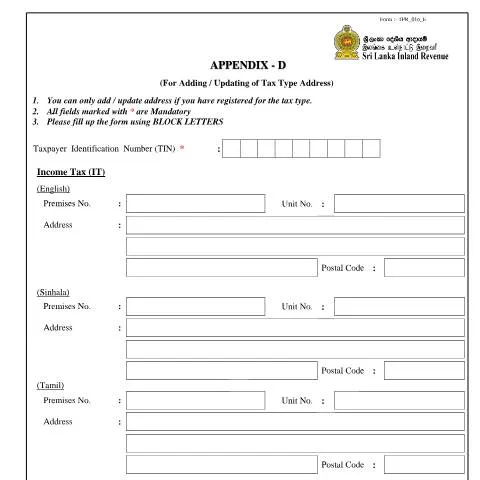
Navigating the Landscape of Taxpayer Registration: Appendix - D in Focus
In the realm of taxation in Sri Lanka, where compliance is pivotal, the Appendix - D (For Adding / Updating of Tax Type Address) form stands as a crucial instrument. This document is vital for individuals and entities looking to maintain accurate tax records, ensuring that the authorities have the most current information regarding the taxpayer's address. Failing to keep such records updated can lead to unforeseen complications, including communication issues or missed deadlines. Understanding the importance of this form is essential for every registered taxpayer, as it directly links to one’s tax obligations and privileges.
The Role of the Taxpayer Identification Number (TIN)
Before delving into the specifics of the Appendix - D form, it is imperative to highlight the significance of the Taxpayer Identification Number (TIN). This unique identification number is assigned to each taxpayer upon registration for a tax type and serves as a critical reference point throughout the tax lifecycle. The TIN is essential when submitting the Appendix - D, as it verifies your identity and links your address details to your tax records.
Important Note: Only taxpayers already registered for a specific tax type can add or update their address. This restriction emphasizes the need for a TIN to ensure that any updates are accurately linked to the correct taxpayer.
Dissecting the Components of Appendix - D
When approaching the Appendix - D form, it is essential to understand its structure to ensure thorough and correct completion. The form is divided into several sections, each designated for different tax types, including:
- Income Tax (IT)
- Pay-As-You-Earn (PAYE)
- Value Added Tax (VAT)
- Nation Building Tax (NBT)
- Withholding Tax (WHT)
- Value Added Tax on Financial Services (VAT on FS)
Each tax type section requires the same fundamental information but may vary slightly in the details requested. Here’s a breakdown of the necessary components:
| Field | Description | Notes |
|---|---|---|
| Premises No. | Specific number of the building or unit. | Mandatory for all sections. |
| Unit No. | Specific number if the premises is part of a larger complex. | Optional depending on the scenario. |
| Address | Full registered address of the taxpayer. | Should be filled using BLOCK LETTERS. |
| Postal Code | Local postal code for the address. | Ensure accuracy for delivery purposes. |
Common Pitfalls When Completing the Form
While the Appendix - D form may seem straightforward, several common pitfalls may arise during its completion, which can lead to unnecessary complications:
- Neglecting mandatory fields marked with an asterisk (*).
- Using incorrect postal codes that do not correspond with the specified address.
- Failing to use BLOCK LETTERS, as specified on the form. This can lead to readability issues and processing delays.
The Lifecycle of Address Updates: From Submission to Confirmation
The journey of submitting the Appendix - D does not end at completion. Once the form is filled out, it must be submitted to the relevant tax authority. This process is vital to ensure that updates to the taxpayer's records are properly documented. Here’s what happens next:
- Submission: The completed form can be submitted through designated channels. Ensure you retain a copy for your records.
- Processing: Upon receipt, the Taxpayer Registration authority will process the request, which may take several business days.
- Confirmation: Following processing, taxpayers will receive a confirmation of the update via their registered communication method.
Understanding the Implications of Inaccurate Information
Inaccurate or outdated address information on tax records can lead to various complications, including:
- Missed notifications regarding tax assessments or changes in legislation.
- Delays in processing tax returns and refunds.
- Potential penalties for non-compliance if tax information cannot be verified.
Ensuring that your address is current is not just a formality; it is a responsibility that every taxpayer must uphold.
Who Needs to Take Action? The Diverse Landscape of Taxpayers
The Appendix - D form is relevant to a diverse group of taxpayers, ranging from individuals to corporate entities. Understanding who should utilize this form is essential for effective compliance:
- Individuals: Personal taxpayers who have registered for Income Tax or PAYE.
- Businesses: Companies required to report under VAT or NBT.
- Freelancers and Contractors: Those who may be subject to Withholding Tax or VAT on Financial Services.
- Foreign Residents: Individuals or entities temporarily residing in Sri Lanka but conducting taxable activities.
Each group's obligations might vary based on their tax type registration, and understanding these nuances is important for compliance.
Special Considerations: Foreign Taxpayers and Minors
While the Appendix - D primarily serves registered taxpayers, there are specific considerations for foreign taxpayers and minors:
- Foreign Taxpayers: Must ensure they have a valid TIN for Sri Lanka and that their address reflects their local tax registration.
- Minors: If a taxpayer is underage, a legal guardian must complete the form on their behalf, ensuring accurate representation of the minor's information.
Appendix - D as Part of a Larger Compliance Framework
Understanding where the Appendix - D fits within the broader context of taxpayer compliance is essential. This form is part of a comprehensive system designed to ensure that all tax obligations are met systematically:
- Initial Registration: Obtain your TIN through the Taxpayer Registration process.
- Regular Updates: Utilize Appendix - D to keep your address current as life circumstances change.
- Compliance Checks: Be prepared for potential audits where having updated contact information is crucial for correspondence.
Practical Steps to Prepare for Completing Appendix - D
To successfully complete the Appendix - D, consider the following preparatory steps:
- Gather Required Information: Ensure you have your TIN and any supporting documentation readily available.
- Check Your Current Address: Confirm that the address you plan to submit is up-to-date and corresponds with your official records.
- Review the Form: Familiarize yourself with the form layout prior to filling it out to minimize errors.
Frequently Overlooked Tips for Efficient Completion
In addition to the preparatory steps, applying the following tips can enhance your experience:
- Completing the form on a computer may improve legibility, especially if you can print using a clear font and appropriate size.
- Double-check each section before submission to ensure all mandatory fields are accurately filled.
In engaging with the Appendix - D form, taxpayers in Sri Lanka can maintain the integrity of their tax records, ensuring that they remain compliant with national regulations. As tax laws and regulations evolve, staying informed and proactive in updating one's information is crucial for effective tax management.
Understanding the Importance of Accurate Tax Type Address Updates
Maintaining an accurate Tax Type Address is crucial for any individual or organization operating within Sri Lanka. The Tax Type Address serves as a primary identifier for tax-related communications between taxpayers and the Department of Inland Revenue (DIR). An incorrect or outdated address can result in missed notifications regarding tax assessments, penalties, and other important financial obligations. For businesses, an incorrect Tax Type Address can impede the timely receipt of tax incentives or benefits, as well as affect compliance with local tax regulations. It is essential that taxpayers regularly review and update their Tax Type Address to ensure that they receive all relevant information and maintain good standing with the DIR.
Step-by-Step Process for Updating Your Tax Type Address
Updating your Tax Type Address through the appropriate administrative channels is a straightforward process that can be completed efficiently if you follow the necessary steps. Below is a detailed outline of the procedure:
- Gather Required Documentation: Before initiating the update process, ensure that you have all necessary documents prepared. This typically includes your National Identity Card (NIC) for individuals or the Certificate of Incorporation for companies, alongside any supporting documents relevant to the new address.
- Access the Relevant Form: Navigate to the official website, forms.gov.lk, where you can find the specific application form designated for updating your Tax Type Address. This is often referred to as Form TTA-1 or similar.
- Complete the Form: Fill in the required information accurately. Ensure that you provide your current Tax Type Address, the new Tax Type Address, and any other necessary details. Double-check for accuracy to avoid delays in processing.
- Submit Your Application: Submit the completed form either online through the e-services portal, or in person at your local DIR office. If submitting online, follow the prompts carefully to ensure successful submission.
- Await Confirmation: After submission, you will receive a confirmation receipt. Keep this receipt for your records. The DIR will process your application, and you should receive confirmation of the update, typically within a few weeks, depending on the office's workload and processing times.
Common Issues and How to Resolve Them
While the process for updating your Tax Type Address is generally seamless, taxpayers may encounter common issues that can delay their application. Understanding these challenges and how to address them can enhance your experience:
- Incomplete Applications: Ensure that all sections of the application form are completed thoroughly. Missing information can result in delays. If you face challenges in understanding what information is required, consider contacting the DIR for guidance.
- Documentation Discrepancies: Ensure that the documents you provide match the information entered in the application form. Discrepancies can lead to rejection of your application. For example, if your NIC shows a different address, it is important to update your NIC before submitting a Tax Type Address change.
- Delayed Processing Times: If you have submitted your application but have not received confirmation within the expected timeframe, do not hesitate to follow up with the DIR. You may contact their helpline or visit your local office to inquire about the status of your application.