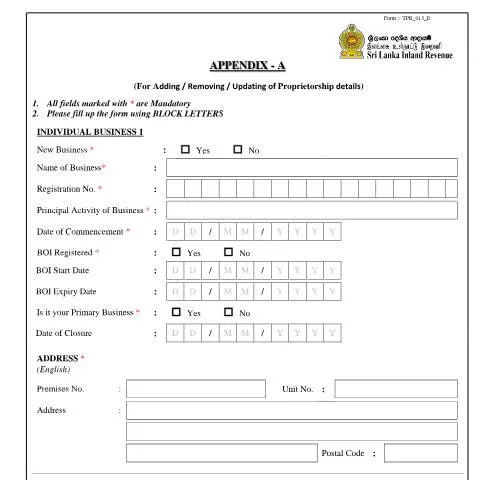
Navigating the Taxpayer Registration Process: Understanding Appendix - A
In the complex world of business operations in Sri Lanka, the administrative landscape often presents challenges to proprietors, particularly regarding compliance with tax regulations. Among the essential documents that business owners must deal with is the official form known as APPENDIX - A (For Adding / Removing / Updating of Proprietorship details), referred to by its code, TPR_013. This form serves a pivotal role in ensuring that a proprietor's business details are current, accurate, and in alignment with the Sri Lankan tax regulations.
Who Should Engage with Appendix - A?
Understanding who is required to submit this form is crucial. Appendix - A is specifically designed for proprietors of individual businesses who need to:
- Add a new business
- Remove an existing business
- Update details associated with their proprietorship, including changes in business structure or activities
This form is vital for individual business owners who may operate multiple businesses and need to update their registrations accordingly. The National Identity Card (NIC) of the proprietor is typically required for identification purposes when filling out this form. Individuals who have recently commenced business activities or those planning to make substantial changes to their current business structure will find this form particularly relevant.
The Sequential Journey: From Initiation to Submission
Completing Appendix - A involves a series of structured steps, each designed to facilitate a smooth registration process:
- Gather Required Information: Before starting the form, it is paramount to collect all relevant details, including the name of the business, registration number, principal activities, and dates related to commencement and closure of businesses.
- Completing the Form: Each section of the form must be filled in BLOCK LETTERS, with attention to all mandatory fields. Incomplete submissions may result in delays or rejections.
- Submission Channels: The completed form can be submitted either online via the ICTA's digital services or in person at designated offices. The choice of submission method can impact the processing time.
- Tracking the Submission: After submission, it is advisable to track the status of your application. This can often be done through the e-services provided by the relevant authorities.
- Receive Confirmation: Once processed, the proprietor will receive confirmation of the changes made to their business registration details.
Deciphering the Fields of Appendix - A
Each section of Appendix - A contains specific fields that need careful attention. Understanding what is required in each section can mitigate the chances of incomplete or incorrect submissions. Here’s a breakdown:
| Field | Importance | Potential Issues |
|---|---|---|
| Name of Business* | This identifies your business for tax purposes. | Incorrect names can lead to discrepancies in records. |
| Registration No.* | Essential for linking your business to the tax system. | Omissions here can result in delays. |
| Principal Activity of Business* | Defines the nature of your business operations. | Selecting the wrong activity may affect tax obligations. |
| Date of Commencement* | Indicates when your business operations began. | Future dates or inaccuracies may cause issues. |
| BOI Registered* | Affects eligibility for benefits under the Board of Investment. | Incorrect responses could lead to loss of benefits. |
| Address* | Provides a physical location for business correspondence. | Incomplete addresses may hinder communication. |
Understanding Submission Channels: Online vs. In-Person
The method of submitting Appendix - A can significantly influence the processing experience. Two primary options are available:
- Online Submission: Utilizing the ICTA digital platform allows for a streamlined process. After filling out the form digitally, proprietors can save time and track their submissions easily. Confirmation will often be received quicker compared to in-person submissions.
- In-Person Submission: For those who prefer face-to-face interactions or have questions, submitting the form at designated offices remains an option. However, it may involve waiting times and potential for misplacement of documents.
Regardless of the submission method chosen, ensure that all necessary information is accurately provided to avoid future complications.
Distinguishing Appendix - A from Similar Forms
It is easy to confuse Appendix - A with other forms associated with business registration. However, its unique focus on proprietorship details makes it distinct. For instance:
- Business Registration Form: Generally used for establishing a business entity for the first time.
- Tax Registration Form: Targets businesses looking to register for tax purposes but does not cover proprietorship changes.
- Annual Return Forms: These are for annual reporting and not focused on updating proprietorship details.
Understanding these distinctions helps proprietors choose the correct forms depending on their specific needs.
Regulatory Background: The Framework of Compliance
The necessity for Appendix - A is grounded in the broader context of Sri Lankan tax law, primarily under the principles of English common law, as established by the Interpretation Ordinance and enhanced by sector-specific enactments. Furthermore, the Electronic Transaction Act has paved the way for a digital approach to forms and registrations, underscoring the government's commitment to streamlining administrative processes.
This regulatory backdrop not only legitimizes the use of Appendix - A but also reflects an ongoing evolution towards a more digitized government interaction model where compliance and efficiency are paramount.
Post-Submission: What to Expect After Filing
Once Appendix - A has been submitted, the following outcomes may occur:
- Review Process: The tax authorities will review the submitted information for accuracy and completeness.
- Notification: Upon approval, proprietors will receive formal notifications outlining any changes made.
- Follow-Up Actions: If further information is required, proprietors may be contacted for clarification. It is advisable to keep communication lines open for any follow-ups.
- Documentation: Retain copies of all submitted materials for your records and future reference.
This phase is crucial as it ensures that any discrepancies can be addressed promptly, thereby maintaining compliance with Sri Lankan tax regulations.
In navigating the intricacies of Appendix - A, understanding the context, requirements, and implications of this document is essential for all business proprietors in Sri Lanka. By familiarizing oneself with the processes involved, individuals can streamline their interactions with the Taxpayer Registration authorities and ensure that their business operations remain compliant with local laws.
Understanding Proprietorship Changes: Legal Framework and Procedures
Managing changes to proprietorship details in Sri Lanka entails navigating a structured legal framework. Under the English common law principles and local enactments, any updates—whether adding, removing, or modifying proprietorship details—must comply with specific regulations set forth by the Department of Registrar of Companies (DRC) and the relevant authorities.
Firstly, it is essential to understand the legal significance of proprietary changes. The alteration of ownership details may impact taxation, liability, and operational aspects of a business. The Electronic Transaction Act empowers businesses to execute these changes digitally, but certain conditions must be met. For instance, any changes to proprietorship details must be reflected precisely to ensure that the legal documentation aligns with the current business operations.
To initiate this process, the proprietor must complete the necessary forms available on the DRC's official website or through portals like forms.gov.lk. Depending on the nature of the change, different forms may be applicable, such as the Change of Proprietorship Form or the Application for Withdrawal of Proprietorship. Detailed instructions for each form can be found on the DRC's website, where users are encouraged to review the requirements carefully to avoid delays.
Additionally, it is advisable for proprietors to consider the specific timing of their application submissions. For instance, if a change in proprietorship coincides with tax filing deadlines, it may necessitate additional steps to ensure that all financial matters are settled correctly. Hence, awareness of the fiscal calendar is crucial for seamless integration of proprietorship changes into ongoing business practices.
Common Challenges in Updating Proprietorship Information
While many proprietors may find the process of updating business information straightforward, there are common challenges that can arise during this administrative procedure. Understanding these challenges can help proprietors navigate the process more effectively.
One prevalent issue is the lack of proper documentation. When adding or removing a proprietor, all relevant identification documents, such as the National Identity Card (NIC), must be submitted alongside the application. Failure to provide complete documentation can lead to application rejections or prolonged processing times. Therefore, it is advisable to prepare a checklist of required documents before initiating the process.
Another obstacle often faced is the misalignment of records between different government departments. Changes made at the DRC must be communicated to other relevant authorities, including tax offices and regulatory bodies. If these updates are not synchronized, it could result in discrepancies that could complicate the business’s legal standing. Proprietors should be proactive in verifying that all records have been updated across relevant platforms.
Moreover, proprietors may face challenges related to digital forms. While the push for digital governance simplifies many processes, issues such as system outages or difficulties in navigation can pose barriers. It is advisable for proprietors to familiarize themselves with the digital portals and, if necessary, seek assistance from administrative personnel to ensure that the online submission process goes smoothly.
Lastly, proprietors must remain aware of the unique circumstances that may apply to their specific case. For example, if a business has outstanding debts or legal issues, altering proprietorship details could require additional approvals or considerations. In such cases, consulting with a legal expert or a business advisor may provide clarity on the necessary steps to mitigate risks.
Best Practices for Maintaining Accurate Proprietorship Records
Maintaining accurate proprietorship records is essential not only for compliance with legal requirements but also for fostering trust with clients, suppliers, and regulatory authorities. Here are some best practices to consider:
Regular Review and Update: Establish a schedule to review proprietorship details regularly, ensuring that all information is current. This could be conducted annually or more frequently if significant changes occur within the business structure.
Centralized Documentation System: Implement a centralized system for storing all documents related to proprietorship. This should include copies of the NICs of all proprietors, registration forms, and any correspondence with governmental bodies. A well-organized filing system will facilitate easier access during audits or inspections.
Training and Awareness: Educate staff and partners about the importance of maintaining accurate proprietorship records. Ensure that all parties involved in business operations understand the implications of changes in ownership and the procedures for reporting such changes.
Utilize Digital Tools: Take advantage of digital tools that allow for efficient record-keeping and reminders for when updates are needed. Software solutions can help automate parts of the administrative process, ensuring that deadlines are met and records remain accurate.
Seek Professional Assistance: For more complex changes or if proprietors are unsure about the process, seeking assistance from a legal professional or a business consultant can provide valuable guidance. They can help navigate the intricacies of the law, ensuring that all changes are compliant and correctly documented.
By adhering to these best practices, proprietors can manage their business information effectively, minimizing the risk of administrative issues and fostering a culture of transparency and accountability within their organization.