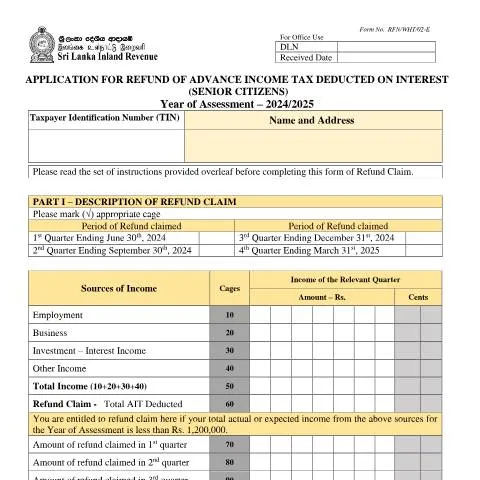
Navigating the Application for Refund of Advance Income Tax: A Practical Guide for Senior Citizens
The process of claiming a refund on advance income tax can seem daunting, especially for senior citizens who often navigate numerous financial and bureaucratic obligations as they transition into retirement. Form RFN_WHT_02_2425 - officially known as the Application for Refund of Advance Income Tax Deducted on Interest (Senior Citizens) - 2024/2025 - offers a crucial pathway for individuals aged 60 and above to reclaim taxes withheld on their interest earnings, provided they meet specific criteria. It is essential for applicants to understand both their entitlements and the process involved thoroughly, as it directly affects their financial wellbeing.
Understanding Tax Obligations and Refund Eligibility
One of the primary considerations when applying for a refund is ensuring eligibility. According to the regulations set forth by the Commissioner General for Senior Citizens, individuals must ascertain that their total assessable income for the assessment year is less than Rs. 1,200,000. This amount encompasses earnings from various sources, including employment, business, and, importantly, interest income from financial institutions.
- Employment Income: This includes salary or wages received.
- Business Income: Proceeds from any self-employment or business activities.
- Investment Income: Specifically, the interest accrued from deposits or bonds.
- Other Income: Any additional other income streams that may arise.
To successfully navigate the application process, it is imperative to compile a comprehensive account of income sources, ensuring accuracy in reporting to avoid complications later on.
Decoding the Sections of the Application Form
The application form is structured into several parts, each serving a distinct purpose. Understanding each section will help applicants fill out the form correctly and efficiently.
Part I: Description of Refund Claim
This section requires applicants to identify the relevant quarter for which they are claiming a refund. Each quarter listed (1st, 2nd, 3rd, and 4th quarter) corresponds to distinct periods within the tax year:
- 1st Quarter: Ending June 30, 2024
- 2nd Quarter: Ending September 30, 2024
- 3rd Quarter: Ending December 31, 2024
- 4th Quarter: Ending March 31, 2025
Applicants should ensure only one application is submitted for the chosen quarter to comply with guidelines.
Part II: Description of Investment (Interest) Income
In this section, applicants must provide details about interest income accrued from their bank accounts. The specifics required include:
- Name of Financial Institution: Identification of each bank where interest is earned.
- Account Number: The unique identifier linked to each financial account.
- Gross Interest (Rs.): The total interest amount earned.
- AIT Deducted (Rs.): The advance income tax that has already been withheld from the interest earned.
It is crucial to accurately record this information, as discrepancies may lead to delays or denials in the refund process.
Total Calculation of Income Sources
As part of the application, it is vital to calculate the overall income accurately. The form includes a section for summing employment, business, and investment income:
| Income Source | Amount (Rs.) |
|---|---|
| Employment | 10 |
| Business | 20 |
| Investment (Interest Income) | 30 |
| Other Income | 40 |
| Total Income | 50 |
Ensuring this total is compiled accurately is critical, as it determines the applicant's eligibility for a refund.
Submission Process: Channels and Procedures
Once the application form is duly filled out, applicants must decide on their submission method. The options available include:
- Online Submission: Utilizing the digital government services platform through the website forms.gov.lk. This option is quickly gaining traction due to its convenience and streamlined process.
- Paper Submission: Applicants may choose to print the completed form and submit it in person or by mail to the relevant tax office.
- In-Person Submission: Visiting a designated office to hand in the application can allow for immediate feedback and the possibility of addressing any concerns directly.
Regardless of the chosen submission method, it is crucial to attach all necessary supporting documents, such as withholding certificates, to substantiate the refund claim.
Processing of the Refund Application
Upon submission, the application will undergo a thorough review by the Inland Revenue Department. The processing time can vary, but applicants can expect to receive updates through their chosen communication method. It is advisable to maintain a record of the submission date and any acknowledgment received from the authorities.
If there is a delay beyond the expected processing period, applicants can follow up with the relevant department. Preparedness with all pertinent information and documentation can facilitate quicker resolution of any inquiries.
The Regulatory Framework Behind the Refund Process
The legal backdrop dictating the refund process stems from the Inland Revenue Act, No. 24 of 2017, reinforced by Circular No. SEC/2023/E/06 dated September 25, 2023. These documents outline the entitlements for senior citizens and the procedures necessary to access refunds on income tax deductions. Adherence to these guidelines ensures that applicants are protected under the law and reduces the risk of punitive measures due to non-compliance.
Implications of Misreporting or Non-Compliance
It is essential to comprehend the serious implications that arise from submitting false information on the application form. Under Section 181 of the Inland Revenue Act, making misleading statements can lead to severe penalties, including fines or further legal action. Therefore, accuracy in reporting income and tax withheld is not merely a best practice; it is a legal obligation that must not be overlooked.
Essential Reminders for Senior Citizens Applying for Refunds
As senior citizens proceed with their applications, they should keep the following reminders in mind:
- Ensure all income sources are accurately documented and summed.
- Select the correct quarter for the refund claim, submitting only one application per quarter.
- Attach all necessary supporting documents to avoid delays.
- Be aware of the legal requirements surrounding the application to prevent misreporting.
- Follow up appropriately with the authorities in case of delays.
By adhering to these guidelines and maintaining diligent record-keeping practices, senior citizens can effectively navigate the process of claiming a refund on advance income tax, ultimately securing their entitled benefits without unnecessary stress.
Understanding the Eligibility Criteria for Senior Citizen Tax Refunds
To apply for the Refund of Advance Income Tax Deducted on Interest for Senior Citizens in Sri Lanka, a clear understanding of the eligibility criteria is essential. Generally, applicants must be over the age of 60 and hold a valid National Identity Card (NIC). The refund application primarily targets individuals whose total annual income does not exceed the specified threshold defined for senior citizens. This threshold can vary slightly depending on annual fiscal policies, thus it is advisable for applicants to confirm the current limits on the official website of the Department of Inland Revenue.
Moreover, eligibility is contingent upon the nature of the income generated. Only interest income from specified financial instruments, such as fixed deposits and savings accounts, qualifies for the refund. Applicants must ensure that the taxes deducted at source exceed the total tax liability to be eligible for a refund. Common exemptions on additional income types—like pensions—need careful consideration, as they may affect the final assessment of tax obligations. Documentation proving age, income sources, and prior tax deductions should be prepared meticulously to facilitate a smooth application process.
Navigating the Application Procedure: Tips for a Successful Submission
The application process for the Refund of Advance Income Tax can be intricate, especially for first-time applicants. Initiating the process begins with completing Form RFN/WHT/02-E, which can be found on the official website of the Department of Inland Revenue. It is crucial to fill this form accurately, ensuring all required sections are completed without any omissions. Incomplete applications may result in delays or rejections.
Once the form is filled out, it must be accompanied by supporting documentation. This includes the NIC of the applicant, bank statements showing the interest earned, and any prior tax deduction certificates from banking institutions. Applicants are advised to keep copies of all documents submitted for their records. Moreover, submitting the application online through the Electronic Transaction Act provisions on the forms.gov.lk platform can expedite the process. In cases where applicants choose manual submission, visiting the nearest tax office in person is recommended, where staff can provide additional assistance and clarification.
Furthermore, applicants should be aware of the submission deadlines, typically aligned with the fiscal calendar year. It is prudent to submit the application well ahead of the deadline to avoid any last-minute complications. Continuous communication with the tax department is advised to ensure that the application is received and processed within the stipulated timeframe.
Common Challenges and How to Address Them
While applying for the Senior Citizen Tax Refund, applicants may encounter various challenges. A prevalent issue is the miscalculation of the advance income tax deducted, which can lead to confusion regarding eligibility for a refund. It is beneficial for applicants to review their bank statements meticulously and compare them against the withholding tax certificates provided by financial institutions. In cases of discrepancies, promptly reaching out to the bank for clarification is vital before proceeding with the application.
Moreover, some applicants may find the language or terminologies within the tax forms overwhelming. Seeking assistance from family members or tax professionals can alleviate this hurdle. Understanding specific terms such as 'advance income tax' and 'withholding tax' is crucial for ensuring accurate completion of the application form.
Lastly, tracking the status of the application post-submission can sometimes be a daunting task. Applicants are encouraged to maintain a record of submission dates and any reference numbers provided by the tax department. Regular follow-ups, whether through official channels or by visiting the local tax office, can help applicants stay informed regarding their application's progress. This proactive approach often leads to quicker resolutions of any issues that may arise.