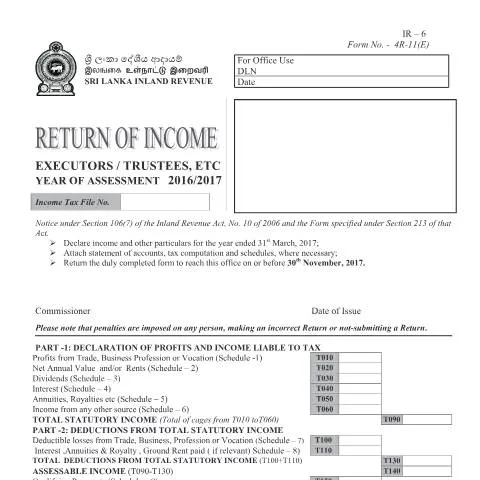
Navigating the Essentials of the Return of Income - Form 4R11
Completing the Return of Income - Form 4R11 is a critical responsibility for Executors and Trustees in Sri Lanka. This document is central to the compliance with the Inland Revenue Act, particularly under Section 106(7) and Section 213 of the Act No. 10 of 2006. Given the serious implications of tax obligations, understanding the nuances of this form is paramount for those who are responsible for managing estates and trusts.
Understanding the Implications of the Return of Income
For Executors and Trustees, the Return of Income serves not only as a means of reporting income but also as a formal declaration of compliance with tax regulations. The importance of submitting this form on time cannot be overstated. Late submissions or inaccurate information can attract penalties, which can significantly impact the financial standing of the estate or trust.
- Tax Compliance: A failure to complete and submit this form accurately may lead to fines or legal repercussions.
- Financial Reporting: This return is integral to establishing the financial health of the estate or trust.
- Executor Responsibility: Executors must ensure that all income, deductions, and liabilities are accurately reported to protect themselves from future claims of negligence.
Preparing Necessary Documentation
Before diving into the specifics of the Return of Income, it is essential to assemble all relevant documentation. The following preparatory steps should be taken into account:
Gathering Financial Statements
Compile comprehensive financial statements, including:
- Profit and Loss Statements for the estate or trust.
- Balance Sheets that reflect the asset and liability situation.
- Bank Statements for the financial year under assessment (ending 31st March 2017).
Documentation for Income Sources
Different categories of income must be clearly documented:
- Trade and Business Income: Include all earnings from business activities.
- Rental Income: Documentation for net annual value and rents received.
- Investment Income: Records of dividends, interest earnings, annuities, and any other income sources.
Each component of income must be supported by relevant schedules and statements as detailed in the form.
Dissecting the Form: Key Sections and Common Pitfalls
The Return of Income - Form 4R11 consists of several critical parts. Each section demands careful attention to detail to ensure accuracy.
Part 1: Declaration of Profits and Income Liable to Tax
This section requires Executors to declare various income sources. It's vital to ensure that:
- Profits from trade, business, or vocation are correctly reported in Schedule-1.
- Net annual value and rents collected are accurately filled out in Schedule-2.
- All dividends and interest from other sources are comprehensively declared in their respective schedules.
Common Pitfall: Omitting income sources can lead to significant penalties. Always cross-reference with bank statements and business records.
Part 2: Deductions from Total Statutory Income
In this segment, the form allows for specific deductions. Understand what qualifies:
- Deductible losses: Losses from business activities can be deducted in Schedule-7.
- Interest & Royalties: Ensure that any payments made that qualify as deductions are listed accurately.
Precision in this section can result in a lower taxable income, offering potential financial relief.
Part 3: Calculation of Income Tax Payable
This part covers the tax computation process. Executors must clearly differentiate between tax payable for Executors and Trustees:
- Executors face a tax rate of 24% on their income.
- Trustees also face the same flat rate.
Note: Ensure that tax credits are applied correctly in Schedule-11 to avoid overpayment. Miscalculating this section can lead to financial strain.
Special Considerations for Unique Situations
While the Return of Income applies generally, certain cases require bespoke handling. Understanding these unique scenarios can guard against compliance mishaps.
Foreign Executors and Trustees
For foreign Executors or Trustees, the tax implications can differ. Specific regulations may apply regarding the declaration of foreign investments and income.
- Detailed documentation regarding international assets is mandatory.
- Seek professional advice to navigate possible double taxation agreements.
Minors and Trusts
When managing the estate of a minor, it is imperative to adhere to additional regulations that govern the financial management of minors' estates. Executors must:
- Ensure that income generated by the minor’s estate is reported accurately.
- Comply with any additional oversight requirements from the court or guardianship entities.
Historical Context and Regulatory Framework
The framework guiding the Return of Income - Form 4R11 is steeped in the history of Sri Lanka's tax regulations. The Inland Revenue Act No. 10 of 2006 ushered in a structured approach to income reporting, necessitating compliance for Executors and Trustees.
As these regulations evolved, they have reinforced the importance of accurate reporting and the consequences associated with non-compliance.
Profiles of Those Impacted by the Form
Understanding who is impacted by the Return of Income involves looking at the profiles of Executors and Trustees:
Executors of Estates
Executors appointed through a will have a fiduciary duty to manage the estate’s assets carefully. Their responsibilities include:
- Ensuring that all debts are cleared prior to distribution.
- Reporting all income accurately to meet tax obligations.
- Providing annual accounts to beneficiaries.
Trustees of Trusts
Trustees carry similar burdens as Executors but are also responsible for ensuring continuity and proper management of trust assets for the beneficiaries. Key responsibilities include:
- Managing the trust in accordance with its terms and applicable laws.
- Filing appropriate tax returns and ensuring all income is reported.
Each profile presents unique challenges, and understanding the intricacies of the Return of Income can help navigate these challenges more effectively.
Ensuring Submission and Compliance
The final step in the process is submitting the completed Form 4R11. The deadline for submission must be adhered to strictly. The completed form should be directed to the appropriate office of the Commissioner of Inland Revenue, ensuring:
- All relevant schedules and documentation are attached.
- The form is signed by the Declarant, affirming the accuracy of all reported information.
Important Reminder: The deadline for submission is crucial. Forms submitted after the 30th of November, 2017, may incur penalties which can escalate over time. Delays in payment of taxes also attract further penalties, underscoring the importance of timely submission.
Final Thoughts on the Journey Ahead
Filing the Return of Income - Form 4R11 is a vital process that goes beyond mere compliance; it is about fulfilling a duty to the beneficiaries and the estate or trust itself. Executors and Trustees must approach this task with diligence and accuracy to uphold their fiduciary responsibilities. The potential pitfalls of non-compliance underscore the importance of familiarizing oneself with the form and its requirements.
Ultimately, investing time in understanding and preparing for the Return of Income will yield benefits, ensuring that the estate or trust is managed efficiently and in accordance with Sri Lankan tax law.
Understanding the Return of Income Process in Sri Lanka
The Return of Income process in Sri Lanka is a statutory requirement for individuals, partnerships, and corporations earning taxable income. Compliance with this directive is essential not only for fulfilling legal obligations but also for maintaining a good standing with the Inland Revenue Department (IRD). The Return provides a comprehensive overview of your income, expenses, and tax obligations for the financial year, which in Sri Lanka runs from April 1 to March 31. Understanding how to accurately complete this form is crucial to avoid penalties and interest on unpaid taxes.
Firstly, individuals must ensure they are aware of their tax registration status. The issuance of a Taxpayer Identification Number (TIN) is pivotal as it serves as your unique identification in all tax-related matters. The IRD issues TINs, and retaining accurate records of your income and expenses throughout the year streamlines the process of completing your Return of Income. It is also advisable to maintain copies of relevant documents, including bank statements and invoices, to substantiate your claims.
Taxpayers categorized as part of the VAT (Value Added Tax) regime or those with annual income exceeding the threshold set by the IRD must file their Returns electronically through the IRD’s online portal. This move towards digitization is part of the ongoing initiative by the ICTA and other government bodies to improve efficiency and accessibility in public services.
Common Pitfalls and How to Avoid Them
While filing the Return of Income may seem straightforward, many taxpayers encounter common pitfalls that lead to complications. Awareness of these challenges can significantly ease the filing process. A prevalent issue arises from the misreporting of income and expenses. Taxpayers often underestimate their earnings or claim excessive deductions, leading to discrepancies that can trigger audits by the IRD.
Another frequent challenge is the failure to file within the stipulated deadlines. The IRD publishes specific deadlines for various categories of taxpayers, and missing these dates can result in hefty penalties. It is essential to refer to the fiscal calendar published by the IRD to remain informed about key dates.
Furthermore, some taxpayers do not seek professional advice when needed. The complexities of tax laws, especially regarding deductions, available exemptions, and the impact of recent amendments, can be daunting. Engaging a qualified tax consultant can provide clarity and ensure compliance with the latest regulations, minimizing the risk of penalties.
Changes in Tax Regulations and Their Implications
The tax landscape in Sri Lanka is subject to frequent modifications influenced by fiscal policy changes and economic conditions. Recent years have seen significant reforms aimed at increasing revenue while simplifying the tax process. Taxpayers must remain vigilant regarding these changes, as they can directly affect their tax liability and filing procedures.
For instance, the introduction of new incentives for small and medium enterprises (SMEs) may alter the deductions available to those businesses. Similarly, amendments to the tax rates can affect both personal and corporate taxpayers. Keeping abreast of these regulations through announcements from the IRD and consultations with tax professionals is essential for compliance.
Furthermore, the Electronic Transaction Act has facilitated the adoption of digital forms, simplifying the submission process for Returns. Taxpayers must be informed about how these technological advancements can enhance their filing experience. Utilizing the e-services offered through the IRD’s portal not only expedites the process but also allows for easier tracking of submitted Returns and payment statuses.