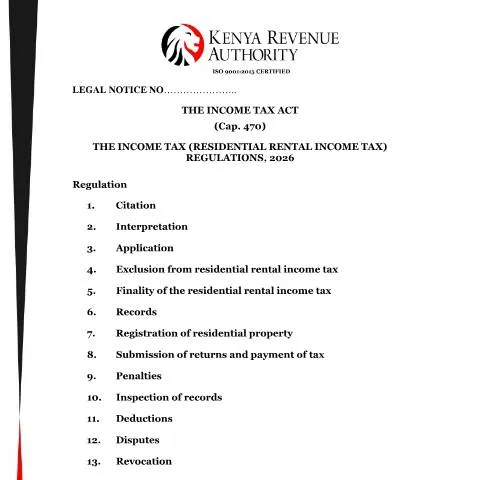
Overview of the Draft Income Tax Residential Rental Income Tax Regulations 2026
The Draft Income Tax Residential Rental Income Tax Regulations 2026 represent a significant development in Kenya’s taxation framework, specifically targeting income derived from residential property rentals. Issued under the authority of the Income Tax Act (Cap. 470), these regulations aim to clarify the obligations of taxpayers involved in residential rental activities, streamline compliance procedures, and ensure effective tax administration by the Kenya Revenue Authority (KRA).
Objectives and Scope of the Regulations
The primary objective of these regulations is to establish a comprehensive legal framework for taxing residential rental income, which is a vital component of Kenya’s housing and real estate sector. They are designed to:
- Define the scope of taxable rental income from residential properties;
- Set out procedures for registration, record-keeping, and reporting;
- Outline compliance requirements and penalties for non-adherence;
- Address issues related to exemptions and opt-outs from the rental income tax regime.
Specifically, the regulations apply to resident persons who generate rental income from Kenyan residential properties, with income thresholds set between two hundred and eighty-eight thousand shillings and fifteen million shillings annually. They also extend to partnerships owning rental properties, ensuring a broad coverage of taxpayers involved in residential leasing activities.
Key Provisions and Regulatory Requirements
Registration and Record-Keeping
One of the fundamental provisions is the requirement for taxpayers to register their residential properties in an electronic system mandated by the KRA. This registration facilitates efficient monitoring and management of rental income data. Additionally, taxpayers must maintain detailed records of all rental transactions, including gross rent received, to enable accurate tax assessment and compliance with the Tax Procedure Act.
Tax Filing and Payment Obligations
Taxpayers are mandated to submit monthly returns of their rental income and settle the corresponding tax by the 20th day of the following month. This streamlined process aims to promote timely compliance and reduce tax evasion. The regulations emphasize that rental income subject to this tax regime is final, meaning it will not be subject to additional taxation under other provisions of the Act.
Exclusions, Opt-Outs, and Dispute Resolution
Individuals or entities wishing to opt out of the residential rental income tax regime must notify the Commissioner at least three months before the end of the income year. The regulations specify procedures for such notifications and acknowledge that the opt-out will take effect in the subsequent income year. Disputes arising from assessments or compliance issues are to be resolved in accordance with the provisions of the Tax Procedure Act, ensuring a structured legal process for taxpayers.
Implications for Landlords and Property Owners
The regulations mark a shift towards formalizing the taxation of residential rental income, encouraging property owners to maintain transparent records and adhere to registration requirements. The mandatory registration and record-keeping obligations are designed to enhance compliance, reduce tax evasion, and increase government revenue. Additionally, the clear delineation of obligations and penalties aims to promote a culture of tax compliance among landlords and property managers.
Legal and Administrative Enforcement
The Kenya Revenue Authority (KRA) is empowered to enforce these regulations through inspections, record audits, and notices requiring production of documents or property details. Failure to comply with these provisions may lead to penalties as prescribed under the Tax Procedure Act, underscoring the importance of adherence for all relevant taxpayers.
Conclusion
The Draft Income Tax Residential Rental Income Tax Regulations 2026 are a pivotal step towards modernizing Kenya’s tax system, aligning it with international best practices, and broadening the tax base. While still in draft form, they reflect the government’s commitment to creating a fair and transparent taxation environment for residential property owners. Stakeholders are encouraged to review these regulations carefully and prepare for their eventual implementation, which promises to enhance compliance and revenue collection in Kenya’s vibrant real estate sector.