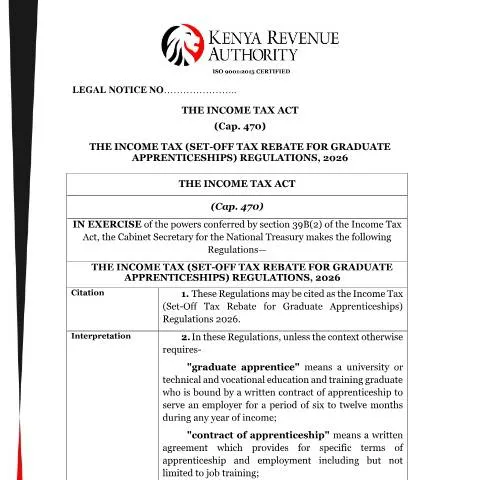
Overview of the Draft Income Tax Set-Off Tax Rebate for Graduate Apprenticeships Regulations 2026
The Draft Income Tax Set-Off Tax Rebate for Graduate Apprenticeships Regulations 2026, issued on 15th April 2026, introduces a new framework aimed at incentivizing employers to engage graduate apprentices within Kenya’s labor market. This regulation, enacted under the authority of the Income Tax Act (Cap. 470), seeks to promote skills development through formal apprenticeship programs by offering tax rebates to eligible employers.
Objectives and Scope of the Regulations
The primary objective of these regulations is to provide a fiscal incentive to employers who employ graduate apprentices, thereby encouraging the formalization of apprenticeship arrangements across various sectors. The regulations specifically target employers subject to income tax under section 3 of the Income Tax Act, excluding those whose income is wholly exempt from tax. The scope covers the engagement, registration, and reporting obligations for employers, as well as the procedural and compliance requirements necessary to benefit from the tax rebate.
Key Definitions and Eligibility Criteria
Definitions
- Graduate apprentice: A university or technical and vocational education and training graduate who is bound by a written contract of apprenticeship for a period of six to twelve months within a fiscal year.
- Contract of apprenticeship: A written agreement detailing the terms of apprenticeship and employment, including job training components.
- Tax rebate: An allowable expenditure that exceeds the standard deductions under section 15(1) of the Income Tax Act, eligible for deduction against taxable income.
Eligibility Conditions
Employers eligible for the tax rebate must be registered and subject to income tax under the relevant provisions of the law, excluding entities with wholly exempt income. They must also obtain prior written approval from the Director-General of the Industrial Training Act before engaging a graduate apprentice.
Procedural Requirements for Employers
Engagement and Contracting
Employers are mandated to enter into a formal, written contract of apprenticeship with each graduate apprentice for a duration of six to twelve months. This contract must be registered with the Director-General of the Industrial Training Act before the commencement of employment.
Certification and Record-Keeping
Upon satisfactory completion of the apprenticeship, employers are required to submit a certificate of completion in the prescribed form to the Director-General. Additionally, they must issue a copy of this certificate to the apprentice. Employers are also obliged to maintain certified copies of all apprenticeship contracts and certificates for a period of five years from the end of the relevant income year.
Tax Rebate Calculation and Deduction
The regulations stipulate that eligible employers can deduct a tax rebate equivalent to fifty percent of the salaries and wages paid to graduate apprentices during the engagement period. This deduction is applicable only for apprentices engaged for a period not exceeding twelve months. No rebate is allowed for apprentices engaged beyond this period.
Reporting and Compliance
The Director-General is tasked with submitting quarterly reports to the Kenya Revenue Authority (KRA), detailing:
- Particulars of employers, including their Personal Identification Number (PIN);
- Details of apprentices engaged, including their PIN;
- Number of apprentices engaged per employer;
- Duration of each engagement.
Employers are expected to maintain accurate records of all apprenticeship-related documentation to facilitate compliance audits and verification processes.
Implications for Employers and Apprentices
This regulation offers tangible benefits to employers by reducing the cost of employing graduate apprentices, thereby incentivizing the creation of more structured apprenticeship programs. For apprentices, this regulation underscores the importance of formal training arrangements and provides assurance of recognition through certification upon successful completion.
Legal and Administrative Context
The regulations revoke the previous Legal Notice number 97 of 2016, signaling a renewed focus on formalizing apprenticeship incentives within the broader framework of Kenya’s tax and labor policies. They are aligned with the objectives of the Ministry of Labour and Social Protection and the Kenya Revenue Authority to foster skills development and employment growth.
Conclusion
The Draft Income Tax Set-Off Tax Rebate for Graduate Apprenticeships Regulations 2026 represents a strategic policy instrument aimed at strengthening Kenya’s skills development infrastructure. Employers are encouraged to familiarize themselves with these provisions to leverage the benefits of the tax rebate, thereby contributing to the country’s economic and human capital development objectives.