Understanding the Tax Treatment of Dividends Paid by Publicly Listed and Tax-Exempt Companies in Jamaica
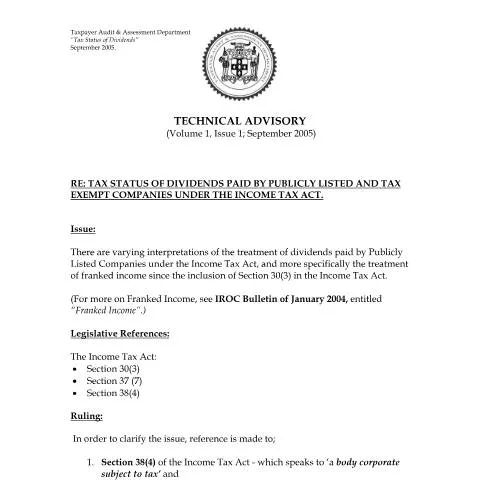
This official advisory, issued by the Taxpayer Audit & Assessment Department (TAAD) in September 2005, provides clarity on the tax status of dividends paid by publicly listed companies and tax-exempt entities under the Jamaican Income Tax Act. It aims to guide taxpayers, corporate entities, and tax professionals in understanding the applicable tax obligations and benefits related to dividend distributions within the Jamaican fiscal framework.
Scope and Legislative Framework
The advisory focuses on the interpretation of specific provisions within the Income Tax Act, particularly:
- Section 30(3), which addresses the taxation rate for dividends paid by companies listed on the Jamaica Stock Exchange (JSE)
- Section 37(7), which pertains to dividends paid by tax-exempt companies
- Section 38(4), which clarifies the treatment of such dividends in the context of corporate taxation
These sections collectively define how dividends are treated for tax purposes, especially concerning franked income and withholding obligations.
Taxation of Dividends from Publicly Listed Companies
Tax Rate and Implications
Dividends paid by publicly listed companies to their shareholders are subject to a tax rate of 0%. This means that:
- No income tax is deducted at the source when dividends are paid out.
- Subsequent recipients of these dividends, including ultimate shareholders, are also not liable for tax on such income.
- The dividends are considered part of statutory income but are taxed at a rate of zero percent under Section 30(3).
Impact on the Taxpayer
Since these dividends are taxed at 0%, they do not contribute to the tax liability of recipients at any stage of the distribution chain. This treatment effectively makes dividends from publicly listed companies tax-exempt for individual and corporate shareholders, facilitating investment and income distribution within the Jamaican capital markets.
Taxation of Dividends from Tax-Exempt Companies
Distribution and Withholding Tax
Dividends paid by companies recognized as tax-exempt under Jamaican law are subject to specific conditions:
- The recipient company, which receives dividends from another tax-exempt company, may distribute these dividends to its shareholders without incurring income tax, provided it has the necessary authorization from the Commissioner of Tax under Section 37(7).
- When such dividends are further distributed to individual or corporate shareholders, withholding tax applies at the applicable rates: 33 1/3% for corporate shareholders and 25% for individual shareholders.
Franked Income and Further Taxation
The dividends paid by tax-exempt companies, once distributed to shareholders, are classified as franked income. Consequently, Section 38(4) of the Income Tax Act applies to subsequent distributions, which may influence the tax obligations of the recipients.
Practical Implications for Taxpayers and Investors
This advisory clarifies that dividends from publicly listed companies are effectively tax-free at the point of distribution, simplifying the tax planning for investors and encouraging participation in the Jamaican stock exchange. However, dividends from tax-exempt companies, while initially exempt from income tax, may attract withholding tax upon distribution to ultimate shareholders, depending on their status.
Taxpayers should consider these distinctions when reporting income, planning investments, or complying with withholding obligations. It is also essential to stay informed about any legislative amendments or updates issued by the Jamaica Tax Authority (TAJ) that may alter the current treatment.
Disclaimer and Further Guidance
This advisory serves as a general guide based on the current legislative provisions and interpretations. It does not replace the detailed provisions of the Income Tax Act or other relevant legislation. For specific cases or complex situations, taxpayers are encouraged to consult a qualified tax professional or contact the TAJ directly.