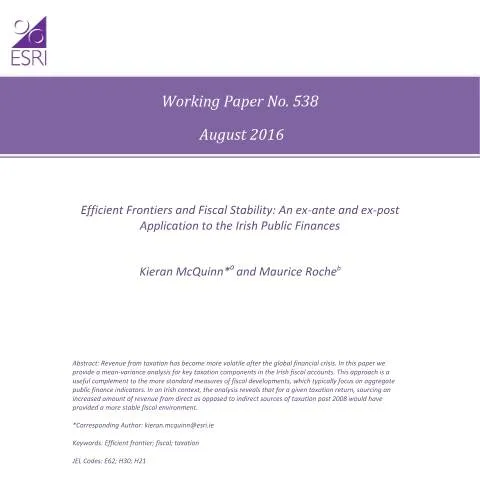
Understanding the Context of Fiscal Stability in Ireland
The financial crisis of 2007-2008 significantly impacted public finances across the globe, with Ireland being no exception. In response to the heightened volatility in revenue from taxation, the Department of Finance published a pivotal document titled Efficient Frontiers and Fiscal Stability: An ex-ante and ex-post Application to the Irish Public Finances in August 2016. This paper, authored by Kieran McQuinn and Maurice Roche, delves into the intricacies of Ireland's fiscal framework and aims to provide a robust analysis regarding taxation components that could enhance fiscal stability.
The document is instrumental in understanding the evolution of Ireland's fiscal policies post-crisis. It employs a mean-variance analysis to evaluate key taxation components within the Irish fiscal accounts, suggesting that a shift towards direct taxation over indirect taxation could have provided a more stable revenue environment. This analysis not only addresses historical data but also looks forward, illustrating how modifications in taxation structures could fortify public finances against future crises.
Diving into the Purpose and Scope of the Document
The essence of this document lies in its elaboration on fiscal policies, particularly in how public finances can be managed to mitigate risks associated with taxation volatility. Unlike more generic forms, this document serves a specific analytical purpose, targeting aspects of taxation that are often overlooked.
- Ex-ante and Ex-post Analysis: The paper discusses both forecasts and actual outcomes regarding taxation, allowing policymakers to grasp the full spectrum of potential fiscal scenarios.
- Mean-Variance Framework: Applying financial analysis techniques to public finance illustrates how different taxation sources can affect overall fiscal health.
- Policy Recommendations: The findings prompt discussions on how to structure tax revenue more effectively, emphasizing the role of direct taxation in stabilizing public finances.
The framework laid out in this document is not merely theoretical; it translates into actionable insights that can guide future fiscal policies. The authors argue that without granular assessments of taxation components, fiscal vulnerabilities may remain hidden, potentially leading to unexpected fiscal crises.
Who Should Engage with This Document?
The target audience for this analysis encompasses a range of stakeholders, including:
- Policy Makers: Those involved in shaping fiscal policy can benefit from the insights provided, particularly those working in the Department of Finance.
- Economists and Researchers: Academics and professionals focused on public finance, taxation, and economic stability will find the methodologies and findings applicable to their work.
- Public Financial Institutions: Organizations responsible for monitoring and advising on fiscal health can utilize the evidence presented to refine their approaches.
- General Public: Citizens concerned about national fiscal health and stability will gain a better understanding of how taxation influences their economic environment.
Identifying specific scenarios within these groups can help tailor discussions around the implications of the document. For instance, researchers may focus on the methodologies used, while policymakers might prioritize actionable recommendations for future fiscal strategies.
Channels for Engagement and Sectional Review
When it comes to engaging with the insights of the document, it's essential to consider the various platforms available. The Department of Finance encourages engagement through multiple channels, ensuring accessibility to different demographics.
Online Access: The document is available for download through official government websites, providing easy access to stakeholders.
Public Consultations: The Department of Finance sometimes hosts discussions and forums based on findings from such reports, allowing for real-time feedback and dialogue.
Academic Journals: As a working paper, it might be published in academic journals or presented at conferences, prompting further investigation and discourse.
Engaging with the Document: A Step-by-Step Approach
- Identification of Key Findings: Readers should begin by identifying and dissecting the core findings of the document, focusing on the suggested shift towards direct taxation.
- Application of Insights: Stakeholders can analyze how these findings can be applied within their specific contexts, whether they are policymakers or educators.
- Feedback Mechanisms: Utilizing platforms for feedback, stakeholders should engage in discussions around potential implementations or critiques of the suggested policies.
- Continual Monitoring: The fiscal landscape is ever-evolving, and as such, continuous engagement with updated policies and findings from institutions is critical.
Taxation Compositions and Their Implications
The document presents a detailed examination of taxation components and their associated volatility. This analysis is pivotal for understanding how the composition of taxation impacts fiscal stability.
| Tax Type | Stability Score (Hypothetical) | Revenue Contribution (%) |
|---|---|---|
| Direct Tax | High | 60 |
| Indirect Tax | Low | 40 |
As illustrated, direct taxes contribute a larger share of total revenue and are associated with greater stability. The analysis within the document posits that a greater emphasis on direct taxation would lead to a more sustainable fiscal environment. This finding has implications for policymakers, who must weigh the benefits of varying tax structures against public sentiment and economic realities.
Timelines and Future Expectations
A critical aspect of engaging with the findings of the document revolves around understanding timelines—when the effects of proposed changes can be expected, and what future evaluations might look like.
Short-term Analysis: Immediate adjustments to taxation structures can be analyzed through preliminary forecasts.
Long-term Projections: The document suggests that sustained changes may take several years to manifest in the broader economic landscape.
Establishing a Timeline for Implementation
- Initial Discussions: As soon as the findings are published, stakeholders should engage in discussions regarding potential policies.
- Pilot Programs: Implementing small-scale pilot programs can provide insights before a full rollout of new taxation strategies.
- Evaluation Phase: After implementation, continuous evaluation should take place to measure effectiveness and make necessary adjustments.
Concluding Insights: The Road Ahead for Irish Public Finances
As Ireland continues to navigate complex fiscal landscapes, the insights gleaned from Efficient Frontiers and Fiscal Stability are invaluable. The discussions surrounding the document can inform future fiscal policies and enhance the stability of public finances.
Ultimately, the proactive engagement of various stakeholders—from government officials to the general public—will shape the efficacy of the proposed strategies. By fostering a collaborative environment around fiscal policy discussions, Ireland can work towards a more resilient economic future.
Understanding the Role of Efficient Frontiers in Public Finance Management
The concept of efficient frontiers, borrowed from portfolio theory, applies significantly to public finance management in Ireland. It refers to the optimal allocation of resources to achieve the highest possible return with the lowest risk. In the context of public finance, this concept helps policymakers identify the best combination of spending and investment strategies that can lead to fiscal stability while ensuring that public welfare is maximized.
In practical terms, this means that government departments must evaluate their expenditures against the potential socio-economic outcomes. For instance, when allocating funds for infrastructure projects, considerations should extend beyond immediate financial returns to include long-term benefits for community development, job creation, and environmental sustainability. By anchoring budgetary decisions on the efficient frontier, the Irish government can establish a framework that not only meets current fiscal targets but also paves the way for robust economic growth and resilience in the future.
Ex-Ante and Ex-Post Analyses: A Comprehensive Approach to Fiscal Planning
The ex-ante and ex-post analyses serve as critical tools for evaluating the effectiveness of fiscal policies in Ireland. Ex-ante analysis involves forecasting fiscal outcomes before implementing policies, while ex-post analysis assesses the actual outcomes post-implementation. These analyses provide a comprehensive approach to understanding how fiscal decisions impact public finances over time.
For instance, when considering a new tax policy or public investment, ex-ante analysis can help in predicting the potential effects on revenue generation, economic growth, and social equity. The Department of Finance utilizes economic modeling and simulations to project these outcomes, allowing for informed decision-making. On the flip side, ex-post analysis evaluates whether the anticipated benefits were realized and identifies any discrepancies in predictions. This retrospective scrutiny is essential for refining future policies and ensuring accountability in public spending.
Both analyses are embedded in the principle of transparency, which is essential for building public trust in government actions. By publicly sharing the methodologies and findings of these evaluations, the Irish authorities can foster a culture of responsibility and responsiveness, leading to better governance and fiscal discipline.
The Impact of Economic Shocks on the Efficient Frontier of Irish Public Finances
Economic shocks, whether they stem from global financial crises, pandemics, or other unforeseen events, have profound effects on the efficient frontier of public finances. In the case of Ireland, the 2008 financial crisis serves as a pertinent example. The shock prompted significant reevaluation of fiscal strategies as the government grappled with rising debt levels and shrinking revenues.
In the aftermath, the importance of agility in public finance management became evident. The Irish government learned valuable lessons in how to maintain fiscal stability amid turbulent economic conditions. Adopting a flexible approach allowed for adjustments in expenditure and revenue strategies without straying too far from the efficient frontier. For example, during the COVID-19 pandemic, the swift introduction of support measures like the Pandemic Unemployment Payment (PUP) illustrated the government's capacity to respond to sudden economic changes while safeguarding social welfare.
Analyzing the impact of these shocks has led to an increased emphasis on building resilient public finances. This means not only maintaining a diversified revenue base and prudent fiscal policies but also investing in systems that can quickly adapt to changing circumstances. The efficient frontier must evolve in response to these economic realities, ensuring that Ireland's public finances remain robust and capable of withstanding future challenges.