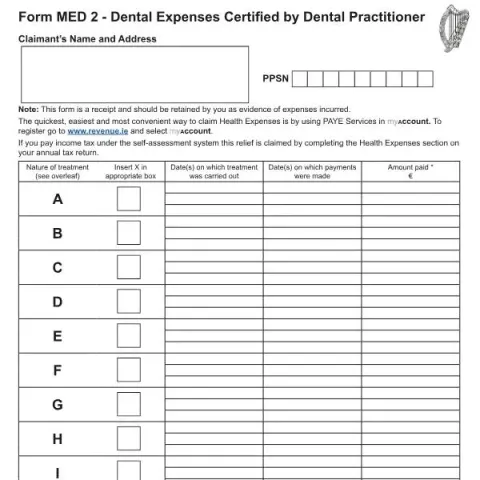
Understanding Form MED 2 - Dental Expenses Certified by Dental Practitioner
Form MED 2 is an official document issued by the Revenue Commissioners of Ireland. Its primary purpose is to serve as a receipt for dental expenses incurred by taxpayers, enabling them to claim tax relief for certain eligible dental treatments. This form is essential for individuals seeking to benefit from income tax relief on specific dental costs, whether through PAYE services via myAccount or during self-assessment tax returns.
Objective and Scope of the Form
The main objective of Form MED 2 is to provide a certified record of dental expenses paid by a patient to a registered dental practitioner. It confirms the details of treatment dates, amounts paid, and the nature of the treatments received. This certification is necessary because the Irish tax legislation allows relief for certain dental treatments, but only when supported by proper documentation from qualified practitioners.
The form covers a range of dental procedures eligible for tax relief, including crowns, veneers, root canal treatments, periodontal therapies, orthodontics, and surgical extractions. However, it explicitly excludes expenses related to routine teeth cleaning, fillings, or the provision and repair of artificial teeth or dentures, regardless of medical necessity.
Preparing Your Dental Expenses Claim
Gathering Documentation
To successfully claim tax relief using Form MED 2, you should retain the completed form as evidence of your expenses. It is advisable to keep this document along with receipts and proof of payments made to your dental practitioner. When preparing your claim, ensure that all details entered are accurate and correspond to your actual payments and treatments.
Completing the Form
The form requires the claimant’s personal details, including name, address, and PPS number, as well as the details of the dental practitioner. The practitioner must certify the accuracy of the information, including the total amount paid and the specific treatments provided.
Key sections of the form include:
- Claimant’s details (name, address, PPSN)
- Details of treatment dates and payments
- Description of treatments (e.g., crowns, inlays, root canals)
- Practitioner’s certification, signature, and date
Modalities of Submission
Online Submission via myAccount
The most convenient method to claim relief for dental expenses is through the Revenue’s online portal, myAccount. After registering for a MyGovID and linking your PPS number, you can upload the necessary documentation digitally. This process simplifies record-keeping and expedites the processing of your claim.
Paper Submission
If preferred, you can submit a paper copy of Form MED 2 to the Revenue Commissioners. Ensure that the form is fully completed, signed by the dental practitioner, and retained for your records. It is recommended to send the form via registered post to establish proof of submission.
Fill in your form directly online
No printing: type your details into the boxes of the official form, tick, then download the PDF ready to send.
- 1Type into the form boxes
- 2Tick in one click
- 3Save and download the PDF
Processing and Follow-up
Once submitted, the Revenue Commissioners review the claim, verify the documentation, and process the tax relief accordingly. If approved, the relief can be applied directly to your income tax liability or refunded via your tax assessment. It is important to submit claims within four years of the end of the relevant tax year to ensure eligibility.
Additional Considerations and Contacts
Tax relief is only available for certain non-routine dental treatments, and the expenses must be supported by a certified invoice from a registered dental practitioner. For further clarification or assistance, taxpayers can contact the Revenue Commissioners or consult detailed guidance available on the official website.
Remember, accurate record-keeping and timely submission are key to successfully claiming tax relief for dental expenses in Ireland.