Understanding the Scholarship Exemption Declaration Form in Ireland
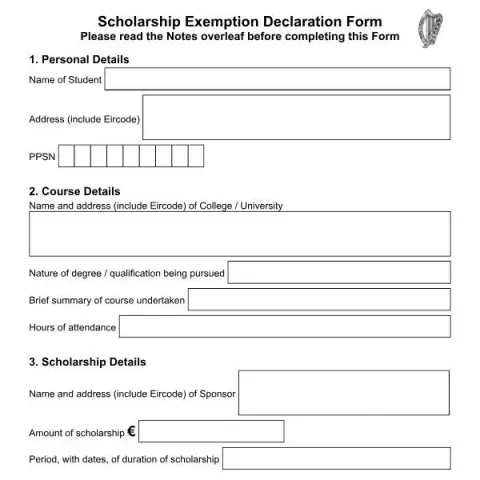
The Scholarship Exemption Declaration Form is an official document issued by the Revenue Commissioners, designed to facilitate the tax exemption of scholarship income for students in Ireland. This form is essential for students who wish to declare their scholarship income as non-taxable under Irish tax law, specifically under Section 193 of the Taxes Consolidation Act 1997.
Purpose of the Form
The primary purpose of this form is to enable students to self-assess and claim exemption from income tax on scholarship income. When completed and submitted correctly, it confirms that the scholarship meets the criteria set out by Irish legislation, ensuring that the recipient does not pay tax on the scholarship amount received.
Who Should Complete the Form?
This form must be filled out by students who:
- Are receiving a scholarship for full-time studies at an Irish or recognized educational establishment.
- Wish to have their scholarship income exempt from income tax.
- Are not employed or engaged in any form of service, directly or indirectly, related to the scholarship or the educational institution.
It is important to note that the exemption applies only to scholarships that meet specific legal criteria. If the scholarship involves employment, research, or service obligations, this form and exemption may not be applicable.
How to Fill Out the Scholarship Exemption Declaration Form
The form is straightforward but requires careful completion to ensure eligibility:
- Personal Details: Enter your full name, address (including your Eircode), and PPSN (Personal Public Service Number).
- Course Details: Provide the name and address of your college or university, the nature of your degree or qualification, a brief description of your course, and your hours of attendance.
- Scholarship Details: Include the name and address of your sponsor, the amount of the scholarship, and the start and end dates of the scholarship period.
- Declaration: Sign and date the form to confirm that all information provided is accurate and that the scholarship meets the legal conditions for exemption.
It is crucial to read the notes on the reverse side of the form carefully before completing it, as making false declarations can be considered an offence under Irish law.
Supporting Documents and Submission
Unlike some other tax forms, the Scholarship Exemption Declaration Form does not require supporting documents to be attached at the time of submission. However, students should retain a copy of the completed form for their records.
The completed form should be returned to the appropriate administrative office within your educational institution. It is advisable to keep proof of submission, such as a receipt or confirmation email, where applicable.
Important Deadlines and Self-Assessment
Since the exemption is based on self-assessment, students should submit the form promptly upon receiving their scholarship or at the start of the academic year. The form remains valid for the duration of the scholarship unless circumstances change, such as a change in the nature of the scholarship or employment status.
Students are responsible for ensuring their declaration remains accurate and up-to-date. If there are any changes that affect the eligibility criteria, a new form should be submitted.
Fill in your form directly online
No printing: type your details into the boxes of the official form, tick, then download the PDF ready to send.
- 1Type into the form boxes
- 2Tick in one click
- 3Save and download the PDF
Common Errors to Avoid
- Providing incomplete or incorrect personal or scholarship details.
- Failing to sign and date the declaration.
- Misinterpreting the criteria—if the scholarship involves employment or research, exemption may not apply.
- Not retaining a copy of the completed form for future reference.
Legal and Tax Implications
Under Irish law, it is an offence to make a false declaration on this form. The Revenue Commissioners rely on the accuracy of the information provided for tax exemption purposes. If the criteria are not met or if false information is submitted, the exemption may be revoked, and tax liabilities may arise.
Furthermore, the Revenue’s view is that the exemption applies to undergraduate and postgraduate scholarships but not to fellowships, which are considered different types of income.
Additional Considerations
The information provided in this guide is intended for general understanding and does not constitute professional legal or tax advice. Students are encouraged to consult with a tax advisor or their educational institution’s administration if they have specific questions about their scholarship or eligibility for exemption.
For further details on data privacy and how your personal information is handled, refer to Revenue’s privacy policy available on the official website.