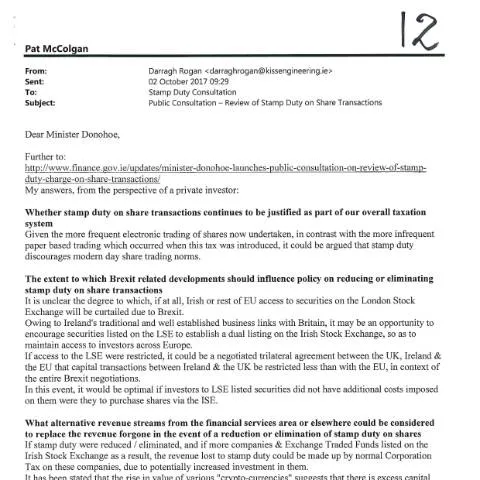
Understanding the Submission Process for Stamp Duty Review
The submission document regarding the Review of the Application of Stamp Duty to Stocks and Marketable Securities of Irish Incorporated Companies plays a pivotal role in the financial landscape of Ireland. This consultation process is not just a bureaucratic formality; it invites stakeholders, including investors, companies, and financial institutions, to voice their opinions on the current stamp duty regulations and their implications.
Who is Invited to Participate?
Participation in this consultation is open to a variety of parties. Primarily, it targets:
- Private Investors: Individuals who own shares or are looking to invest in Irish stock markets.
- Corporations: Companies listed on the Irish Stock Exchange (ISE) or those looking to list.
- Financial Institutions: Banks and investment firms that manage investments on behalf of clients.
- Advisors: Financial and legal advisors providing guidance on investment strategies.
Each of these groups has unique perspectives and experiences that can influence the stamp duty landscape significantly.
Breaking Down the Stamp Duty Submission Document
The document itself contains several fields and sections that require careful consideration. Each part serves a different purpose, and understanding each one is key to crafting a comprehensive submission.
Key Sections of the Document
- Contact Information: Participants must provide their names, contact details, and affiliations. This establishes the authenticity and traceability of each submission.
- Reason for Submission: This section allows submitters to outline their rationale behind the consultation. It's vital to articulate concerns or suggestions clearly.
- Proposed Changes: Here, participants can specify what amendments they believe should be made to the current stamp duty policy, supported by data or case studies where possible.
- Impact Analysis: Submitters should detail how proposed changes could affect their investments or business operations. This analysis should be based on market trends and statistical evidence.
- Conclusion and Recommendations: A final section where submitters can summarize their views and suggest further areas for consideration. This is a chance to leave a lasting impression on policymakers.
Submitting the Consultation Document: Channels and Methods
Submitting the consultation document can be done via multiple channels, which offers flexibility depending on participants' preferences. Understanding these channels can streamline the submission process and ensure that your input is received in a timely manner.
Online Submission
The easiest and most efficient method for submission is through the Department of Finance's online portal. This method allows for immediate confirmation of receipt and streamlines processing. Here’s how to navigate the online submission:
- Visit the Department of Finance’s official website.
- Locate the consultation section and navigate to the Stamp Duty Review page.
- Upload your completed submission document and fill in the required fields.
- Submit and ensure you receive confirmation via email.
Paper Submission
For those who prefer traditional methods, submitting a paper document is still an option. This entails printing the completed submission and sending it via postal services. While this method can take longer, it may be preferred for those who want a physical record of their submission.
In-Person Submission
For stakeholders seeking direct engagement, in-person submissions can be made at designated finance department offices. This method allows for immediate dialogue with department representatives, though prior appointments are often necessary.
Who Decides? Understanding the Review Process
After submissions are collected, the next question is who reviews these documents and how decisions are made. Understanding this process can help participants frame their submissions more effectively.
The Review Committee
A dedicated review committee, typically comprised of financial experts and policy advisors from the Department of Finance, evaluates each submission. This committee assesses how the suggested changes align with national fiscal policies, economic goals, and market stability.
Evaluation Criteria
The evaluation process considers several factors, including:
- Economic Impact: How potential changes to stamp duty could affect investment flows and the broader economy.
- Compliance and Enforcement: The feasibility of implementing proposed changes within existing legal frameworks.
- Market Competitiveness: How adjustments to stamp duty might position the Irish market in comparison to other European stock exchanges.
Special Considerations: Unique Situations That May Arise
Certain special circumstances require nuanced understanding and possibly separate considerations when submitting the consultation document.
Submissions from Foreign Investors
Foreign investors may face unique challenges and perspectives. Their submissions might address concerns about how Irish stamp duty affects cross-border trading and competitiveness in a global market.
Underage Investors
Minors wishing to invest through custodial accounts may also want to provide input regarding the implications of stamp duty on their investment strategies.
Complex Investment Structures
Entities such as trusts or partnerships may need to outline how stamp duty impacts their specific operations differently from traditional investors. Their submissions should address complexities in compliance and tax implications.
Common Pitfalls in the Submission Process
While preparing submissions, participants often make common mistakes that can undermine their contributions. Recognizing these pitfalls can enhance the quality of submissions.
Ambiguity in Proposals
Vague proposals lacking specific recommendations can lead to uncertainty. It is crucial to ensure that all suggestions are well-defined and supported with reasoning or data.
Ignoring Submission Guidelines
Each consultation may come with specific guidelines regarding formatting or content. Ignoring these can result in submissions being dismissed or overlooked.
Failure to Follow Up
Once a submission has been made, it is advisable to follow up with the Department of Finance to ensure it has been received and is under review. This demonstrates a proactive approach and helps clarify any potential issues.
Timeline and Next Steps After Submission
Understanding the timeline and subsequent steps after submitting a consultation document equips participants with realistic expectations.
Response Period
Typically, the Department of Finance will allocate a set period for reviewing submissions. This duration may extend up to several weeks, during which the committee evaluates all received documents.
Feedback Mechanism
Participants may receive feedback on their submissions, either directly from the department or through general announcements regarding outcomes. Staying engaged during this period can provide valuable insights into the decision-making process.
Policy Implementation
Should the review yield significant recommendations, the Department of Finance will outline the next steps for implementing changes. Any amendments to the stamp duty policy will likely involve additional consultations or legislative actions.
Final Thoughts: Engaging in the Process
Engaging in the consultation process on stamp duty is an opportunity for stakeholders to influence fiscal policy in Ireland. By understanding the nuances of the submission document and preparing thoughtful, well-articulated responses, participants can contribute meaningfully to shaping the future of stamp duty regulations.
Ultimately, the consensus reached through this process not only impacts individual investors but also affects the broader economic landscape in Ireland, reflecting the interconnected nature of financial regulations and market dynamics.
Understanding Stamp Duty: Implications for Investors and Companies
Stamp duty, a tax levied on documents that transfer ownership of property or securities, plays a crucial role in the financial landscape of Ireland. For Irish incorporated companies, the application of stamp duty to stocks and marketable securities can influence investment decisions and capital structure. The tax is calculated based on the market value of the securities at the time of the transaction, and the rate can vary depending on specific circumstances.
For investors, understanding the implications of stamp duty is essential. When acquiring shares, investors need to account for this additional cost, which can affect overall returns. Furthermore, companies must consider how stamp duty impacts their ability to raise capital. Higher transaction costs may discourage potential investors, thereby affecting liquidity in the market.
Moreover, the review of the application of stamp duty could lead to discussions around its rate and how it compares to other jurisdictions. If the stamp duty rate is perceived as high, it may push investors to look for opportunities outside of Ireland, thus impacting domestic capital markets. The outcome of the current consultation could redefine the competitive landscape for Irish companies.
Consultation Process: Engaging Stakeholders in Reform
The consultation process surrounding the review of stamp duty on stocks and marketable securities is vital for ensuring that all stakeholders have a voice in any potential reforms. Engaging with a diverse group of participants—ranging from individual investors to large corporations—can provide a comprehensive overview of the effects of stamp duty on different market segments.
During the consultation, stakeholders can submit their views on various aspects such as the current burden of stamp duty, suggestions for reform, and the potential impact on investment behaviour. This participatory approach not only democratizes the decision-making process but also allows for the collection of valuable insights that can shape effective policy modifications.
To ensure meaningful participation, the Revenue and the Department of Finance might offer guidelines on submission formats, deadlines, and topics of interest. Stakeholders are encouraged to draw on real-life experiences and data to strengthen their submissions. Furthermore, transparency about how submissions will be evaluated and considered is fundamental to fostering trust in the process.
Potential Alternatives to Stamp Duty: Exploring Other Fiscal Tools
As the review progresses, the dialogue may naturally extend to exploring alternatives to stamp duty. Various fiscal tools can be employed to achieve similar revenue objectives while potentially offering a more investor-friendly climate. For instance, a transaction tax based on trading volumes rather than a fixed stamp duty could be considered. Such a tax might be less burdensome for investors and could stimulate higher trading activity.
Another alternative could involve adjusting the overall corporate tax framework to balance revenue generation with investment attraction. This approach could include tailored incentives for companies that reinvest profits domestically or explore tax breaks for small or innovative businesses. The aim would be to strike a balance between necessary revenue collection and fostering a vibrant investment ecosystem.
However, implementing alternatives requires careful consideration of their potential long-term impacts on tax revenue and market behaviour. It is essential that any changes do not inadvertently create loopholes or inequities that could disadvantage specific groups of investors or companies.