Understanding Form LPT8 – Application for Exemption in Ireland
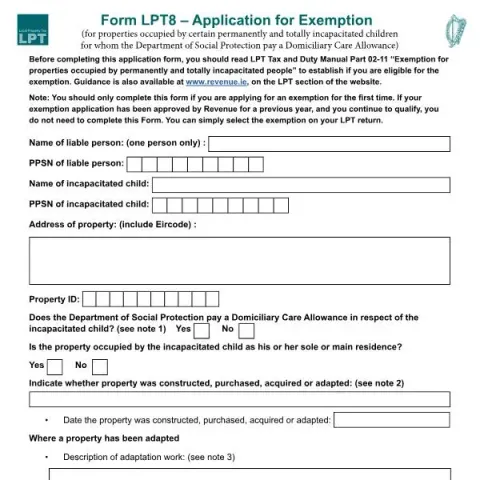
Form LPT8 is an official document issued by the Revenue Commissioners, the Irish tax authority responsible for property taxation, specifically for the Local Property Tax (LPT). This form is designed for individuals seeking an exemption from LPT due to the occupation of a property by a permanently and totally incapacitated child who receives a Domiciliary Care Allowance from the Department of Social Protection. This exemption aims to reduce the financial burden on families caring for children with severe disabilities.
Purpose and Eligibility of the Form
The primary objective of Form LPT8 is to apply for an exemption from LPT for properties occupied by children with significant disabilities. To qualify, the child must be recognized as permanently and totally incapacitated, and the Department of Social Protection must pay a Domiciliary Care Allowance for the child. It is crucial to note that this form is only applicable for first-time applications. If an exemption has been previously granted and the circumstances remain unchanged, the applicant does not need to complete this form again. Instead, they can indicate the exemption on their annual LPT return.
Preparing Your Application
Before completing Form LPT8, applicants should review the relevant guidance available in the LPT Tax and Duty Manual Part 02-11, which details the criteria for exemption eligibility. It is essential to gather all necessary information, including:
- Personal details of the liable person (name, PPSN, contact information)
- Details of the incapacitated child (name, PPSN)
- Property address, including the Eircode
- Information about the property’s construction, purchase, acquisition, or adaptation
- Details of any adaptation work carried out, including costs and dates
- Declaration of the accuracy of the information provided
Filling Out the Form
The form is structured to capture detailed information about the property and the child's circumstances:
Property and Incapacity Details
- Property ID and address (with Eircode)
- Whether the Department of Social Protection pays Domiciliary Care Allowance
- Confirmation if the property is the child's sole or main residence
- Construction, purchase, acquisition, or adaptation details, including dates and descriptions
Adaptation Work
If the property has been adapted, applicants must specify:
- Description of the work
- Cost of adaptation
- Chargeable value before adaptation
- Date of completion
Declaration and Certification
The applicant must declare that all information is correct and sign the form, providing contact details. Additionally, a healthcare professional, such as an occupational therapist or doctor, must complete a section certifying the child's condition and the necessity of property adaptation or purchase.
Submitting the Application
Completed Form LPT8 should be sent to the Revenue Commissioners at:
Revenue Commissioners, LPT Branch, PO Box 100, Ennis, Co. Clare
For inquiries, applicants can contact the LPT helpline at 01 738 3626. It is recommended to keep copies of the submitted form and any supporting documentation for future reference.
Fill in your form directly online
No printing: type your details into the boxes of the official form, tick, then download the PDF ready to send.
- 1Type into the form boxes
- 2Tick in one click
- 3Save and download the PDF
Follow-Up and Processing
Once received, Revenue will review the application to verify eligibility. They may request additional information or documentation, especially regarding the adaptation works or the child's incapacity. If approved, the exemption will be applied to the property, potentially reducing or eliminating the LPT liability for that property. If the application is unsuccessful, applicants will be informed of the reasons and may have the opportunity to appeal or reapply if circumstances change.
Additional Considerations
It is important to note that the exemption applies only to properties occupied as the child's sole or main residence and where the adaptation costs exceed 25% of the property's estimated chargeable value before adaptation. Accurate valuation and detailed documentation of adaptation works are essential to support the application.
Conclusion
Form LPT8 provides a vital pathway for families of children with severe disabilities to seek relief from property tax obligations. Proper preparation, understanding of eligibility criteria, and accurate documentation are key to a successful application. For further guidance, applicants should consult the official Revenue resources or seek professional advice if needed.