Understanding the Purpose and Use of Form 16B: Registry of Deeds
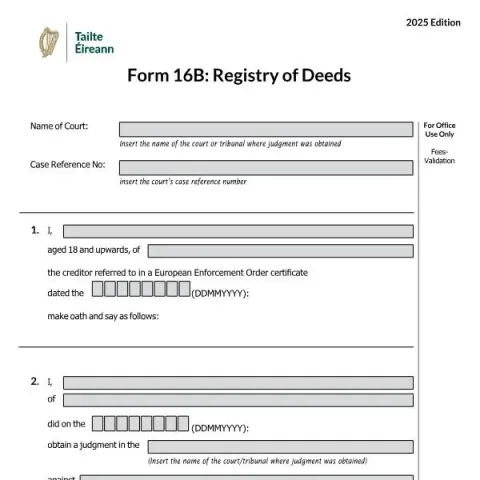
Form 16B is an official legal document used within the Irish property registration system, specifically managed by Tailte Éireann’s Registry of Deeds. Its primary function is to facilitate the registration of a judgment as a judgment mortgage against a property. This process is essential for creditors seeking to secure their interests over land or property assets following a court judgment. This article provides a comprehensive overview of the form’s purpose, the procedural steps involved in its completion and submission, and practical guidance for interested parties.
What is the Objective of Form 16B?
The core purpose of Form 16B is to formalize the registration of a court judgment as a judgment mortgage on land or property. When a creditor obtains a judgment in court against a debtor, registering this judgment as a mortgage ensures that the creditor’s rights are protected and prioritized in relation to the property. This registration acts as a public notice, alerting third parties of the creditor’s interest, and can be a critical step in enforcement proceedings or future transactions involving the property.
Specifically, the form is used to:
- Register a judgment obtained in an Irish court or tribunal;
- Certify that the judgment is recognized as a European Enforcement Order;
- Record details of the property against which the judgment mortgage is to be registered;
- Ensure the creditor’s legal rights are secured in the Land Registry system via the Registry of Deeds.
Preparing the Documentation and Information
Before completing Form 16B, it is essential to gather all relevant information and documentation. This includes:
- The court or tribunal where the judgment was obtained;
- The case reference number for tracking the judgment;
- The date of the judgment and the date of certification as a European Enforcement Order;
- Details of the property or properties involved, including postal address, townland, parish, barony, city, county, and area.
In addition, the creditor must have the judgment certification as a European Enforcement Order, which confirms the judgment’s enforceability across the European Union, streamlining cross-border legal procedures.
Completing and Submitting Form 16B
Step-by-step Process
- Filling out the form: The applicant must complete all sections, including personal details, judgment information, property particulars, and the declaration of application for registration.
- Oath or Affirmation: The form requires the deponent to swear an oath or make an affirmation before a qualified person, such as a Commissioner for Oaths or a practising solicitor. This step confirms the truthfulness of the information provided.
- Signatures: The deponent and the authorised witness must sign the form, certifying the accuracy of the contents.
- Submission: The completed form, along with any supporting documentation, should be sent to the Registry of Deeds at the address specified on the form. It is advisable to retain copies for your records.
Processing and Follow-up
Once submitted, the Registry of Deeds reviews the application to ensure all information is complete and correctly filled out. If approved, the judgment will be registered as a judgment mortgage, creating a legal lien against the specified property. This process provides the creditor with a secured interest, which can be enforced in accordance with Irish property law.
It is important to note that registration does not automatically enforce the judgment but creates a legal record that can be used in subsequent enforcement actions, such as sale or foreclosure proceedings.
Contacts and Additional Guidance
For further assistance or clarification regarding Form 16B, applicants can contact the Registry of Deeds at:
Fill in your form directly online
No printing: type your details into the boxes of the official form, tick, then download the PDF ready to send.
- 1Type into the form boxes
- 2Tick in one click
- 3Save and download the PDF
- Address: Smithfield Hall, Smithfield, Dublin 7, D07 AEF4
- Telephone and email contacts are available through the official Tailte Éireann website or the Registry of Deeds department.
Applicants are encouraged to consult a legal professional or solicitor experienced in property law and registration procedures to ensure compliance with all legal requirements and to facilitate a smooth registration process.
Summary
Form 16B plays a crucial role in securing creditor rights over property in Ireland by registering judgments as mortgages. Proper preparation, accurate completion, and timely submission are key to ensuring the process is effective. By understanding the purpose and procedures associated with this form, creditors and legal practitioners can better navigate the property registration landscape within the Irish legal system.