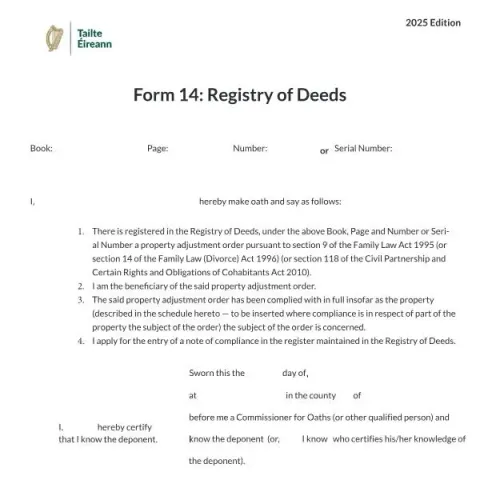
Understanding Form 14: Registry of Deeds in Ireland
Form 14 is an official document used within the Irish legal system to record compliance with property adjustment orders registered in the Registry of Deeds. Managed by the Property Registration Authority, the Registry of Deeds serves as a vital record for property transactions, particularly those related to family law and civil partnerships. This article provides a comprehensive overview of the purpose, preparation, submission process, and follow-up procedures associated with Form 14, ensuring that individuals and legal practitioners can navigate this process effectively.
Purpose of Form 14
The primary objective of Form 14 is to certify that a property adjustment order, as specified under relevant Irish legislation such as the Family Law Act 1995, the Family Law (Divorce) Act 1996, or the Civil Partnership and Certain Rights and Obligations of Cohabitants Act 2010, has been fully complied with. When a court issues a property adjustment order—often in the context of divorce, separation, or civil partnership dissolution—the parties involved are required to adhere to its terms. Once compliance is complete, Form 14 serves as an official sworn declaration that the order has been satisfied, and it requests that a note of this compliance be recorded in the Registry of Deeds.
Preparing the Form
Key Information Required
- Details of the Property Adjustment Order: including the Book, Page, Number, or Serial Number where the order is registered.
- Declaration of Beneficiary Status: confirming that the applicant is the beneficiary of the order.
- Compliance Confirmation: a statement affirming that the terms of the order have been fully met concerning the specified property.
- Property Description: detailed description of the property involved, which should be included in the schedule attachment.
Swearing the Declaration
The applicant must swear or affirm the contents of Form 14 before a Commissioner for Oaths or another qualified person. This step ensures the authenticity and legal validity of the declaration. The form includes spaces for the date, location, and signatures of both the deponent and the authorized witness.
Submitting and Filing the Form
Method of Submission
Form 14 can be submitted in person at the Registry of Deeds or through authorized legal representatives. The form must be accompanied by the schedule describing the property and any supporting documentation proving compliance with the property adjustment order. It is essential to ensure that all details are accurate and complete to avoid delays.
Processing Time and Follow-up
Once lodged, the Registry reviews the submission to verify its correctness. If everything is in order, a note of compliance is entered into the register, officially recording that the property adjustment order has been satisfied. This entry provides legal confirmation of compliance, which can be crucial in subsequent property or legal proceedings.
Contact and Further Guidance
For assistance with Form 14, individuals should contact the Property Registration Authority or consult with a solicitor experienced in family law and property registration. The Registry of Deeds' contact details and procedural guidance are available on the official website of the Property Registration Authority, which provides detailed instructions and downloadable forms.
Fill in your form directly online
No printing: type your details into the boxes of the official form, tick, then download the PDF ready to send.
- 1Type into the form boxes
- 2Tick in one click
- 3Save and download the PDF
Summary
In summary, Form 14 is a vital legal document that certifies full compliance with property adjustment orders registered in Ireland's Registry of Deeds. Proper preparation, accurate completion, and timely submission are essential to ensure that the record reflects the current legal status of the property. This process helps safeguard the rights of parties involved in family law proceedings and maintains the integrity of property records in Ireland.