Understanding the Notice of Termination for Refusal of Consent to Sub-letting or Assignment in Ireland
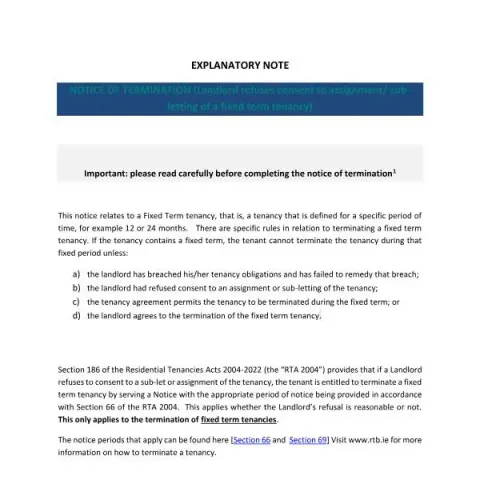
The Notice of Termination – Landlord refuses consent to assignment/sub-letting of a fixed-term tenancy is an official document used by tenants in Ireland to formally notify their landlord of their intention to end a fixed-term tenancy when the landlord has refused consent for a sub-let or assignment. This process is governed by the Residential Tenancies Acts 2004-2022 and is designed to protect tenants' rights in specific circumstances related to tenancy transfers.
When is this notice applicable?
This notice is relevant exclusively for tenants who have a fixed-term tenancy agreement, which is a lease set for a predetermined period, such as 12 or 24 months. If a tenant wishes to sub-let or assign the tenancy, but the landlord refuses consent, the tenant may serve this notice to terminate the tenancy legally. It is important to note that this process is only applicable if the landlord’s refusal is in relation to a request for sub-letting or assignment, not other breaches or reasons.
Legal basis and grounds for termination
Under Section 186 of the Residential Tenancies Acts 2004-2022, tenants are entitled to serve a notice of termination if the landlord refuses consent to a sub-let or assignment. The law states that the tenant can end the tenancy by providing the appropriate notice period, regardless of whether the landlord's refusal was deemed reasonable or not.
This legal provision ensures tenants are not locked into a fixed-term tenancy when the landlord refuses a legitimate request to sub-let or assign the tenancy. It also emphasizes the importance of following the correct legal procedures to avoid disputes or invalid notices.
Key components of the notice form
The official notice form contains several essential sections that tenants must complete accurately:
- Landlord details: Full name(s) of the landlord(s) or managing agent.
- Termination date: The date on which the tenancy will end, which must comply with the notice period requirements.
- Property address: The full address of the rented dwelling.
- Reason for termination: A statement indicating that the notice is due to the landlord’s refusal to consent to sub-letting or assignment, referencing the relevant legal section.
- Notice period: The minimum period of notice, which depends on the length of the tenancy, as specified in the legislation.
- Inspection and deposit return: Suggestions for a property inspection before vacating, to facilitate the return of the deposit.
- Signature and date: The tenant’s signature and the date of serving the notice.
How to serve the notice correctly
To ensure the notice is valid, tenants must serve it in accordance with legal requirements. This typically involves delivering the notice in writing, either by hand, post, or other approved methods, and keeping proof of service. The notice period begins the day after the notice is served, and the tenant must adhere to the minimum notice period based on the tenancy duration.
Disputes and the role of the Residential Tenancies Board
If the landlord disputes the validity of the notice or the grounds for termination, they can refer the matter to the Residential Tenancies Board (RTB) within 90 days of receipt of the notice. The RTB provides a dispute resolution process to ensure both parties' rights are protected and that the termination process complies with legal standards.
Fill in your form directly online
No printing: type your details into the boxes of the official form, tick, then download the PDF ready to send.
- 1Type into the form boxes
- 2Tick in one click
- 3Save and download the PDF
Additional considerations
It is advisable for tenants to:
- Review the specific notice period applicable to their tenancy length, as outlined in Section 66 and Section 69 of the RTA 2004.
- Consult the RTB’s guidance or legal advice if unsure about the notice process or legal rights.
- Plan the property inspection and deposit return process in advance to avoid delays.
Conclusion
The Notice of Termination for refusal of consent to sub-letting or assignment is a vital legal tool for tenants in Ireland to end a fixed-term tenancy when faced with a landlord’s refusal. Proper completion, serving, and adherence to the legislation ensure tenants can exercise their rights effectively and minimize disputes during the termination process.