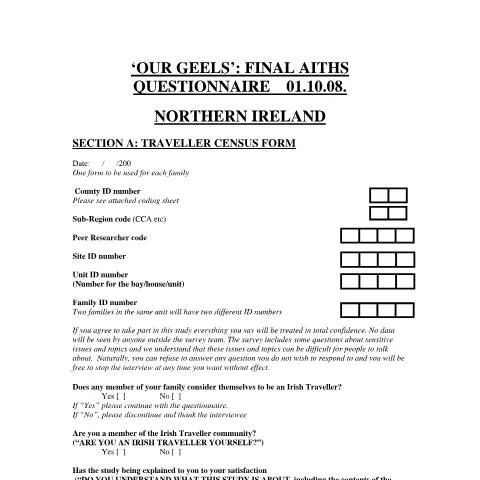
Understanding the All-Ireland Traveller Health Study: The Role of the "Our Geels" Final Aiths Questionnaire
The "Our Geels" questionnaire is a critical component of the All-Ireland Traveller Health Study, especially in Northern Ireland. This document stands as a vital tool in gathering comprehensive data about the health, living conditions, and social circumstances of the Irish Traveller community. By participating in this study, individuals contribute valuable insights that can lead to improved health services tailored to their unique needs. Let's delve into the intricacies of this questionnaire, exploring its purpose, completion process, and the significance of its findings.
Who is Involved in Administering the Questionnaire?
Administered under the auspices of the Department of Health in Northern Ireland, the questionnaire relies on trained peer researchers who engage directly with Traveller families. This approach not only ensures cultural sensitivity but also fosters trust, encouraging candid responses. Each peer researcher plays a pivotal role in explaining the study and guiding respondents through the questionnaire, ensuring that every participant understands the purpose and confidentiality of their contributions.
The Role of Peer Researchers
- Peer researchers are integral to establishing rapport with the Traveller community.
- They provide clear, accessible explanations regarding the study's aims and methodology.
- Trained to address sensitive topics, they ensure that participants feel comfortable and informed.
Completing the Questionnaire: Steps and Considerations
Completing the "Our Geels" questionnaire involves multiple sections, with each designed to capture specific demographic and health-related information. The structure is straightforward, yet it requires careful attention to detail to ensure accuracy. Here’s how to navigate through the questionnaire effectively:
Preparation Before Completion
- Gather necessary information such as family member names, ages, and current living arrangements.
- Ensure that all participating family members feel comfortable and consent to provide information.
- Review the questionnaire to familiarize yourself with the types of questions that will be asked.
Section Breakdown
The questionnaire is divided into several key sections:
- Demographics: Questions about family size, composition, and self-identification as a Traveller.
- Accommodation: Details regarding the type of housing, facilities, and conditions.
- Health and Accessibility: Insight into access to healthcare services and transport.
Each section includes specific inquiries that may evoke sensitive responses. Participants are reminded that they have the right to refuse to answer any question they find uncomfortable.
Submission Process: Where and How to Send the Completed Questionnaire
Once the questionnaire is completed, it is essential to submit it correctly to ensure that responses are processed efficiently. Here are the steps to follow:
Submission Steps
- Check that all sections of the questionnaire are completed thoroughly.
- Return the questionnaire to the peer researcher who administered it, or follow the provided instructions for postal submissions if applicable.
- Confirm that your responses will remain confidential and only be used for research purposes.
Should you have further questions about the submission process, do not hesitate to contact the peer researcher for clarification.
Implications of Participation: Understanding the Impact of Your Responses
Engaging in the All-Ireland Traveller Health Study has far-reaching implications. The data collected through the "Our Geels" questionnaire is used to influence policies and health services specifically targeting the Traveller community. This is a significant opportunity for participants to voice their needs and experiences, which may have been overlooked in broader health surveys.
What Happens After Submission?
- The data is collated and analyzed by health professionals and researchers.
- Findings will be published in reports that aim to inform future health strategies and policies.
- Participants may receive follow-up notifications about the study's outcomes and how their contributions are influencing change.
Addressing Concerns: What if There’s an Issue with Your Submission?
In any administrative process, there may be occasions where issues arise, such as missing information or misunderstandings about questions. It is essential to understand how to address these concerns effectively:
Recognizing and Resolving Submission Issues
- If you realize you have made an error in your responses, contact your peer researcher immediately to discuss the possibility of a correction.
- In case your questionnaire is rejected due to incompleteness, you will be provided with guidance on how to rectify the issue.
- Stay informed about the follow-up process, as peer researchers will often provide updates on the status of submissions.
Comparative Overview: Distinguishing the "Our Geels" Questionnaire from Similar Forms
It's common for individuals to confuse the "Our Geels" questionnaire with other health-related forms. However, there are distinct elements that set this questionnaire apart:
| Feature | Our Geels Questionnaire | Other Health Surveys |
|---|---|---|
| Target Audience | Irish Traveller community | General population |
| Focus Areas | Specific health and living conditions of Travellers | Diverse health metrics across various demographics |
| Method of Administration | Peer researchers on-site | Online or postal submissions, general researchers |
| Confidentiality Assurance | Provided specifically for sensitive community issues | General data privacy statements |
By acknowledging these differences, participants can better understand the significance of the "Our Geels" questionnaire and the unique insights it seeks to gather within the context of Traveller health.
Navigating the Health Landscape: The Broader Context for the All-Ireland Traveller Health Study
The undertaking of the All-Ireland Traveller Health Study reflects a growing recognition of the health disparities faced by the Traveller community across Ireland. This initiative is vital not only for the immediate benefits it provides but also for the long-term changes it aims to bring about in health policy and practice. The "Our Geels" questionnaire serves as a foundational element in this transformative journey.
Legislative Framework and Historical Context
The rationale for such studies is rooted in the historical and systemic challenges faced by the Traveller community, which have often resulted in poorer health outcomes. Governments, including the Department of Health, are now prioritizing the inclusion of minority groups in health research to ensure equitable access to services.
As part of the legislative framework, the culmination of insights derived from the questionnaire will contribute to the strategic direction of health services, promoting patient-centered approaches that resonate with the unique cultural elements of the Traveller community.
Final Thoughts: The Importance of Your Contribution
Participating in the "Our Geels" questionnaire may seem like a simple act, but it carries profound significance. Each response contributes to a larger narrative that advocates for the health rights of the Irish Traveller community. By engaging with this research, participants not only provide essential data but also take part in a movement aimed at fostering equality, understanding, and improved health outcomes for generations to come.
Thus, it is imperative for members of the Traveller community to view the completion of the questionnaire as an opportunity to share their stories and experiences, ultimately shaping the future of health services that genuinely meet their needs.
Understanding the Role of Data in the All-Ireland Traveller Health Study
The All-Ireland Traveller Health Study (AITHS) serves as a significant initiative aimed at enhancing our understanding of the health and well-being of the Traveller community across both Northern Ireland and the Republic of Ireland. One of the essential components of this study is the collection of data through comprehensive questionnaires, including the 'final aiths questionnaire' specific to Northern Ireland.
Data collection in such studies is not merely about gathering figures; it is about understanding real-life experiences, social determinants of health, and the challenges faced by Travellers. The final aiths questionnaire was meticulously designed to capture a range of health indicators and lifestyle choices, ensuring that the voices of Travellers are not only heard but also integrated into health policymaking.
The questionnaire comprised various sections, including demographics, health service usage, mental health, physical health, and social conditions. Each part is crucial as it sheds light on specific issues such as access to healthcare services, the prevalence of chronic illnesses, and the impact of socio-economic factors on health outcomes. By analysing this data, stakeholders can better allocate resources, design effective health interventions, and ultimately contribute to closing the health gap between the Traveller community and the general population.
Importantly, the ethical considerations surrounding data collection in this context cannot be overstated. Ensuring informed consent, protecting confidentiality, and fostering a trusting relationship between researchers and the Traveller community are foundational elements that guide the study's implementation. Researchers must be acutely aware of the historical context and the marginalisation faced by Travellers. This awareness shapes not only the data collection process but also the interpretation and application of the findings.
Impacts of the AITHS on Health Policy and Practice in Northern Ireland
The findings from the All-Ireland Traveller Health Study, particularly those derived from the final aiths questionnaire in Northern Ireland, have the potential to significantly influence health policy and practice. The data collected provides a nuanced understanding of the health disparities faced by Travellers, which can inform various policy initiatives aimed at promoting equity in health outcomes.
For example, the study highlights the need for tailored health services that address the unique cultural and social needs of the Traveller community. Policymakers can use the evidence gathered to advocate for the integration of Traveller-specific health needs into mainstream health services, which is essential for ensuring that Travellers receive appropriate and effective care.
One notable impact of the AITHS is the increased awareness it generates among healthcare providers about the specific health challenges Travellers face. Training programs and workshops can be developed based on the study’s findings, aimed at equipping healthcare practitioners with the knowledge and skills needed to interact respectfully and effectively with Travellers. This cultural competence is pivotal in reducing the barriers to accessing healthcare that many Travellers experience.
The AITHS also provides a platform for advocacy. Community organisations and health advocates can leverage the data to push for legislative changes that protect the rights and health of Travellers. This might include campaigns for better housing conditions, improvements in mental health services, or initiatives aimed at reducing substance abuse within the community.
Challenges and Limitations of the All-Ireland Traveller Health Study
While the All-Ireland Traveller Health Study represents a landmark effort in understanding Traveller health, it is not without its challenges and limitations. Addressing these issues is crucial to enhancing the validity and applicability of the study findings.
One of the significant challenges faced during the study was participation. Engaging the Traveller community in research can be difficult due to historical mistrust of external authorities and a general reluctance to participate in qualitative studies. To mitigate this, researchers employed culturally sensitive approaches and community engagement strategies to foster trust and encourage participation. Despite these efforts, ensuring a representative sample remains an ongoing challenge.
Another limitation arises from the inherent complexity of health data analysis. The interrelated socio-economic factors that affect health outcomes, such as education, income, and living conditions, require sophisticated analytical methods to untangle. Researchers must be cautious when interpreting data to avoid over-generalising findings or attributing causation without adequate evidence, which can inadvertently reinforce stereotypes about the Traveller community.
Moreover, the temporal aspect of health studies must be considered. Health issues can evolve, and what may be perceived as a pressing concern at one point in time may change. The study findings must be continuously updated and contextualised within current health trends and societal shifts to remain relevant and impactful.