Understanding the RTB FOI Request Form: A Guide for Irish Tenants and Stakeholders
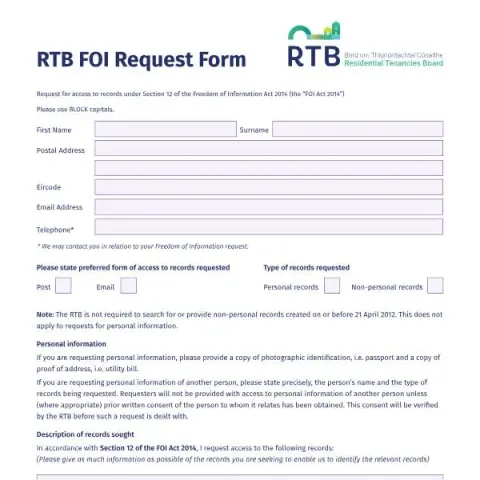
The Residential Tenancies Board (RTB) in Ireland provides a formal process for individuals and organizations to access records related to rental properties, disputes, and tenancy management through the RTB FOI Request Form. This form is essential for those seeking transparency and detailed information under the provisions of the Section 12 of the Freedom of Information Act 2014.
When to Use the RTB FOI Request Form
The RTB FOI Request Form is designed for anyone wishing to obtain specific records held by the RTB. This includes tenants, landlords, legal representatives, or researchers who need access to documented information about tenancy agreements, dispute resolutions, enforcement actions, or other related records. It is particularly useful when the information is not publicly available or when prior inquiries have not yielded the necessary details.
It is important to note that the RTB is not obliged to search for or disclose non-personal records created on or before 21 April 2012. However, requests for personal data are exempt from this restriction, provided the requester supplies appropriate identification.
Types of Records You Can Request
The form allows applicants to specify the nature of the records they seek, with options including:
- Personal records: Information related to a specific individual, such as tenancy details or correspondence.
- Non-personal records: General data or reports held by the RTB, such as statistical reports or policy documents.
Applicants must clearly describe the records they want to enable accurate identification. The more precise the description, the better the RTB can locate the relevant information.
How to Complete and Submit the Form
Providing Personal Identification
If requesting personal records, the applicant must include photographic identification (e.g., passport) and proof of address (e.g., utility bill). For requests concerning another individual’s records, explicit consent from that person must be obtained, and the RTB will verify this before releasing any information.
Choosing the Mode of Access
The form offers options for how the records will be delivered:
- Post
Applicants should specify their preferred method, noting that the RTB will process requests accordingly, aiming to respond within 20 working days of receiving a valid application.
Identifying the Relevant RTB Business Unit
To facilitate efficient processing, the form requests applicants to identify which RTB department may hold the records. Options include:
- Communications and Research
- Dispute Resolution
- Enforcement and Legal Affairs
- Finance, Governance and Risk
- HR and Corporate Services
- ICT
- Investigations and Sanctions
- Registrations, Outsourcing, Strategic Projects and Procurement
- Customer Service
Important Points and Practical Tips
When submitting the RTB FOI Request Form, ensure all sections are completed accurately to avoid delays. Use BLOCK CAPITALS for clarity, and double-check contact details, especially email addresses and telephone numbers, to facilitate communication.
Fill in your form directly online
No printing: type your details into the boxes of the official form, tick, then download the PDF ready to send.
- 1Type into the form boxes
- 2Tick in one click
- 3Save and download the PDF
Remember that requests should be as specific as possible, including relevant dates, names, or reference numbers. This precision helps the RTB locate the records more efficiently.
Requests sent to incorrect addresses or incomplete forms may not be processed within the statutory timeframe. Therefore, it’s advisable to send the completed form either by email to [email protected] or by post to the RTB’s designated address at PO Box 12323, Dublin 2.
Conclusion
The RTB FOI Request Form is a vital tool for accessing official records related to residential tenancies in Ireland. Whether seeking personal data or broader information, understanding how to complete and submit this form correctly ensures a smoother process. It supports transparency, accountability, and informed decision-making within the rental sector, benefiting tenants, landlords, and legal professionals alike.