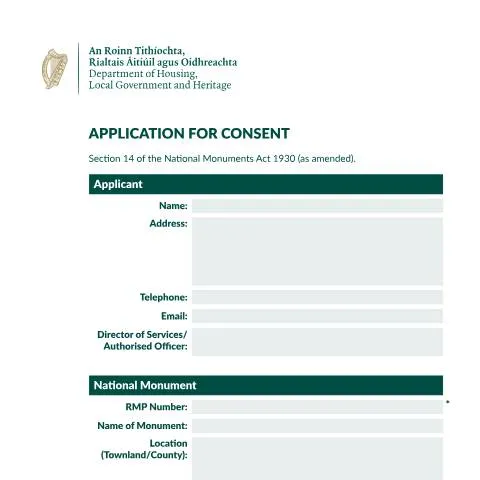
Understanding the Ministerial Consent Application for Monuments
When embarking on a project that involves work at or in relation to a national monument, it is imperative to grasp the significance of the Ministerial Consent/Notification of Work at or in Relation to a Monument document. This form serves as a formal request for consent from the Department of Housing, Local Government and Heritage, enabling the applicant to legally conduct works that may affect the integrity of the monument. The process is crucial for the preservation of national heritage and is grounded in the National Monuments Act 1930.
Who Needs to Submit This Application?
This application is applicable to various stakeholders, particularly:
- Local Authorities: Those undertaking works on behalf of a local government body must submit this application to ensure compliance with heritage conservation regulations.
- Private Owners: Individual property owners intending to conduct works that may impact a national monument on their property are also required to apply.
- Developers: Anyone proposing developments near or on a national monument must ensure they have the appropriate consent.
Specific Scenarios for Application
Consider the following scenarios that may necessitate the submission of the Ministerial Consent application:
- Archaeological Excavation: If the planned works involve digging or excavating, it is critical to provide a method statement for review.
- Restoration Projects: Works aimed at restoring a monument to its original condition will require consent to ensure that the methods used comply with best practices in heritage conservation.
- Public Infrastructure Projects: Projects such as roads, bridges, or other public utilities that may affect the proximity or integrity of a national monument also necessitate this application.
The Application Process: Step by Step
The process of applying for Ministerial Consent involves several structured steps. Here’s what you need to do:
- Gather Required Information: Collect all necessary details such as the name and location of the national monument, and prepare the required documents including maps and statements.
- Complete the Application Form: Fill out the Ministerial Consent application accurately, ensuring all sections are completed, including details about the proposed works.
- Review and Attach Supporting Documents: Ensure you attach the OS map indicating the works' location, any relevant correspondence from local authorities, and detailed descriptions of the works.
- Submit the Application: Email your completed application to [email protected]. It is essential to use the subject line 'S14 Ministerial Consent Application' for clarity.
- Await Confirmation: Do not assume your application has been received until you get a confirmation in writing.
What Documents Are Essential?
Submitting a comprehensive application is paramount. Here’s a checklist of the essential items:
- OS map at the appropriate scale (1:5000/1:10000 for rural areas; 1:1000 for urban areas).
- Contact details for an archaeologist or architect involved in the project.
- A method statement indicating how the works will be carried out, especially if they involve archaeological excavation.
- A letter from the local authority or owner confirming permission for the proposed works.
- Any relevant project reference numbers, including those from the Department of Housing, Local Government and Heritage.
Understanding the Role of the National Monuments Service
The National Monuments Service plays a crucial role in safeguarding Ireland’s national heritage. It assesses applications for consent based on several criteria:
- Impact Assessment: Evaluating how the proposed works will affect the monument's structural integrity and cultural significance.
- Regulatory Compliance: Ensuring all works comply with the National Monuments Acts and related legislation.
- Public Interest: Considering the potential impact on the community and public heritage.
Communication with the National Monuments Service
Maintaining clear communication with the National Monuments Service throughout the application process is vital. Here are steps to foster effective communication:
- Provide accurate and detailed information in your application to prevent delays.
- Follow up if you have not received confirmation within a reasonable time frame (typically within a few weeks).
- Be prepared to provide additional documentation or clarification as requested by the service.
What If Your Application Is Refused?
Receiving a refusal to your application can be disheartening, but it is essential to understand the next steps. Here’s how to navigate a refusal:
- Review the Feedback: Carefully read the reasons for the refusal provided by the National Monuments Service.
- Consider Modifications: Often, applications are refused due to concerns that can be addressed. Consider modifying your proposal to meet the service's requirements.
- Reapply: If you make changes to your application, submit a new application along with a detailed explanation of how you have addressed the previous concerns.
- Seek Professional Advice: Consult with a heritage consultant or legal professional specializing in national heritage law to explore potential avenues for appeal or resubmission.
Common Misunderstandings About the Consent Form
A key aspect of navigating the application process is understanding what distinguishes the Ministerial Consent application from other forms. Many individuals confuse it with:
- Planning Permission Applications: While both types of applications may be required for certain projects, planning permission focuses on land use and local zoning laws, whereas Ministerial Consent is about protecting national monuments specifically.
- Environmental Impact Assessments (EIAs): EIAs assess the potential environmental impact of a project. Ministerial Consent, however, is strictly about the heritage implications.
- Section 57 Declarations: These relate to works that are exempt from consent under the National Monuments Acts, which is not applicable in scenarios where Ministerial Consent is required.
Examples of Overlaps and Differences
| Application Type | Focus | Required for |
|---|---|---|
| Ministerial Consent | Heritage Protection | Works impacting national monuments |
| Planning Permission | Land Use Regulation | Developments affecting land use |
| Environmental Impact Assessment | Environmental Protection | Projects with potential environmental concerns |
| Section 57 Declaration | Exemptions from Consent | Minor works or repairs |
Special Cases: Handling Complex Situations
Some situations may complicate the application process, including:
- Involvement of Foreign Entities: If a foreign developer is involved, additional documentation may be required to comply with both Irish and international heritage laws.
- Minors or Vulnerable Parties: When applications involve minors or vulnerable parties, it is essential to ensure proper consent protocols are followed to safeguard their interests.
- Urgent Works: In emergency situations where immediate work is needed to prevent further damage to a monument, applicants should communicate the urgency clearly and may need to provide justifying evidence for expedited consideration.
Adapting the Application for Special Cases
In special cases, the application may need to include:
- An urgency letter explaining why expedited consent is necessary.
- Additional support documents verifying the involvement of foreign entities.
- Clarification on the measures taken to protect vulnerable parties involved in the project.
Final Thoughts: The Importance of Heritage Preservation
Submitting the Ministerial Consent application is not merely a bureaucratic step; it plays a crucial role in conserving Ireland's rich cultural heritage. By following the outlined procedures, gathering the right documentation, and maintaining clear communication with the National Monuments Service, applicants can support the ongoing effort to protect and preserve the nation's historical monuments for future generations.
Understanding Ministerial Consent for Works Related to National Monuments
Ministerial Consent is a critical component in the management of Ireland's rich cultural heritage, specifically regarding national monuments. Under the National Monuments Acts, any proposed works that may affect a national monument require explicit consent from the Minister for Housing, Local Government and Heritage. This requirement is in place to ensure that the integrity and historical significance of these monuments are preserved for future generations.
The need for Ministerial Consent applies not only to the physical alteration or demolition of a national monument but also to activities that may impact its setting or surroundings. This can encompass a variety of works, from construction projects to conservation efforts. Engaging with the process early on can help to navigate potential challenges related to heritage protection.
The Application Process for Ministerial Consent
Applying for Ministerial Consent involves a detailed process tailored to the specifics of the intended works. The application can be initiated by any party, including private individuals, local authorities, or developers, and it typically requires the submission of a comprehensive proposal outlining the nature of the works, their potential impact on the national monument, and any mitigation measures to be implemented.
Fill in your form directly online
No printing: type your details into the boxes of the official form, tick, then download the PDF ready to send.
- 1Type into the form boxes
- 2Tick in one click
- 3Save and download the PDF
The key stages in the application process include:
- Initial Consultation: Before submitting an application, it is often beneficial to engage in preliminary discussions with the National Monuments Service to clarify what is required and to understand any potential concerns regarding the proposed works.
- Preparation of Documentation: Detailed documentation is required, which may include archaeological assessments, environmental impact assessments, design plans, and justification for the works. The thoroughness of the documentation can significantly affect the outcome of the application.
- Submission of Application: The completed application, along with all supporting documents, should be submitted to the National Monuments Service. It is essential to ensure that all elements are accurate and complete to avoid delays.
- Review Process: The National Monuments Service will review the application, consulting with relevant stakeholders, including local authorities and heritage experts, as necessary. This process can vary in duration based on the complexity of the works and the level of public interest.
- Decision-Making: Following the review, a decision will be made by the Minister. If consent is granted, it may come with specific conditions aimed at mitigating any adverse effects on the monument.
- Post-Decision Obligations: If consent is obtained, there will be ongoing obligations to ensure compliance with the terms of the approval during the execution of the works.
This process is pivotal in safeguarding Ireland's national heritage, and stakeholders are encouraged to approach it with diligence and respect for the historical significance of the sites involved.
Implications of Non-Compliance with Ministerial Consent
Failure to seek Ministerial Consent before undertaking works on or near a national monument can have serious repercussions. The National Monuments Acts provide for enforcement measures that may include fines, restoration orders, or even criminal charges for intentional damage to a national monument. This underscores the importance of compliance, as the heritage of the nation is considered invaluable and irreplaceable.
Moreover, non-compliance can result in significant delays to projects, with the potential for enforcement action taken by the National Monuments Service, which may halt works and necessitate restoration to the original state. This can lead to financial losses and reputational damage for developers and contractors alike.
In addition, public sentiment plays a crucial role in the management of national monuments. Projects that proceed without proper consent may face backlash from community groups and heritage organizations, leading to public protests and increased scrutiny from media and regulatory bodies.
Therefore, it is essential for anyone considering works in relation to a national monument to thoroughly assess their obligations under the National Monuments Acts and to engage with the Ministerial Consent process diligently. By doing so, they can avoid the pitfalls associated with non-compliance and contribute positively to the safeguarding of Ireland's cultural heritage.