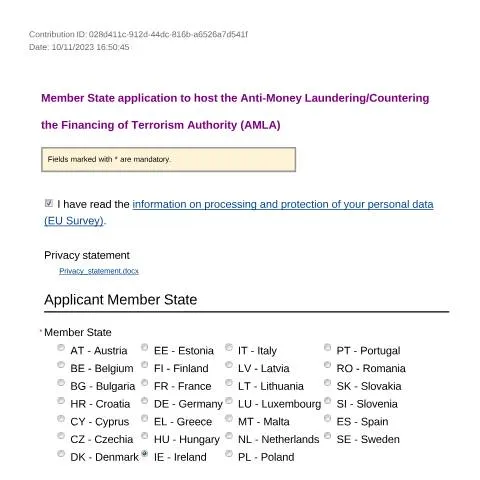
Navigating Ireland's Application for AMLA: An Essential Guide
In the pursuit of bolstering financial integrity across Europe, Ireland is stepping forward with a significant initiative: the application to host the Anti-Money Laundering/Countering the Financing of Terrorism Authority (AMLA) in Dublin. This document serves as a critical gateway for Ireland to enhance its role within the European Union while providing a robust framework for combating financial crimes. To ensure a smooth application process, understanding the nuances of this official document is imperative.
A Timeline for Submission: Key Dates and Next Steps
The timeline associated with Ireland’s application for AMLA is both crucial and intricate. The submission period is underpinned by deadlines established by the European Council, necessitating a clear schedule for effective preparation and submission.
Initial Submission Phase
The application process opens on a specified date, as announced by the European Council. This is when interested member states are encouraged to submit their proposals to host AMLA. Ensuring that all necessary details are included in the application is vital, as any missing information could lead to delays.
- Submission Date: The specific date will be communicated through official EU channels.
- Review Period: Following the submission, the European Parliament and the Council will undertake a thorough review of the applications.
- Feedback Phase: Applicants may receive feedback or requests for additional information during this time, which should be addressed as promptly as possible.
Post-Submission Procedures
Once the applications have been reviewed, the decision-making process kicks into action. This involves further assessments, public consultations, and potentially negotiations regarding the hosting arrangements.
- Assessment of Applications
- Consultations with Stakeholders
- Final Decision Announcement
After the final decision is rendered, successful candidates will be notified, and preparations will begin for establishing AMLA within the chosen member state.
Document Composition: Understanding Each Section of the Application
The application for AMLA is structured into several distinct sections, each requiring careful attention to detail:
Applicant Member State Information
This section includes critical identifiers such as the member state's name and primary contacts. It is essential to provide accurate contact details for communication purposes.
- Main Contact Person: This individual will be responsible for the application process and must be available to respond to any queries.
- Backup Contact Person: Having a secondary contact ensures continuity in communication.
Purpose and Justification for Hosting AMLA
Applicants must articulate the reasons their city is suitable for hosting AMLA. This section should highlight:
- Dublin's Strategic Position: Its role as a financial hub and a multicultural city.
- Support for AMLA's Mission: How hosting AMLA aligns with Dublin's capabilities and commitment to combat financial crime.
- Infrastructure Readiness: Availability of office space and resources for AMLA’s operational needs.
Details of Proposed Location
This section demands a comprehensive overview of potential locations for AMLA, detailing:
| Location | Facilities Available | Accessibility |
|---|---|---|
| City Centre Office Space | Modern infrastructure, meeting rooms | Proximity to public transport |
| Accommodation for Staff | Residential complexes, amenities | Easy commuting options |
Crafting a Compelling Rationale: The Heart of the Application
Success hinges not simply on filling out forms, but on presenting a compelling case as to why Dublin should be chosen to host AMLA. This involves drawing on various aspects of Dublin’s vibrant identity as a global city.
Leveraging Dublin's Global Reputation
Emphasising Dublin's established reputation as a global financial centre can give Ireland a competitive edge. It is crucial to highlight:
- Financial Sector Expertise: The presence of multinational corporations and financial institutions.
- Technological Innovation: Dublin's status as a technology hub that supports financial services.
- Cultural Vibrancy: The appeal of Dublin as a cosmopolitan city that fosters an inclusive community.
Demonstrating Commitment to AMLA's Goals
Articulating a strong commitment to AMLA's objectives is essential. This can be illustrated through:
- Government Support: Evidence of backing from the Irish Government and relevant ministries.
- Community Engagement: Local initiatives aimed at increasing awareness and involvement in anti-money laundering efforts.
Challenges and Contingencies: What If Things Don’t Go as Planned?
No application process is without its hurdles. Being prepared for potential challenges can make a significant difference.
Addressing Application Refusals
Should Ireland’s application be unsuccessful, it is vital to understand the avenues available for addressing refusals. Options include:
- Engaging in Dialogue: Seek feedback from the decision-makers to understand the basis of the refusal.
- Reassessing the Proposal: Consider revising and resubmitting the application based on feedback received.
Handling Errors or Missing Information
In the event of an error or omission in the application, swift action is critical.
- Immediate Notification: Inform the relevant authorities about the error as soon as it is discovered.
- Providing Corrections: Submit necessary corrections or additional documentation promptly to rectify the situation.
Specific Considerations for Various Applicants
As the application process unfolds, it is essential to recognise the unique circumstances that may affect different applicants. Understanding these nuances can ensure a more tailored approach.
Foreign Nationals and Their Involvement
For foreign nationals wishing to contribute to the application process, specific provisions must be addressed:
- Documentation: Ensure that all necessary identification and residency status documentation is provided.
- Legal Implications: Be aware of any legal requirements or restrictions that may pertain to non-Irish nationals.
Navigating Complex Situations
Some applicants may encounter complications due to various factors, including:
- Legal Status: Individuals with particular legal statuses may face different requirements.
- Emergency Applications: Recognise the protocols for expedited processes if time constraints are a factor.
By anticipating these scenarios and preparing accordingly, applicants can enhance their chances of a successful submission.
Conclusion: A Call to Action for a Collaborative Future
Hosting AMLA in Dublin represents a pivotal opportunity for Ireland to contribute meaningfully to the European framework for combating financial crime. The application process, while intricate, is navigable with careful preparation and a strong strategic vision. As Ireland embarks on this journey, it calls upon all stakeholders—government officials, financial institutions, and citizens alike—to unite in support of this vital initiative, ensuring that the fight against money laundering and financing of terrorism is both effective and far-reaching.
As the application progresses, it serves as a beacon for Ireland’s commitment to upholding the values of the European Union, while also fostering a safer financial environment for all its citizens.
Understanding Ireland's Commitment to AMLA Implementation
The Anti-Money Laundering Authority (AMLA) represents a significant advancement in the European Union's strategy to combat money laundering and terrorist financing. As Ireland moves towards full compliance with AMLA, it is crucial to understand the country's commitment and the implications of this transition. The implementation process involves multiple stakeholders, including government bodies, financial institutions, and regulatory agencies.
Fill in your form directly online
No printing: type your details into the boxes of the official form, tick, then download the PDF ready to send.
- 1Type into the form boxes
- 2Tick in one click
- 3Save and download the PDF
The Department of Finance is coordinating the necessary legislative and regulatory frameworks to ensure that Ireland's commitments align with EU standards. This entails not only the alignment of national laws with the EU's Anti-Money Laundering Directive (AMLD) but also the establishment of effective systems for monitoring and enforcement. The Financial Intelligence Unit (FIU) will play a central role in overseeing compliance and ensuring that reporting entities, such as banks and other financial institutions, adhere to AML regulations.
Moreover, Ireland aims to foster a culture of compliance among businesses, encouraging them to implement robust internal controls and risk assessment procedures. This proactive approach will not only help in preventing financial crimes but will also enhance Ireland's reputation as a secure and stable financial centre.
The Role of Technological Innovation in AMLA Compliance
In the digital age, the integration of technology into anti-money laundering practices is critical. As Ireland prepares for AMLA implementation, the adoption of advanced technologies such as artificial intelligence (AI) and machine learning (ML) can significantly enhance the efficiency and effectiveness of compliance efforts.
Financial institutions are increasingly leveraging technology to monitor transactions in real-time, identify unusual patterns, and automate reporting processes. These innovations not only streamline operations but also improve the precision of risk assessments. For instance, AI can analyze vast amounts of transaction data to detect anomalies that might indicate money laundering activities.
Furthermore, the use of blockchain technology provides an additional layer of security and transparency in transactions, making it more difficult for illicit activities to go undetected. As Ireland's regulatory framework evolves, the synergy between technological advancements and robust regulatory oversight will be paramount for successful AMLA compliance.
It is essential for businesses to stay abreast of these technological trends and consider investing in systems that will enhance their compliance capabilities. This not only aids in adhering to AMLA requirements but also positions organizations as leaders in the fight against financial crime.
International Collaboration and Ireland's Role in Global AML Efforts
As part of its commitment to AMLA, Ireland recognizes the importance of international collaboration in combating money laundering and terrorist financing on a global scale. The interconnectedness of financial markets means that effective AML strategies cannot operate in isolation. Thus, Ireland is actively engaged with international organizations, such as the Financial Action Task Force (FATF) and the Egmont Group, to share best practices and strengthen cooperative efforts.
Through these international partnerships, Ireland aims to enhance its intelligence-sharing capabilities, improve cross-border cooperation, and contribute to a more robust global AML framework. This engagement not only aids in compliance with AMLA but also reflects Ireland’s commitment to being a responsible member of the international community.
Moreover, the collaboration extends to training and capacity-building initiatives for law enforcement agencies and financial institutions. By participating in international workshops and conferences, Irish officials can share insights and learn from the experiences of other countries facing similar challenges in AML compliance.
In conclusion, Ireland's proactive approach in engaging with international partners, adopting innovative technologies, and fostering a culture of compliance will be key in successfully navigating the complexities of AMLA implementation and enhancing the integrity of its financial systems.