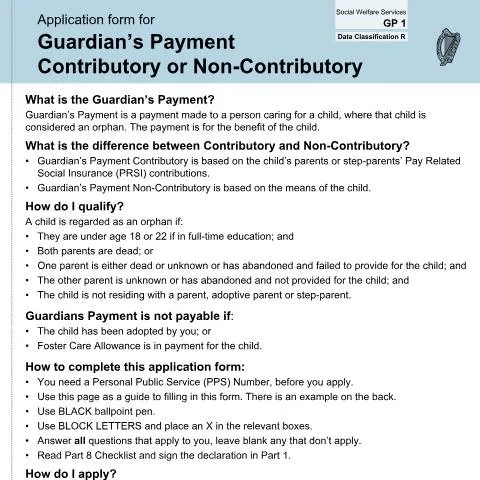
Navigating the Guardian's Payment: Understanding the Essentials
The Guardian’s Payment is a critical support scheme provided by the Department of Social Protection in Ireland, aimed at ensuring the welfare of children deemed orphans. Understanding this payment is essential for prospective guardians who wish to secure financial assistance for the children in their care. This article delves into the key components and processes associated with the Guardian's Payment (Contributory and Non-Contributory), guiding you step by step through the nuances and requirements.
Who Benefits from the Guardian’s Payment?
This payment is designed for individuals who have taken on the role of a guardian for a child that has lost one or both parents. Situations that often necessitate this form of financial support include:
- Children who are under the age of 18, or up to 22 if they are in full-time education.
- Children with no living parents or where parental responsibility has been vacated, such as cases of abandonment.
- Instances where the child does not reside with a parent, adoptive parent, or step-parent.
It is paramount to recognize that the Guardian’s Payment is meant for the child’s benefit, aiding guardians in providing for their needs as they navigate through difficult circumstances.
Distinguishing Between Contributory and Non-Contributory Payments
Understanding the difference between the two types of payments is crucial for applicants:
- Guardian’s Payment Contributory: This payment is determined by the Pay Related Social Insurance (PRSI) contributions made by the child’s parents or step-parents.
- Guardian’s Payment Non-Contributory: This variant is based on the means of the child, assessing their financial needs and available resources.
Recognizing which payment you may be eligible for is essential for your application, as it will significantly impact the amount and type of support you can access.
Eligibility Criteria for Guardian’s Payment
To qualify for the Guardian’s Payment, specific conditions must be met. Eligibility is assessed based on the child's orphan status, which is defined as follows:
- Both parents are deceased, or one parent is deceased or unknown, and the other parent is also absent or has abandoned the child.
- The child must not be under the guardianship of an adoptive parent or be receiving a Foster Care Allowance.
It is important to carefully evaluate these criteria prior to applying, as any discrepancies may affect the processing of your application.
Application Process: Step-by-Step Guide
Applying for the Guardian’s Payment involves a systematic approach to ensure that all relevant information is correctly documented. Here’s how to navigate the application process:
- Obtain a Personal Public Service (PPS) Number: This number is a prerequisite for any application relating to social welfare benefits in Ireland.
- Access the Application Guidelines: The GP1 document serves as your roadmap through the application:
- Refer to the document for detailed instructions on how to fill in the application.
- It contains examples that can guide you on presenting your information clearly.
- Complete the Application Form: Use a black ballpoint pen and block letters. Only fill in applicable sections and leave other sections blank.
- Provide Comprehensive Documentation: Attach any necessary documents that support your claim, such as evidence from a social worker if applicable.
- Submit the Application: Send your completed application to the Guardian’s Payment Section at:
- Seek Assistance if Needed: If you encounter difficulties while filling out the form, reach out to the Guardian’s Payment Section, your local Intreo Centre, or Citizens Information Centre.
| Address |
|---|
| Guardian’s Payment Section |
| Department of Social Protection |
| Social Welfare Services |
| College Road |
| Sligo |
| F91 T384 |
Key Documents and Evidence Required
As you prepare your application, you will need to gather several documents to substantiate your claim. Here are the essential items you should consider:
- Proof of Identity: A valid form of ID, including your PPS Number.
- Evidence of the Child’s Status: Documentation that verifies the child’s orphan status, such as death certificates or legal declarations of abandonment.
- Financial Documentation: For Non-Contributory applications, you may need to provide evidence of the child's means or financial situation.
- Social Worker Reports: If applicable, attaching a report from a social worker can strengthen your application.
Failure to include necessary documentation may result in delays or denial of your application, so ensure all papers are in order before submission.
Common Misunderstandings About the Guardian’s Payment
When navigating the Guardian’s Payment, applicants often encounter several misconceptions. Addressing these clarifications can aid in streamlining your experience:
- Not All Guardians Qualify: Remember that if the child has been legally adopted by you or is receiving a Foster Care Allowance, they are not eligible for this payment.
- Impact of Other Payments: If you are already receiving payments for the child from other sources, including orphan’s pensions from other countries, this may affect your application.
- Application Timeline: The processing time for applications can vary. It’s advisable to apply well in advance of when you anticipate needing financial support.
Having a clear understanding of these points will help set realistic expectations when applying for the Guardian’s Payment.
Interlinking with Other Welfare Supports
The Guardian’s Payment is one component of a broader network of social welfare supports available to guardians and children in need. It is beneficial to explore these additional options:
- Foster Care Allowance: For those considering fostering, this allowance provides financial support for children who are placed in foster care.
- Child Benefit: This is a monthly payment made to guardians of children under 16 years, or under 18 if in full-time education, further bolstering financial support.
- Supplementary Welfare Allowance: This can help those facing exceptional circumstances that require additional financial assistance.
Proactively investigating these connections can maximize the support available to you and the child under your guardianship.
Final Thoughts on the Guardian’s Payment
Securing a Guardian’s Payment through the Department of Social Protection is an essential step for guardians aiming to provide stability and support for children facing the loss of parents. The complexities surrounding eligibility, documentation, and interlinkages with other welfare supports can seem daunting, but with the right information and approach, navigating through the application process can be managed effectively.
By understanding the guidelines outlined in the GP1, potential applicants can equip themselves with the knowledge necessary to access the financial assistance that serves the best interest of the child in their care. For further assistance, don't hesitate to utilize the resources offered by the Department of Social Protection and local social welfare offices.
Eligibility Criteria for Guardian's Payment (Contributory)
To qualify for the Guardian's Payment (Contributory), applicants must meet specific eligibility criteria. Firstly, applicants must be the legal guardian of a child under the age of 18 or a person who is in full-time education and under 22 years old. Additionally, the applicant's eligibility is determined by their contribution history under the Pay Related Social Insurance (PRSI) scheme.
To be eligible for GP1, applicants generally need to have a minimum of 260 weeks of PRSI contributions paid or credited. This includes both paid contributions and those credited during periods of unemployment or caring responsibilities. Applicants should also be aware that the payment is means-tested, which means that other income sources might affect the amount they receive. It’s essential to gather all necessary documentation, such as proof of PRSI contributions and income details, when filling out the application.
Moreover, special considerations may apply to individuals who have previously received certain social welfare payments or those transitioning from a disability payment. Understanding these nuances is crucial for ensuring that potential applicants do not miss out on entitlements due to technicalities in their contributions or personal circumstances.
Application Process for Guardian's Payment (Contributory)
The application process for the Guardian's Payment (Contributory) is structured yet straightforward. Applicants must complete the Form GP1, which is available through the Department of Social Protection's website or other designated offices. It’s advisable to fill out the form meticulously to avoid delays.
Once the form is filled, it should be submitted alongside required documentation, which includes details of the child’s birth certificate, proof of guardianship, and evidence of PRSI contributions. Applications can be submitted via post to the relevant Social Welfare office, ensuring that all documents are securely attached.
Following submission, applicants will receive an acknowledgment from the Department of Social Protection. The processing time can vary depending on the completeness of the application and the current workload of the department. It is not uncommon for applicants to follow up regarding their application status after a few weeks.
In cases where the application is denied, the applicant has the right to appeal the decision. The appeals process requires a separate form, and applicants should carefully review the reasons for denial to effectively address any discrepancies in their appeal.
Impact of Guardian's Payment on Other Benefits and Income
One important aspect to consider when applying for the Guardian's Payment (Contributory) is how it interacts with other benefits and income. The Guardian's Payment may affect eligibility for other social welfare payments, especially those that are means-tested. For instance, receiving the Guardian's Payment might reduce the amount of the Family Income Supplement or other supplementary payments.
Furthermore, any additional income the applicant receives, such as earnings from employment or other social welfare payments, may influence the total amount of Guardian's Payment. It’s essential for applicants to calculate their total income accurately and seek clarification from the Department of Social Protection if they are unsure how their circumstances may affect their payment.
Additionally, recipients of the Guardian's Payment should be aware of their obligations regarding the declaration of income when applying for various benefits. Non-disclosure of additional income can lead to overpayments, resulting in a requirement to repay any excess funds received. Regularly updating the Department with changes in personal circumstances is vital to maintaining compliance and ensuring correct payment levels.