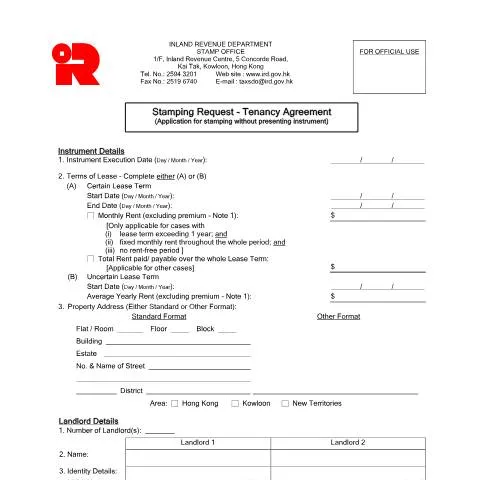
Navigating the Stamping Request for Tenancy Agreements in Hong Kong
Understanding the intricacies of the Stamping Request - Tenancy Agreement (form code IRSD 111(E)) is crucial for landlords and tenants in Hong Kong. This official document is essential for the lawful execution of tenancy agreements, establishing the rights and responsibilities of both parties while ensuring compliance with local regulations. A thorough grasp of the form's requirements, implications, and processes can significantly impact the leasing experience.
Identifying the Stakeholders: Who Needs This Form?
Both landlords and tenants need to be aware of the necessity of this form. The Stamp Duty Ordinance mandates that any tenancy agreement must be stamped to be legally enforceable. The following outlines the profiles of individuals who typically fill out this form:
1. Landlords
- Individual Owners: Private property owners who lease their properties.
- Corporations: Companies that own real estate and engage in leasing activities.
- Joint Owners: Multiple owners that need to jointly declare their ownership status.
2. Tenants
- Individuals: Those renting residential or commercial properties.
- Businesses: Companies engaged in securing rental agreements for office or retail spaces.
- Sub-tenants: Individuals or entities leasing from the original tenant.
Discerning This Form from Related Documents
Many individuals confuse the IRSD 111(E) form with other similar documents. However, it’s crucial to understand the distinctions:
| Form Code | Purpose | Usage Context |
|---|---|---|
| IRSD 111(E) | Stamping Request for Tenancy Agreements | For rental agreements from 2 August 2004 onwards |
| IRSD 115 | Stamping Request for Deeds of Conveyance | Real estate transfers |
| IRSD 113 | Stamping Request for Lease Assignments | When a lease is transferred to a new party |
The Stakes: Legal and Financial Implications
Failing to submit the Stamping Request can lead to several consequences:
- Legal Void: A tenancy agreement that is not stamped may be deemed unenforceable.
- Fines: Non-compliance can result in penalties imposed by the Inland Revenue Department.
- Tax Liabilities: Landlords may incur additional tax fees if the appropriate duties are not paid timely.
Historical Context: The Framework Surrounding the Stamping Request
The Stamping Request for Tenancy Agreements fits within the broader framework of the Stamp Duty Ordinance, which dates back to the early regulations in Hong Kong aimed at regulating property transactions. The amendment effective since August 2004 introduced more stringent requirements regarding the stamping of tenancy agreements to ensure greater compliance and revenue collection. Over time, this system has evolved, reflecting changes in the real estate market and the need for clarity in property transactions.
Preparing Necessary Documentation: A Checklist
Before submitting the IRSD 111(E) form, several documents must be gathered to streamline the process:
- Tenancy Agreement: A signed copy of the tenancy agreement outlining terms, rental amounts, and duration.
- Identification Documents: Hong Kong Identity Card (HKID) numbers for all landlords and tenants involved.
- Proof of Ownership: Documentation confirming the landlord's ownership of the property.
- Payment Details: A cross cheque payable to “The Government of the Hong Kong Special Administrative Region” for the required stamp duty.
Process of Submission: Steps and Channels
The submission of the Stamping Request can be made through various channels, each with its own advantages:
1. Online Submission
The online channel offers a user-friendly experience, allowing users to complete and submit the form directly through the Inland Revenue Department's (IRD) e-services. This is particularly useful for those who prefer a quick and efficient process.
2. Postal Submission
For those opting for postal submission, ensure that the completed form and accompanying documents are sent to:
Stamp Office, Inland Revenue Centre, 5 Concorde Road, Kai Tak, Kowloon, Hong Kong.
Make sure to allow ample time for postal delivery to meet deadlines.
3. In-Person Submission
For individuals who prefer face-to-face interaction, visiting the Stamp Office allows for direct submission and immediate clarification on any queries.
Handling Refusals or Missing Information
If the IRD rejects your application or identifies missing information, it’s critical to take swift action:
- Clarification Requests: Address any inquiries from the IRD promptly to avoid further delays.
- Supplementary Documents: Compile and submit any additional information required to complete the application.
- Resubmission: If denied due to procedural errors, ensure that the corrected form is resubmitted swiftly to avoid penalties.
Addressing Unique Circumstances: Special Cases
Several unique situations may arise necessitating adjustments in how the form is completed:
1. Foreign Tenants or Landlords
Foreign parties renting property in Hong Kong need to ensure they provide valid identification and possibly additional documentation, such as proof of residence or business registration.
2. Minors Involved in Agreements
When either party is a minor, legal guardians must sign the document and ensure compliance with local laws regarding minors entering into contracts.
3. Complex Ownership Structures
In scenarios involving multiple landlords or tenants, careful attention must be paid to accurately represent all parties on the form to avoid legal complications.
Final Remarks: Ensuring Smooth Navigation of the Stamping Process
Effectively navigating the nuances of the Stamping Request – Tenancy Agreement is vital for a seamless leasing experience in Hong Kong. Thorough preparation, understanding the implications of the stamping process, and being aware of individual circumstances can greatly enhance compliance and ensure that tenants and landlords enjoy a stress-free tenancy.
Understanding the Stamp Duty for Tenancy Agreements
In Hong Kong, stamp duty on tenancy agreements is a crucial aspect of property leasing that landlords and tenants must navigate carefully. From 2 August 2004 onward, the Stamp Duty Ordinance requires that agreements for the lease of property be stamped to ensure their legal enforceability. The primary tax applies to leases with a duration of more than 1 month, which is often the case in residential rentals.
Fill in your form directly online
No printing: type your details into the boxes of the official form, tick, then download the PDF ready to send.
- 1Type into the form boxes
- 2Tick in one click
- 3Save and download the PDF
Stamp duty is calculated based on the total rent payable over the term of the lease, and it varies depending on the length of the lease and the rental amount. For tenancies exceeding three years, the rent is assessed on a scale that can yield a higher duty, especially for luxury properties. Additionally, if a lease is extended or renewed, a new stamping request may be necessary, which means that landlords and agents should be vigilant about compliance to avoid penalties.
It's also worth noting that there are exemptions and reliefs available for certain types of tenancy agreements. For instance, certain government-acquired lands or properties used for specific purposes may qualify for reduced duties. Therefore, it is advisable for tenants and landlords alike to seek advice on possible exemptions to minimize their financial obligations.
Documentation Requirements for Stamping Requests
When filing a stamping request for a tenancy agreement in Hong Kong, certain documentation is required to ensure compliance and expedite the process. The primary document is the signed tenancy agreement, which must contain all relevant details, including the names of the parties involved, the rental amount, the duration of the lease, and any renewal clauses. It is imperative that this agreement is drafted correctly to avoid any potential disputes or issues when submitting the request.
Accompanying the tenancy agreement, you may need to submit additional documentation, such as a copy of the property title deed to verify ownership or a valid copy of the landlord's identity (which can be their Hong Kong Identity Card (HKID) or a passport). When the tenant is a corporate entity, corporate documents and proof of business registration may also be required.
Furthermore, it is essential that the stamping request is made within the specified time frame following the execution of the lease; typically, this is within 30 days. Failure to submit the request in time may incur additional penalties or increased stamp duty rates. Therefore, preparing the necessary documentation in advance can avert potential complications and ensure a smooth process.
Online Services and E-Documentation for Stamp Duty
In today's digital age, the Hong Kong government has moved towards providing e-services for various administrative processes, including stamp duty on tenancy agreements. Applicants can submit their stamping requests online through the Inland Revenue Department's e-Stamping system. This online platform allows landlords and tenants to prepare and submit their requests efficiently, providing a convenient alternative to traditional paper submissions.
The e-Stamping system requires users to create an account using their HKID or relevant business registration details. Once registered, users can upload digital copies of their tenancy agreements and other supporting documents directly to the platform. The system also allows for real-time tracking of the application's status, which can reduce uncertainty and improve transparency in the process. Applicants can also make electronic payments for the stamp duty owed through the platform, thus enhancing the overall user experience.
Moreover, the e-Stamping service provides access to various educational resources, including step-by-step guides and frequently asked questions, aimed at helping users understand the requirements and implications of their applications. Embracing these digital solutions not only facilitates the stamping process but also aligns with Hong Kong's vision of a smart city, promoting efficiency and accessibility in public services.